In Kampala and Wakiso, politics has narrowed to something brutally simple.
Voters are no longer weighing ideology or history. They are measuring clinics without drugs, schools without teachers, roads that flood, and services that exist on paper but not in life.
For President Museveni, the battle for the city is no longer about loyalty or legacy; it is about whether the state can still work for the people who live closest to it—and feel its failures most sharply, writes TOLIT CHARLES ATIYA .
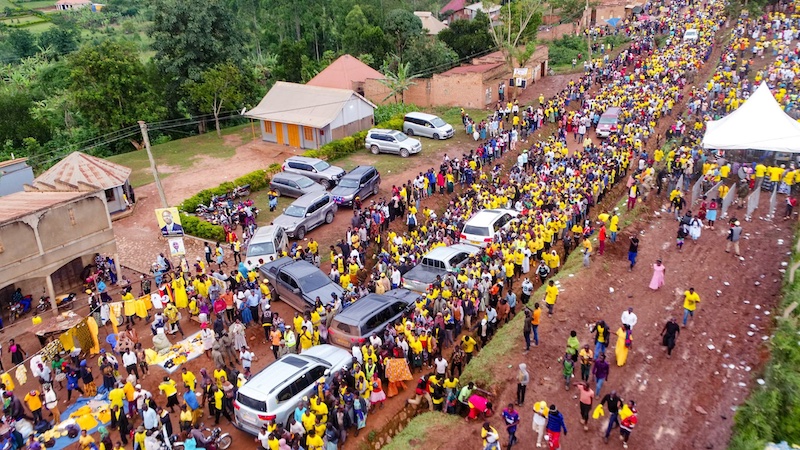
As Uganda edges toward the 2026 presidential election, Kampala and Wakiso are no longer routine campaign stops on the electoral map; they have become critical sites where social policy outcomes are being politically judged.
President Yoweri Museveni’s bruising losses in these areas during the 2021 elections to Robert Kyagulanyi (Bobi Wine) and the National Unity Platform (NUP), did more than signal a swing in political allegiance.
They exposed what social policy scholar Angus Erskine would describe as a widening gap between policy intent and policy experience, particularly among urban populations. Erskine’s approach to social policy emphasizes moving beyond formal government commitments to examine who actually receives services, how they are delivered, and with what effects.
Applied to Kampala and Wakiso, this lens reveals why urban voters are increasingly disengaging from rhetoric and turning instead to everyday encounters with the state, at health centers without drugs, overcrowded classrooms, unplanned settlements without sanitation, and social welfare offices without staff or resources.
In this framework, elections become a form of social policy evaluation, with citizens acting as auditors of state performance. Kampala and Wakiso, home to Uganda’s largest concentration of youth, informal workers and urban poor, are particularly suited to this kind of assessment.
Here, the proximity of hospitals, schools and government ministries sharpens frustration rather than easing it. Access, as Erskine’s methods remind us, is not merely about physical presence but about affordability, quality, equity and reliability.
Academic research, policy analysis and lived experience now converge on a sobering conclusion: Uganda’s social service delivery system is structurally failing the urban poor, even in areas that appear well-served on paper.
Fragmented governance, chronic underfunding, weak frontline workforces and uneven decentralization have combined to produce what social policy analysts term “institutional thinness”—a state that is visible but ineffective in meeting basic needs. As the 2026 contest approaches, Kampala and Wakiso, therefore, represent more than opposition strongholds.
They are testing grounds for competing claims of legitimacy, where voters are less interested in liberation credentials or future promises than in whether political leadership can translate policy into lived improvements.
In these urban constituencies, the ballot is increasingly shaped by one question central to Erskine’s social policy inquiry: does the state work for those who need it most?
A CITY NEAR SERVICES—BUT LOCKED OUT
Kampala and Wakiso host Uganda’s most advanced hospitals, leading universities and the nerve center of state administration. On paper, they represent the country’s highest concentration of public services.
Yet for millions living in informal settlements, from Kisenyi and Katanga in Kampala to Kyengera, Nansana and Kira in Wakiso, these services remain frustratingly out of reach.
This contradiction sits at the heart of findings by the Economic Policy Research Centre (EPRC) at Makerere University, which has repeatedly warned that urban proximity has not translated into meaningful access.
Instead, EPRC research describes a system marked by fragmented delivery, chronic underfunding and exclusionary outcomes, particularly for the urban poor. From a social policy perspective, this represents a failure to meet basic social needs, healthcare, education, sanitation, income security, despite the physical presence of institutions designed to meet them.
EPRC analysts argue that the problem is not the absence of policy, but the weakness of implementation mechanisms that should convert policy into welfare.
SOCIAL PROBLEMS IN PLAIN SIGHT
EPRC’s work situates Kampala and Wakiso as spaces where social problems are highly visible but poorly addressed. Informal settlements exhibit overlapping vulnerabilities: overcrowding, unsafe water, poor sanitation, unemployment and insecure housing.
These conditions directly undermine health and educational outcomes, particularly for children and older people. What makes the urban case politically explosive is that deprivation exists alongside visible affluence and state power.
This sharp contrast reinforces what social policy scholars describe as relative deprivation, the perception of injustice that arises not from absolute poverty alone, but from exclusion within a resource-rich environment.

Examining the findings of EPRC, the opposition alternative priority areas compendium it is clear that Uganda’s social welfare system in urban areas is institutionally thin. Social workers are few, underpaid and poorly resourced. Programs targeting children, persons with disabilities, and the elderly are often uncoordinated and reactive, rather than preventive.
From a social policy lens, this reflects a disconnect between social welfare as a policy commitment and social welfare as lived protection. While government frameworks acknowledge vulnerable groups, research evidence shows that delivery mechanisms fail to provide consistent support, particularly in fast-growing urban districts like Wakiso, where population growth has outpaced planning.
Analysts have framed access to services not merely as a development issue, but as a question of equality and rights. Public health, basic education and social protection are formally recognized as rights, yet, in practice, they are unevenly distributed. Urban inequality in Kampala and Wakiso is not accidental.
Multiple studies point to a pattern in which exclusion is quietly rebuilt into everyday systems: so-called “free” public services still come with user costs; informal fees and transport expenses fall heaviest on the poor; and administrative requirements tend to favour those who are formally employed, well connected, or able to navigate bureaucracy with ease.
These patterns amount to what social policy scholars identify as systemic exclusion—where institutions unintentionally privilege some groups while marginalizing others.
SOCIAL JUSTICE, ALTRUISM AND THE LIMITS OF THE STATE
There also exits evidence of growing reliance on informal coping mechanisms, community savings groups, faith-based charities, NGOs and family networks, to fill gaps left by the state.
While these forms of altruism and reciprocity demonstrate social resilience, they also signal institutional failure. From a social justice perspective, the burden of care has shifted downward, from the state to communities least equipped to carry it.
Reports caution that while reciprocity sustains survival in the short term, it cannot replace universal, rights-based provision without deepening inequality. Kampala and Wakiso are not uniformly excluded; they are internally divided.
Collaborated findings show stark differences between planned neighborhoods and informal settlements in access to clean water, health facilities and quality schools. These divisions reflect deeper structural differences tied to income and employment, gender roles that place disproportionate care burdens on women, age-related vulnerability among children and older people, and insecure tenure, which often determines whether households can access public utilities and basic services at all.
Such differences reinforce social exclusion and undermine social cohesion—conditions that are politically consequential in urban elections. Recent findings from a Vision Group survey on citizen priorities, alongside other studies, help explain why Kampala and Wakiso have become some of Uganda’s most contested political spaces.
When social needs remain unmet and rights unevenly realised, electoral politics becomes a channel for demanding social justice. For many urban voters, the question is no longer which leader promises development, but which political project can rebuild a welfare system that includes them.
In cities surrounded by services yet locked out of them, exclusion itself has become a powerful political force—one likely to shape voting behaviour in Kampala and Wakiso as Uganda approaches 2026.
HEALTHCARE: PROMISE VERSUS REALITY
Healthcare has emerged as a defining political issue in Uganda’s urban heartland. Kampala and Wakiso host some of the country’s best referral hospitals and the densest concentration of health infrastructure.
Yet millions of residents, especially in informal settlements, face persistent barriers to basic care. A recent Parliament Watch Uganda report highlights systemic problems that fall hardest on the urban poor. Uganda allocates about 6.1 per cent of its national budget to health, far below the 15 per cent target set by the Abuja Declaration.
Chronic underfunding contributes to shortages of medicines, equipment and staff, particularly in public facilities serving low-income communities. Out-of-pocket health spending remains high—around 41 per cent of total health expenditure—pushing vulnerable households deeper into poverty when illness strikes.
Research by health scholars at Makerere University shows a sharp mismatch between the presence of facilities and the actual availability of functional services in urban informal settlements. Medicine stock-outs, long waiting times and broken diagnostic equipment are widely reported, driving residents towards private clinics or informal drug vendors.
CAMPAIGN PROMISES AND CREDIBILITY
With health now central to urban voting choices, presidential candidates are sharpening their messages, though credibility varies. The ruling National Resistance Movement has reiterated its long-standing pledges on health infrastructure and facility expansion.
However, media and civil society reviews of the party’s 2021–26 commitments show that only a small share of past health promises were fully implemented. Flagship projects, including the Lubowa International Specialized Hospital and new general hospitals for Kampala and Wakiso, have faced repeated delays or been recycled in successive manifestos without clear timelines.
Critics argue that expanding infrastructure without addressing staffing, medicine supply and governance gaps will not close access inequalities. Opposition leader Robert Kyagulanyi has framed health reform in rights-based and accountability terms.
His platform includes pledges to equip facilities with ambulances and oxygen, recruit more health workers and raise salaries, linked to broader anti-corruption reforms. While the messaging resonates with urban voters, analysts note that details on financing and implementation remain thin, leaving questions about feasibility.
EDUCATION: ACCESS WITHOUT EQUITY
Education tells a similar story. Universal Primary Education dramatically increased enrolment, but quality and equity have lagged. Overcrowded classrooms, underpaid teachers and weak learning outcomes disproportionately affect children from low-income urban households.
Early childhood education is even more unequal. Studies show that access for vulnerable children in informal settlements is extremely limited, reinforcing disadvantage before primary school begins.
Research from Makerere University and the Makerere Institute of Social Research documents how informal fees, poor sanitation and pressure on children to work continue to block access, even where schools physically exist.
WELFARE AND THE PARADOX OF PROXIMITY
Social welfare systems remain fragmented and overstretched. Vulnerable groups—children, women, older people and the urban poor—bear the heaviest burden. Ironically, research shows that slum conditions are associated with poor child health outcomes, including diarrhoeal disease and malnutrition, despite physical proximity to clinics and water infrastructure.
Overcrowding, weak sanitation and poor regulation erase the advantages of urban location. This contradiction—closeness without access—has become a potent political narrative. For President Museveni and the NRM, the challenge in Kampala and Wakiso is no longer messaging but credibility.
Urban voters are increasingly unmoved by macroeconomic statistics or long-term infrastructure promises when everyday access to healthcare, education and sanitation remains broken. Kyagulanyi and the National Unity Platform have capitalised on this credibility gap by framing service delivery as a question of governance and dignity rather than patronage.
The message resonates with voters who see exclusion not as bad luck, but as the result of political choices and weak institutions. As a senior researcher at the Advocates Coalition for Development and Environment puts it, “Urban voters are not asking for miracles. They are asking for systems that work.”
In Kampala and Wakiso, the debate has shifted from what leaders promise to what the state actually delivers. For a growing share of urban residents, the ballot has become both a verdict on service delivery and a demand for a government that functions in practice, not just on paper.
As Uganda moves toward 2026, the cities will not be won by slogans or rallies, but by who convinces voters they can fix the everyday breakdowns that define urban life.
About the Author