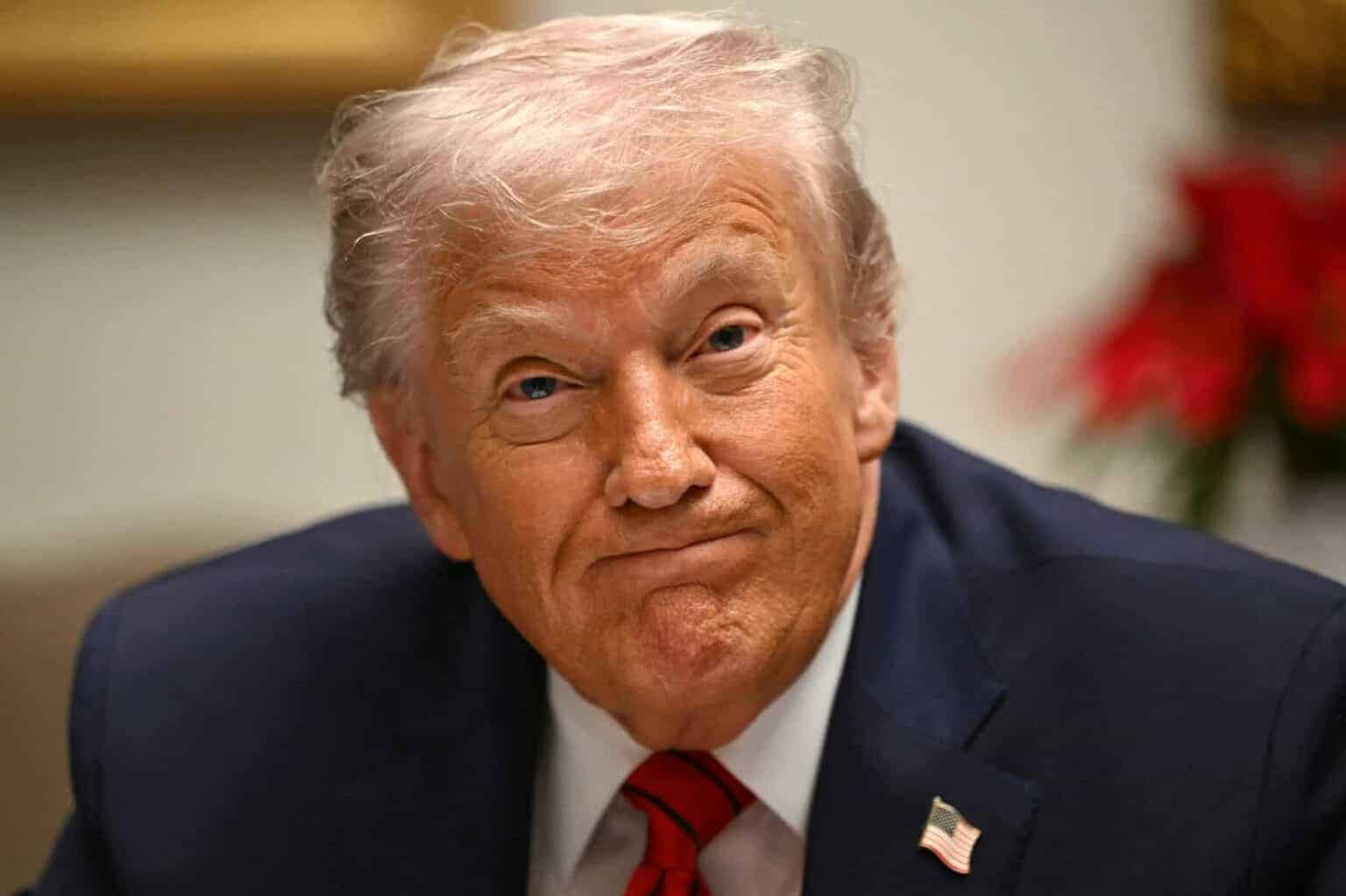
US President Donald Trump reacts during a roundtable discussion in the Roosevelt Room of the White House in Washington, DC, on December 10, 2025. (Photo by ANDREW CABALLERO-REYNOLDS / AFP)
For both good and ill, the Donald Trump presidency is the most consequential since Franklin D Roosevelt steered the US into World War II.
He is fundamentally reshaping the world.
Trump’s new world order
Many column inches are still being expended on diatribes about his personal defects: the vulgarity, the bombast, the brazen dishonesty, the appetite for excess.
All true. But this is part of a fantasy that midterm electoral setbacks and a Democratic victory in 2028 will revive the “good old days” of the nominally “rules-based” post-1945 international order.
They are mistaken. Whether Trump finishes his term or not, he has sent the US along a trajectory that will undoubtedly be adapted, but will be well-nigh impossible to reverse.
The interventions in Venezuela and Iran are critical markers of that shift.
ALSO READ: UNHCR declares ‘major humanitarian emergency’ in Middle East
The argument is no longer that American power makes the world a better, more egalitarian place.
Just that it makes the world safer and more manageable.
In Western circles, the assumption was the removal of Venezuelan President Nicolas Maduro would mean regime change in the classic sense.
It would be followed by a US-mid wifed transition to the suppressed opposition.
Trump instead decided the best way to minimise the risk of political turmoil was to work by proxy through the remnants of the old regime.
US attacks Iran
A similar approach appears to be developing around Cuba. Now Iran.
Trump’s initial statement describes the US aims as eliminating the nuclear threat, destroying the ballistic missile arsenal, degrading proxy terror networks and crippling naval forces.
There’s not a single word about building democracy. Only afterwards did he urge Iranians to “take back” their government.
The commentariat has fixated on that afterthought and the unlikelihood of aerial decapitation strikes birthing a democratic nation-state.
That is true enough, but it is besides the point. The US does not intend to be involved in the slow, messy work of nation-building.
Even if the US or Israel periodically has to “mow the grass” to keep the clerics in line, Trump will nevertheless not only have recast the Middle East, but he will simultaneously have dealt Russian and Chinese geopolitical ambitions a grievous blow.
READ MORE: Here’s how many South Africans are in the Middle East, as Dirco urges immediate evacuation
A nuclear-thwarted Iran, whose axis of terror has been dismantled, is admittedly no guarantee of Israeli regional peace.
But it will revitalise the Abraham Accords. Perhaps most importantly, Washington would gain “strategic bandwidth”: the capacity to manage multiple resource- and energy-draining commitments at once.
A Middle East freed from Iranian intimidation is also a Middle East less susceptible to Russian and Chinese interference, ultimately freeing up US resources.
A quieter Gulf would let the US project more consistently into the Indian Ocean to contest Chinese maritime ambitions.
It would enable a more self-reliant, rearmed Nato to contain Russia on the old Soviet frontier.
And in South America and the Caribbean, US and Western interests would be immeasurably better protected.
Risks for SA
For South Africa, the consequences are uncomfortable.
Under President Cyril Ramaphosa, the ANC’s relationship with the likes of Iran, Cuba, Venezuela, Russia and China has moved from harmless expressions of revolutionary solidarity to becoming pillars of SA’s foreign policy and international military alignment, with a virulently anti-US and anti-Israel positioning.
Yes, there are risks. These include escalation into a wider war; terrorism expanding rather than disappearing.
Those are maybes. But if Iran is allowed continue on the implacable course it has set itself, most of these maybes and worse will, in any case, become certainties over time.
At this moment, the greatest danger is not what Iran might do next, but what the West might do next.
Finally, there is, unfortunately, also Trump’s notorious lack of focus and short attention span.
NOW READ: Iran says it will fight the war alone
About the Author