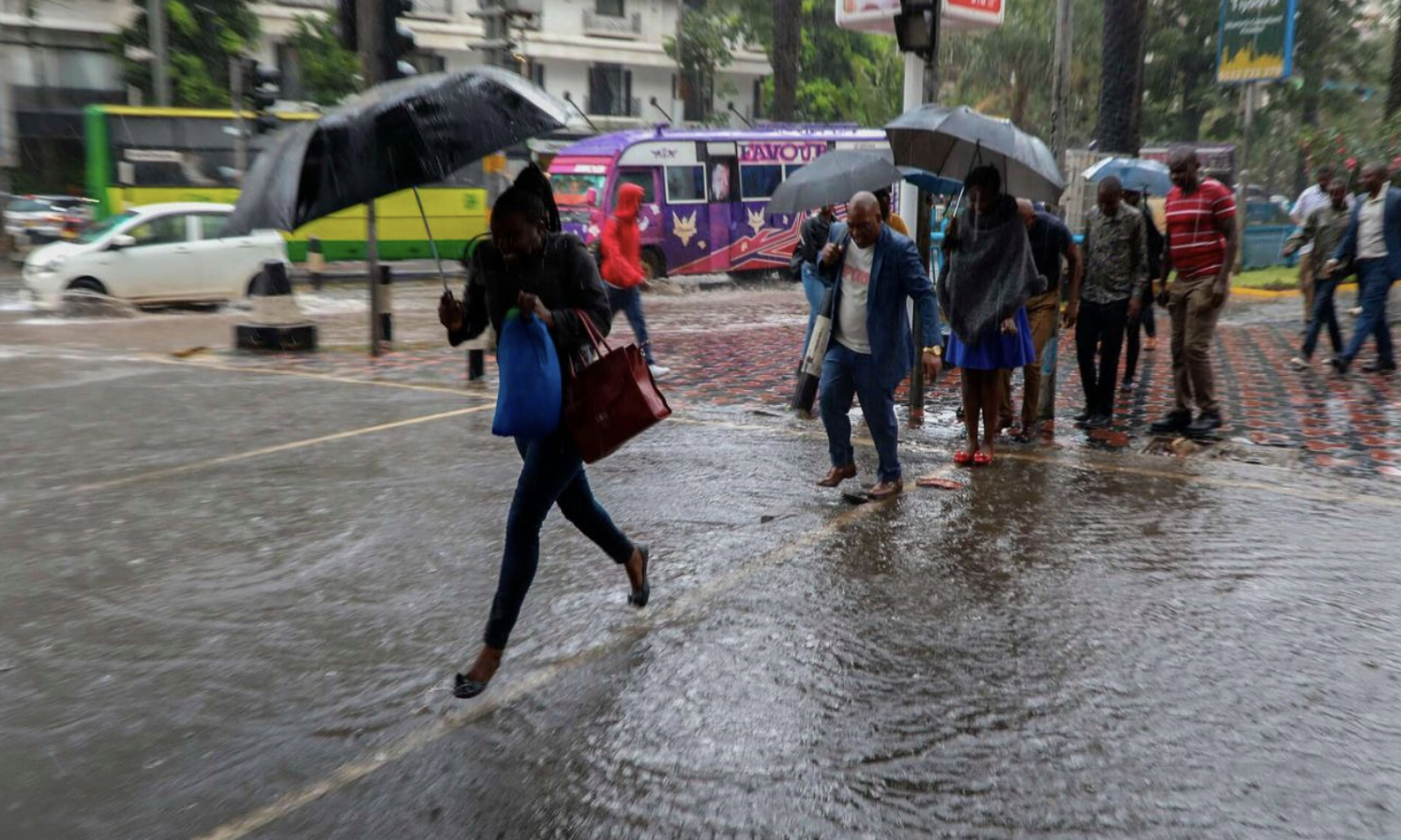
Heavy rainfall is expected from Wednesday, through to Saturday, March 7, 2026, raising the risk of flooding across most counties.
In an advisory issued on Tuesday evening, the Kenya Meteorological Department (KMD) cautioned that rainfall exceeding 20 millimetres in 24 hours will continue across large parts of the country, including the Lake Victoria basin, Western Kenya, parts of central highlands, southeastern lowlands. The Coastal region is expected to experience heavy rainfall until March 9, 2026.
“Residents in all the mentioned areas are advised to be on the lookout for potential floods, flash floods and poor visibility,” KMD noted.
According to KMD, flooding may occur even in areas where it has not rained heavily, especially downstream.
Counties on alert include Turkana, Samburu, Migori, Nyamira, Bungoma, Busia, Kakamega, Vihiga, West Pokot, Baringo, Elgeyo Marakwet, Trans Nzoia, Nandi, Uasin Gishu, Nakuru, Siaya, Kisumu, Homa Bay, Kisii, Kericho, Bomet, Kiambu, Embu, Murang’a, Kirinyaga, Nyandarua, Nyeri, Laikipia, Tharaka-Nithi, Meru, Nairobi, Narok, Kajiado, Makueni, Machakos, Taita-Taveta, Kitui, Kwale, Mombasa, Tana River, Kilifi, Isiolo, Marsabit, Garissa and parts of Wajir and Mandera.
The severity of the rainfall has been classified as moderate to heavy, with a moderate probability of occurrence. The KMD further urged the motorists not to drive through flooded roads and pedestrians to avoid walking in moving water.
“People are advised to avoid driving through or walking in moving water or open fields,” the advisory read.
In addition, residents have also been cautioned against sheltering under trees or near grilled windows during storms to reduce exposure to lightning strikes.
People from different parts of the country reported experiencing rainfall in the past week with some reporting about loud thunderstorms and lightning at night.
Speaking to Nation, David Koros from KMD explained that the recent occurrence and frequent thunderstorms are largely linked to climate change, which is altering weather patterns across the country. He noted that these conditions create favourable environments for thunderstorms, including high convective potential energy and elevated temperatures, particularly in regions that historically have not experienced such frequent rainfall.
“Areas like Nairobi and the Southeastern lowlands, including Machakos, Kitui, and Makueni, are now seeing more thunderstorms than in previous years,” Koros said.
Scientific dates
In an exclusive interview last week with Nation, the acting KMD Director Edward Muriuki advised that planting decisions be guided by scientifically confirmed onset dates at the local level, rather than by isolated rainfall events.
The March–May 2026 long rains were noted to have begun in several regions, including the Highlands West of the Rift Valley, the Lake Victoria Basin, the Central and South Rift Valley and the Highlands East of the Rift Valley, including Nairobi County.
The South-eastern lowlands and South Coast experienced the onset of rains during the fourth week of February, while the Northwestern and North-eastern regions are expected to see rainfall between late March and early April.
“Recent rainfall should be interpreted as early or pre-season rainfall in some regions and does not automatically signal an end to drought conditions,” Mr Muriuki said, “especially in the northern and eastern arid and semi- arid areas where the main rains are yet to commence.”
About the Author