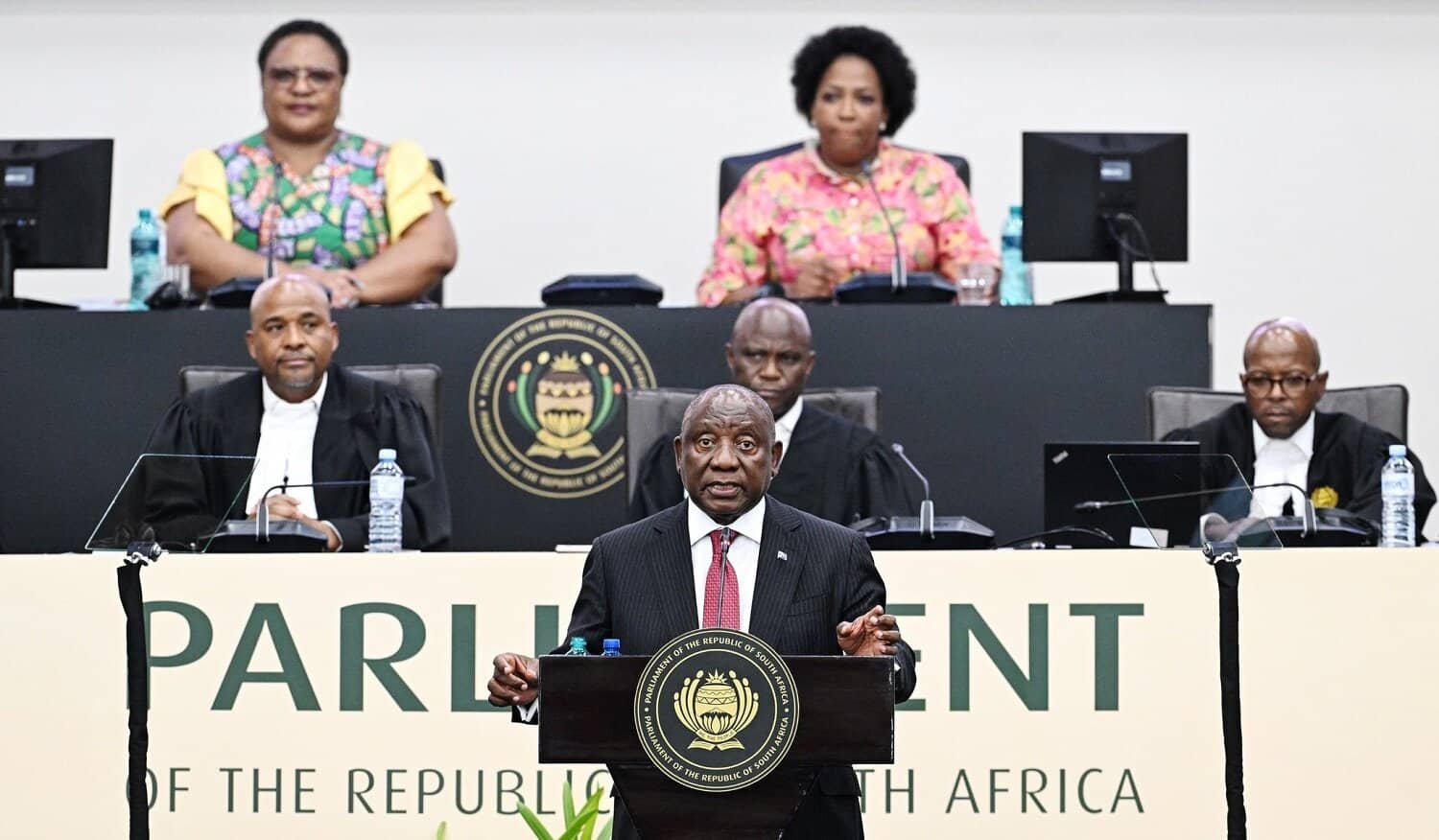
President Cyril Ramaphosa has said that in Cabinet there are no political parties, only a collective government sharing responsibility for success and failures.
The president said this as he replied to the State of the Nation Address (Sona) debate on Thursday afternoon.
His reply comes after opposition parties challenged Ramaphosa on unemployment, economic growth, crime and reform during the debate on Tuesday and Wednesday.
‘Our successes are collective’ – Ramaphosa on GNU
During the debate, members of parliament (MPs) spoke on behalf of their political parties.
DA leader and Minister of Agriculture John Steenhuisen said on Tuesday that South Africa’s improving economic indicators were a direct result of the DA’s participation in the government of national unity (GNU).
“But in Cabinet, there are no parties,” the president said. “There are no ANC or DA or IFP or PA or UDM or GOOD or FF Plus or PAC or Al Jama-ah ministries.”
ALSO READ: Energy, education and home affairs: A few successes and promises from 2026 Sona debate
Ramaphosa said no minister or deputy should be claiming their work in the GNU as an achievement of their party. He added that, in many cases, previous administrations laid the foundation for the achievements realised.
“Our successes are the achievements of the collective. By the same measure, we are collectively responsible for our mistakes and shortcomings,” the president said.
On Wednesday, Nhlamulo Ndhlela, the uMkhonto weSizwe Party (MK party) spokesperson, said Ramaphosa spoke of progress in the economy while the country burns with unemployment.
Economic progress ‘modest’ but building momentum
The president said that although progress is modest, the momentum of change is building. He said the promising signs of recovery include reduced unemployment, improved public finances and low inflation.
“Our task now is to sustain this momentum, to protect and build on the progress we have made, and to ensure that it results in a tangible improvement in the life of every South African,” he said.
“Improved economic indicators may seem distant and abstract, but they have a real impact on our lives.”
ALSO READ: ‘You might be worse than Zuma’: Unemployment and crime dominate Sona debate
He added that economic indicators such as lower borrowing costs and reduced public debt are crucial for growth.
“And yet, as we have heard in this debate, we still have a long way to go,” Ramaphosa said.
More than 10 million South Africans live below the food poverty line, and over 11 million people remain unemployed.
‘Better late than never’
The president said the government is working to improve the lives of young people through programmes like the child support grant and free primary health care.
He said the government is working to improve early childhood development, as well as literacy and numeracy in the foundation phase. He added that the government is working with social partners, NGOs and communities to address social inequality.
“As they say in the classics: better late than never. We are doing it now,” Ramaphosa said.
ALSO READ: Water is life: Building a nation around its most precious resource
Water crisis plans
A water crisis has crippled numerous municipalities across the country, prompting the government to establish a National Water Crisis Committee to restore a reliable water supply.
“Like electricity and logistics, the crisis in water has many causes stretching back many years,” the president said.
He added that a reform process is underway to change the way the water sector functions.
Ramaphosa said investment in water infrastructure and institutional reforms to support municipalities in crisis are necessary.
Crime
The president acknowledged that crime and insecurity are significant impediments to growth. He said that the government is intensifying the fight against organised crime, gang violence and gender-based violence (GBV).
Following the Sona, GBV activists believed that the speech lacked urgency, detail, accountability and visible political will, despite a declared national disaster. They said the country should measure a national disaster by the number of lives saved, not by repeated rhetoric.
ALSO READ: ‘You auctioned our country’: Opposition slams Ramaphosa’s Sona on economy, corruption and crime
Ramaphosa said one of the most important developments in South Africa in recent years is the mobilisation of society to end GBV.
The president added that government departments, NGOs, businesses and educational institutions are working together.
“The classification of gender-based violence and femicide as a national disaster enables all spheres of government to act with greater speed, reduces the fragmentation of effort and establishes a clear command, coordination and accountability framework,” he said.
About the Author