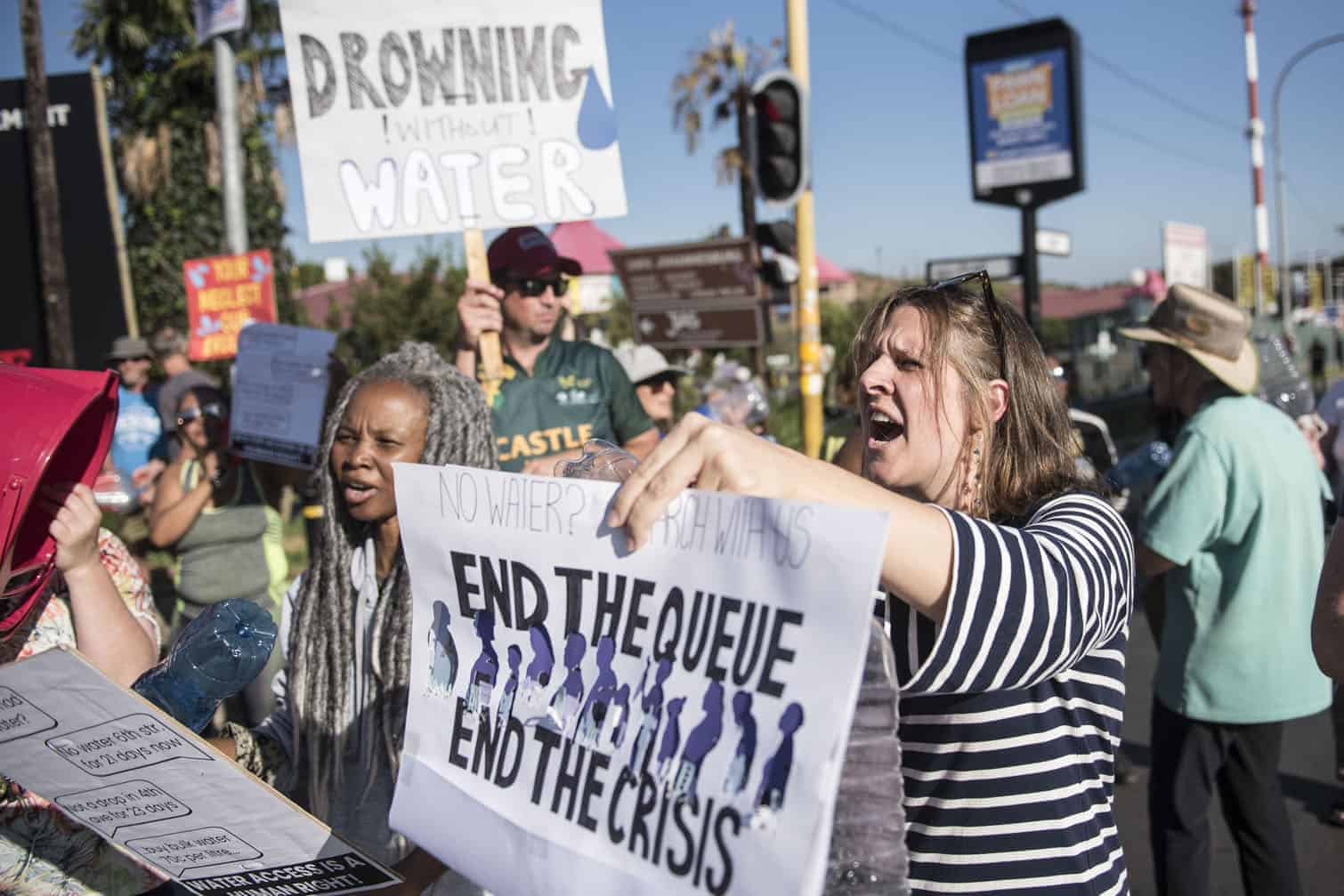
Residents of Melville, Westdene and surrounding areas protest against the lack of water supply in their suburb and many parts of Johannesburg, 11 February 2026, along Main Street in Melville. The city is facing an increasingly dire water situation as taps have run dry. Picture: Michel Bega/The Citizen
Johannesburg, South Africa’s economic powerhouse and self-styled “World-class African City,” is facing a crippling water crisis.
With hundreds of thousands of residents enduring dry taps – some for nearly a month – frustration is boiling over as officials struggle to explain why the city is teetering on the brink of “day zero.”
Dry taps, leaking pipes and strikes are just some of the bungles that have contributed to Joburg’s water crisis.
Showering in the rain
One Westdene resident, 72-year-old Lieza Louw, after waking up with dirty hair on day 25 without water, pulled on a swimming costume and coveralls, slipped into her slops, grabbed shampoo and conditioner and staged her own rush-hour protest.
“I just decided I would go out in my bathing costume and wash my hair in the rain. After the water container was empty, I managed to rinse my hair in water gushing out of a downpipe.”
ALSO READ: Joburg residents ‘effectively living under day zero conditions’
Joburg in the dark
President Cyril Ramaphosa acknowledged the enormity of the problem in his state of the nation address (Sona) this week, saying he would personally take charge of a national water crisis committee.
But in Johannesburg, a city of about 6 million people and the country’s economic hub, residents are still in the dark – despite multiple media conferences and the creation of a provincial water crisis war room – about why hundreds of thousands of them are without water.
Even the vaunted “water throttling” that residents were told would finally solve the problem backfired amid claims that it may have caused even more harm by prolonging outages.
Joburg Water in crisis
Meanwhile, it emerged that a new system introduced by Joburg Water to deal with complaints made the situation even worse, according to The Sunday Times.
The utility’s latest quarterly report for July-September 2025 reveals an entity in crisis. Among the issues raised are:
- Staff do not understand how to work a new field services management system, resulting in delays in resolving problems.
- Only 41.27% of water bursts were repaired within 48 hours, way off the target of 90%.
- Only 66% of sewer blockages were resolved within 24 hours, against a target of 95%.
- The number of bursts per month rose to an average of 4,519, from 2,960 for the same period in 2024.
- Performance standards stipulating that response teams should attend to a minimum of three major bursts and three other water-related jobs in any given day were not met.
- Staff remuneration ballooned past the budgeted R470m to R523m. Of the excess, R38.2m was attributed to overtime costs; and
- Of the performance contracts that 2,675 employees were meant to sign, only 421 – about one in six – did so.
The Citizen has contacted Joburg Water for comment, which will be added to the story once received.
ALSO READ: Helen Zille reveals DA will take Joburg Water and the city to court over water crisis
Shower in a hotel
This week, Gauteng Premier Panyaza Lesufi apologised to residents of Joburg who have been without water for days, after suggesting they shower at hotels.
This backfired badly, forcing him into an embarrassing apology. And Mayor Dada Morero’s call on residents to “shower together” similarly backfired, with a deluge of social media jokes and memes, with many accusing them of being insensitive to the plight of residents battling a deepening water crisis in Joburg.
Many said they do not have the money or the luxury to shower at a hotel.
‘Smell me’
Morero admitted that residents who have not had water at all are in “day zero”, and on Wednesday, an angry resident confronted him about the crisis.
“You can smell me. I haven’t had water for 24 days. But that apart, it’s been a year that we don’t have water at night… Brixton, right here behind me.”
AU Water Summit
On Saturday, Ramaphosa arrived in Ethiopia for a two-day African Union (AU) Summit held under the theme: “Assuring Sustainable Water Availability and Safe Sanitation Systems to Achieve the Goals of Agenda 2063.”
The AU designated 2026 as the year of water and sanitation.
Ramaphosa’s spokesperson, Vincent Magwenya, said this is in line with pursuing continental access to sustainable water and reliable sanitation services geared to achieve the Goals of Agenda 2063.
“The theme aligns with addressing critical and interconnected continental crises as well as harnessing key drivers in tackling water insecurity, poor sanitation, and climate change impact.
“South Africa will participate in the AU AIP Water Investment Summit, which takes place as a side event on the margin of the 39th African Union Summit,” Magwenya said.
Intervention
Speaking at the annual Presidential Golf Challenge (PGC) at the Atlantic Beach Golf Estate in Melkbosstrand on Friday, a day after his Sona, Ramaphosa said he understands the current water crisis.
“What I said is that we have now realised that, rather than have our people without water and be punished, by the lack of activity or delivery by municipalities, we are now going to intervene, and we will use a section in the Water Act, to intervene, and also, during the process of looking at the white paper, local government.”
Billions needed
Earlier this week, Minister of Water and Sanitation Pemmy Majodina said roughly R400 billion is needed to repair and upgrade water infrastructure at the local government level – funding that is currently unavailable.
“In terms of budget allocation, we cannot now hear myself and DM (David) Mahlobo commit to whether there will be an extra budget that is allocated to the Gauteng province to be able to assist the municipalities.”
Majodina has blamed persistent water shortages, which have left communities going days without water, on municipalities’ inability to properly maintain water infrastructure and a lack of skills.
NOW READ: Lies detected: Taps run dry while dams overflow
About the Author