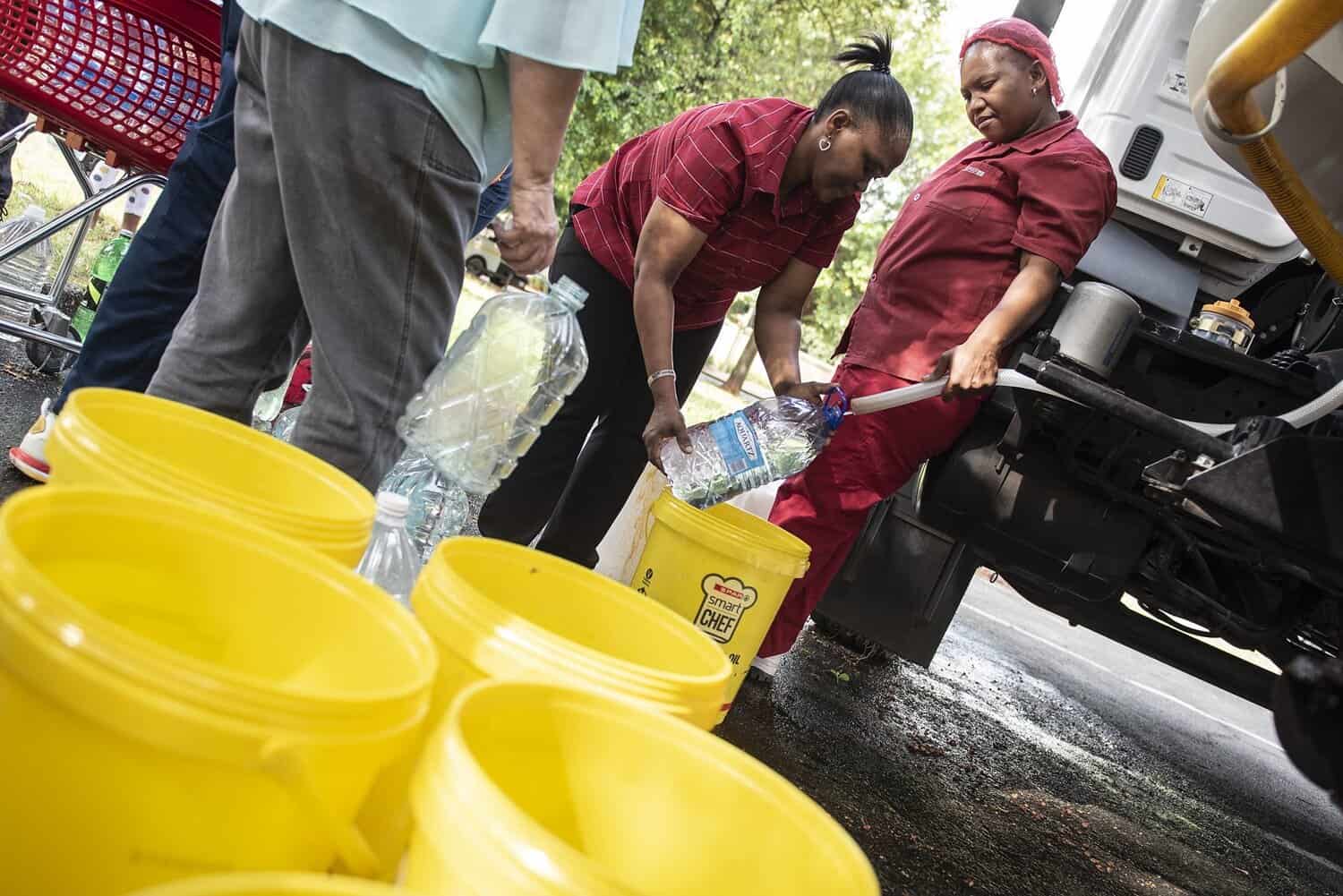
It’s not load shedding these days, it’s “water shifting”. And the DA believes it is already under way in Joburg – without the knowledge of residents.
DA spokesperson on water and sanitation Stephen Moore said they cannot accept the Gauteng provincial government’s picture of a water crisis under control.
“All indications are that Gauteng has begun water shifting, termed load shifting by Deputy President Paul Mashatile on Friday, and borne out by resident feedback that it seems like areas are being turned on and off,” he said.
Opposition leaders warn that water shifting has already started
Moore said if water shifting is underway, the least that the Gauteng government can do is publish a schedule so the residents can plan for their cut-offs.
“If supply will be shifted between areas to stabilise the system, residents must be treated with respect and provided with schedules, not uncertainty,” he added.
Earlier, Moore posted on X about a briefing given to Joburg councillors late last week. He said Joburg Water and Rand Water “have restricted the top 30 bulk meters by 20%-40%.
ALSO READ: Crisis deepens: Is water being throttled in Joburg?
“Those meters account for 90%+ of the city’s consumption. That tells you how quickly pressure can drop in parts of the network.”
He supplied numbers from the Commando system as an example: Normal minimum flow: 2 500 m³/hour: recent (9-13 Feb): 1 942 m³/hour.
He said the reason given was that Rand Water’s Meredale and Waterval reservoirs “were low because overall demand is exceeding capacity”.
Joburg Water buckling under strain of repairs
The briefing also revealed that Joburg Water is buckling under the strain of repairs with a monthly load of more than 10 000 jobs.
Moore said: “That is a scale problem. When the network is stressed, leaks, bursts and valve work become a daily churn.” In addition, he said, “cashflow is biting.
“Joburg Water says it has R150 million in outstanding payments to contractors linked to cashflow constraints from the city. That directly affects response times and maintenance momentum.”
ALSO READ: ANC champions Freedom Charter but doesn’t think water is a big enough issue
One positive Moore noted was that “Rand Water is in discussions with the department of water and sanitation about licence flexibility/relaxation to allow extra production.”
He added: “We were told it may be finalised next week, but no firm timeline was given.”
AfriForum’s head of environmental affairs Lambert de Klerk said the water issue wasn’t new.
Water issue wasn’t new – AfriForum
“In December, there was a major issue with water in Johannesburg, where communities were without water for weeks at a time.” De Klerk said it was worse in places such as Parys and Lichtenburg.
“The blue and green drip report from the department clearly tells us from their statistics that a major crisis is coming.
“AfriForum’s blue and green drip report tested the water of 210 towns and only 87% of it is clean. That means 13% of the water we tested during that period of the project was not of the quality that it should be for human consumption. These are the signs hat a crisis is coming.”
ALSO READ: ANC champions Freedom Charter but doesn’t think water is a big enough issue
De Klerk said Gauteng is an example that the water crisis is a man-made issue due to poor maintenance and billions of rands wasted through water losses.
“The national average water loss is 40%. It is a big issue that we are losing water that has already been purified through leaks.”
“The Gauteng provincial government’s statement on Friday night lists the right headings: leak repairs, pump stations, reservoirs, pressure management, technical support, ring-fencing of grants and budget reprioritisation, but it provides almost no detail about what has changed, what is funded and what delivery will occur by when,” he added.
Not goof enough
Moore said in a crisis, that is not good enough.
In Tshwane, city spokesperson Selby Bokaba reported that the overall water supply system was healthy at the start of the week.
About the Author