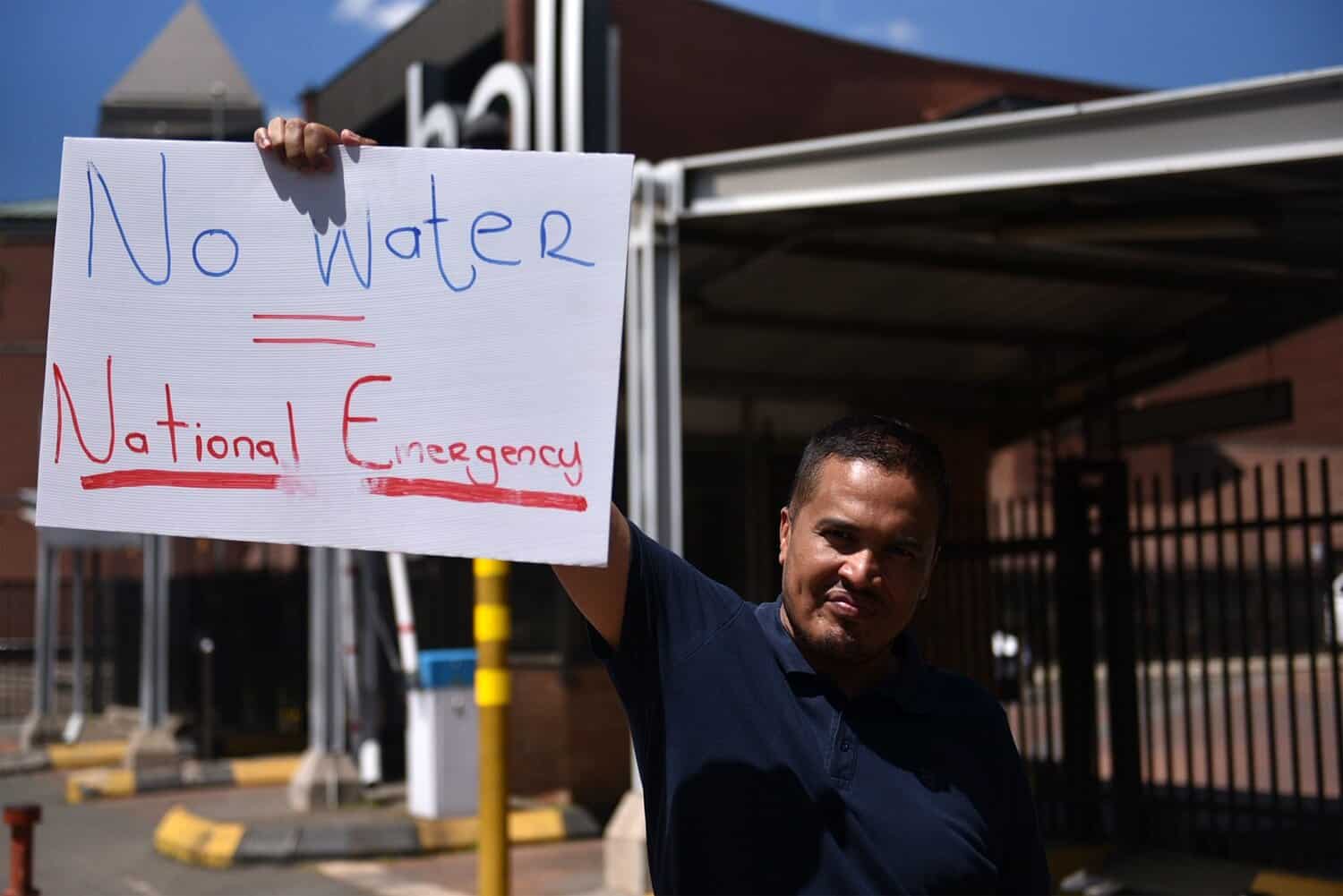
When a nation turns on its taps and nothing flows, it is not merely a service delivery failure. It is an assault on human dignity, public trust and the social contract itself.
Water is the first promise of any developmental state.
It is against this backdrop that the decisive interventions announced by President Cyril Ramaphosa in his recent State of the Nation Address must be understood.
His commitment to tackling SA’s water challenges head-on, including the establishment of a national water crisis committee, signals not only urgency, but also a deep appreciation of water as the lifeblood of the economy and society.
The formation of the committee is a crucial and timely intervention. For too long, water challenges in parts of the country have been treated as isolated municipal breakdowns or infrastructure backlogs.
The president’s announcement reframes the issue correctly as a national priority requiring coordinated, high-level oversight and rapid response.
ALSO READ: Day Zero: What Cape Town’s water crisis can teach Joburg
Water governance in SA is inherently complex. Government is responsible for bulk infrastructure and policy; provinces play an oversight and support role; municipalities are tasked with delivering water and sanitation to communities; and water boards operate bulk schemes across regions.
When any link in this chain weakens, whether through financial mismanagement, infrastructure neglect, skills shortages or poor consequence management, the entire system feels the strain.
The president’s intervention recognises the chain must function as an integrated whole. A crisis committee at the highest level provides a mechanism to align mandates, accelerate decisions and enforce performance standards across spheres of government.
Equally important is the emphasis on infrastructure investment. SA’s water systems were built decades ago to serve a smaller population and a different economy.
Ageing pipes, failing wastewater treatment works and neglected pump stations translate into dry taps, sewage spills and environmental degradation.
The president has declared that infrastructure renewal is non-negotiable if water is to be secured for future generations.
ALSO READ: Sona: South Africa needs results, not promises
The commitment to accelerate strategic water projects, including dams and water treatment works, is particularly significant.
These projects are economic enablers. Mining, agriculture, manufacturing and energy production all depend on reliable water supply.
When bulk systems are strengthened, growth corridors are unlocked, job creation is stimulated and investment risk is reduced. Water security is economic security.
The renewed focus on improving municipal performance and enforcing accountability is equally vital. Poor governance, financial mismanagement and failure to maintain infrastructure cannot be normalised.
Across the country, there have been instances where water revenue is not ring-fenced, where maintenance budgets are diverted and where debt to water boards accumulates. This undermines the entire system.
Accountability is restorative. It restores public confidence, investor certainty and institutional credibility. It also protects the engineers, technicians and municipal officials who work tirelessly under difficult conditions.
ALSO READ: ‘Water shifting’ quietly begins in Gauteng
These interventions by the president align with broader reforms underway. Regulatory frameworks are being modernised, the capacity of boards is being strengthened, project preparation processes are improving and blended finance models are being explored to bring in private capital where appropriate.
Climate change further intensifies the urgency. SA is a water-scarce country with highly variable rainfall.
Extended droughts, more intense floods and shifting hydrological patterns require a system that is flexible and resilient.
Expanding storage capacity, diversifying supply sources, including reuse and desalination where viable, and reducing non-revenue water through leak detection and maintenance must form part of a comprehensive water security strategy.
The establishment of the committee also sends a powerful signal to communities that their concerns are being heard.
In some towns and metros, residents have endured intermittent supply, tanker dependence and failing sanitation systems.
ALSO READ: Water shifting: No schedules, no clarity
A structured mechanism to identify hotspots, deploy technical support teams, unblock procurement obstacles and monitor implementation with measurable milestones is long overdue.
Ultimately, government can’t succeed in isolation. Provinces must strengthen oversight. Municipalities must prioritise water in their budgets.
Water boards must operate with financial discipline. Communities must partner in protecting infrastructure from vandalism and illegal connections.
The country has built some of the most sophisticated inter-basin transfer schemes on the continent and pioneered progressive water laws that recognise water as both an economic good and a human right.
Water security is about more than pipes and pumps. It is about nation-building. It is about ensuring that every child, whether in a rural village or an urban township, grows up with reliable access to safe water and dignified sanitation.
It is about protecting rivers so that future generations inherit ecosystems that sustain life, rather than threaten it. It is about building an economy that is resilient in the face of climate uncertainty.
NOW READ: SIU welcomes arrests of nine over illegal R75m water tanker tender