The Department of Water and Sanitation has been under fire for the delays in finishing Phase II of the Lesotho Highlands Water Project (LHWP) as the budget for the project has ballooned to R53 billion, from the forecasted R8 billion made almost two decades ago.
In an attempt to get the public to understand more about the project, the department hosted South African journalists in Lesotho from Friday, 12 December to Tuesday, 16 December. Four days of frustration, miscommunication and mistreatment – leaving many journalists wondering why they accepted to go on the trip.
The initial deadline of the second phase of the LHWP was 2019, however, this has been extended to 2028-29. Minister Pemmy Majodina, during her address in Lesotho on Sunday, 14 December, said she would not allow any further extension, as South Africa has no more money to put into the project.
However, if the department failed to plan a trip for journalists to assess the project’s progress, how can they be expected to complete a complex and expensive task that risks leaving South Africans without enough water?
ALSO READ: Completion date for R53 billion Lesotho Highlands Water Project postponed again
Lesotho Highlands Water Project trip: First red flag
The first red flag about the trip was the desperation for a journalist from The Citizen to attend; multiple messages and calls were received to confirm attendance, bordering on harassment.
The invite was late; it was sent on the evening of Friday, 5 December, and an answer was requested immediately, despite the cut-off time for confirmation being Monday, 8 December. Also, according to the invite, it was only signed on 4 December.
Any trip, especially one out of the country, requires discussions in the newsroom to determine who can go. Due to the lateness of the invite, I was the only journalist available to attend; however, once I agreed to attend, we as journalists were treated like second-class citizens.
Even after confirming before the cut-off time, the department delayed confirming travel arrangements. The pick-up location of the “ground transport” was made known on Thursday afternoon, a day before journalists were scheduled to leave. Even the accommodation was only made known on that day.
The invite promised journalists an itinerary “once finalised”; this was made up at the end of each day of the trip or sent in the morning. A proper itinerary outlines what to pack, among other things. Communication from the department just said “you are advised to pack warm clothes, as it is very cold up there in the Mountain Kingdom” and “protective shoes (PPE) in order to access construction sites”.
First day in Lesotho for water oversight
Journalists were told they would not be able to access the sites if they were not wearing safety boots. In the bus while debating about how the department is supposed to organise the safety boots for journalists, an official from the department said she advises journalists to buy the boots as this will not be the last time they are requested to be in possession of them, “after all, they are just around R700,” she said.
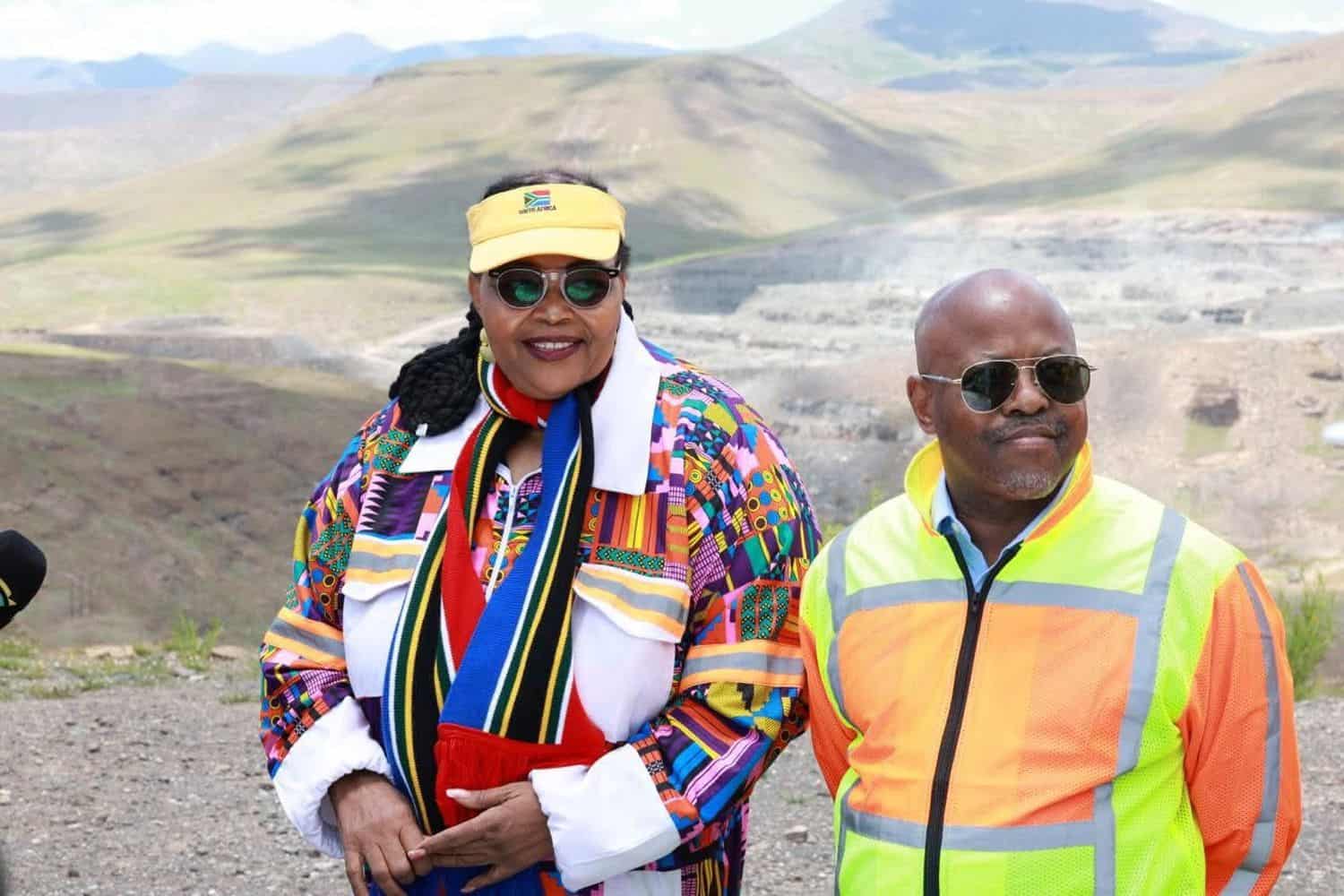
Majodina was joined by Lesotho’s Minister of Natural Resources, Mohlomi Moleko, during the two-day oversight tour of the project. Deputy Minister of Planning, Monitoring and Evaluation, Seiso Mohai, was also present, with other officials.
On Saturday, journalists, together with some department executives who flew from the City of Gold to Lesotho, had a ‘trial-run’ by visiting the places the ministers were going to assess during the oversight tour.
However, the day saw the reporters and some officials from the department stranded outside one of the sites without lunch, as the driver had to refuel the bus. The last meal was at 9am, followed by dinner at 7pm.
Ministers arrive late in helicopters
In countries where development is fragile, and most people are financially stretched, the ministers and their delegates arrived in helicopters on Sunday, almost three hours late – a spit in the public’s face and journalists who had to endure an almost 12-hour bus journey from Gauteng to Lesotho.
After the presentation by the Lesotho Highlands Development Authority (LHDA), Majodina commended them, as the managing agent of the project, for the progress made thus far, but warned that the project must be finished by the extended deadline.
“If you are running behind schedule, you must have a clear turnaround plan on how and when you are going to catch up, because we cannot afford to delay this project any further. The taste is in the eating of the pudding,” Majodina said.
R21 billion already spent on water project
The presentation by LHDA highlighted that more than R21 billion had already been spent by November 2025 on the second phase. Most money is spent on main works (R8 billion) and on advanced infrastructure (R7.8 billion).
After the presentation, we went to the 165m-high concrete-faced rockfill dam at Polihali, including the 38km-long concrete-lined gravity tunnel linking the Polihali and Katse reservoirs, as Majodina needed to see the progress made so far.
During the visits, she expressed encouragement at the pace of development and confirmed that South Africa is preparing to receive water once the project is completed.
Leaving the construction sites to get lunch with the minister, the bus the journalists were travelling in got lost. When they finally arrived at the right location, the reporters were informed that most of the food was finished, and the ministers were ready to leave for the last visit of the day, where questions about the project would be answered. Another day with no lunch for the hosted media practitioners.
ALSO READ: In pipeline: R100bn is what fixing supply will cost you
From R8 billion to R53 billion?
The last visit of the day was at Sengqu Bridge construction site, where the ministers were supposed to take questions from journalists.
Majodina was asked how the project ballooned from R8 billion to R53 billion. She said she does not know how the R8 billion figure was first determined, as at the time, there were no designs on how the project would look.
In 2008, phase 2 was projected to cost R8 billion. By 2022, this had ballooned to R42 billion. It now stands at R53 billion. This increase has raised eyebrows.
The journalists weren’t able to properly question the massive cost increases or the project’s delays.
After taking questions from just three journalists, the ministers said they had to depart as the wind was picking up and the helicopters taking them to their accommodation in Maseru, Lesotho, would have difficulty flying if they stayed any longer.
Measures to prevent additional increase
On the last day of the oversight visit, The Citizen was afforded a chance to speak to Majodina – but only given time for two questions. She was asked if there are any measures in place to ensure that the budget of the project does not increase beyond the R53 billion.
“What we have done is to give a directive to the commission that whoever is delaying, whoever is not meeting the deadline, they must take part of the work from that company and to also add penalties,” said Majodina.
“So since we have started that process, people now are on time, on schedule, and those that are giving the additional work, they are doing very well because they want more and more. So that has created competition on the site that everyone wants to finish on time, on schedule.”
R5 billion contingency fund
According to the presentation by LHDA, out of the R53 billion budget for the project, there is a contingency fund worth more than R5 billion. The first budget for the second phase of the project did not include any contingency fund.
A contingency fund is money set aside in advance to cover unexpected costs or emergencies, acting as a financial safety net when plans go wrong. The Citizen asked the ministers how they will ensure this fund will not deplete prematurely.
“If it is work construction, you can’t say money can be depleted prematurely. If it’s depleted fast, it means the project is moving fast,” Moleko said.
“Most of the time when you monitor progress of a project, you check the percentage of money used and actually push for that money to be used fast because if you use it fast, you actually save on future costs. So a contingency [fund] basically is just for unforeseen, if there are variations.”
ALSO READ: Full Vaal Dam to the rescue as Lesotho Highlands Water Project takes bad turn
‘R53 billion is not taxpayers’ money’
Most of the questions were moved to Percy Sechemane, CEO of the Trans-Caledon Tunnel Authority (TCTA), as they were about the budget of the project. He told The Citizen that South Africa pays for the construction of the dams, together with royalties, but not with taxpayer money. He said the money is borrowed through loans.
“We go into the market to borrow the money because South Africa does not have enough money to pay for this. At least now we have a good reputation in the market in terms of saying we are able to service loans and when it is time to repay the capital, we are able to do so,” he said.
“Once the work is done, the department will sell the water to waterboards, Rand Water, for example. Rand Water will look at purifying the water and selling it to municipalities. Municipalities will then sell to end-users, residents and businesses.
“The end-users pay the municipalities, municipalities pay waterboards, waterboards pay the department and the department will service these loans.” South Africa pays approximately R230 million monthly in royalties to Lesotho for water from the project.
Overcharging residents
Sechemane also touched on one of the challenges of water leaks in South Africa.
“But now the biggest problem on the SA side is the municipalities are not looking after infrastructure,” he said. “The amount of water we lose is too much in other municipalities, 40%, some over 50%.
The issue starts when municipalities increase their tariffs to make up for the loss they have made from these water leaks, because, despite whatever amount of water they have lost, they have to pay the full amount to waterboards.
Great concern in the delay
Julius Kleynhans, executive manager for local government at Organisation Undoing Tax Abuse (Outa), told The Citizen that it is concerning that there has been another extension on the project.
“It is a great concern due to this project being delayed for nearly a decade now. Missing deadlines lead to cost increases, and Gauteng is in desperate need of additional water supply,” he said. “Increased cost covered by the taxpayer with little return is of great concern.”
“This project, however, can almost be compared to the Medupi and Kusile [power stations] due to poor planning and execution, nearly hijacked through corrupt tender processes under the [Nomvula] Mokonyane era and now costing the taxpayer over R20bn more than it should’ve. Yet again, there are no consequences. That said, we trust that the current DG and his team will get the project over the finish line.
“We need to tread carefully as we have a signed treaty with Lesotho, which commits us to pay royalties to the country. The sooner we provide additional water supply, we can stimulate economic growth and generate revenue from the water, which can also cover the royalty costs. Until then, this is another white elephant.”
Apology?
On the last night in Lesotho, the department told journalists that incidents experienced on the trip were out of its control, as it was not in charge of the planning of most aspects. Without offering any apology, the department added that it and journalists are all foreigners and the mishaps were beyond their control.
The biggest frustration came from no attempts being made during the tour of the sites to provide journalists with an internet connection to allow stories to be filed. The only time one had an internet connection was at the guesthouse.
In an attempt to redeem itself, the department gave journalists three bottles of alcohol and a few tequila shots. However, the ordeal was not over. The return trip to South Africa on Tuesday was also a headache, as the bus’s brake pads, which had been making a sound since Friday, had to be changed, resulting in a lengthy stop in Ficksburg. The frustrated journalists were then told “calm down, guys” by an official who flew back to Gauteng.
I tend not to burn any bridges because life is long, but it looked like the department was planning the media tour as the days went by. Those who have been hosted by them before noted that this is the first time they have been treated so poorly.
NOW READ: Did Donald Trump get false info about Lesotho exports? Thousands of jobs are at risk
About the Author