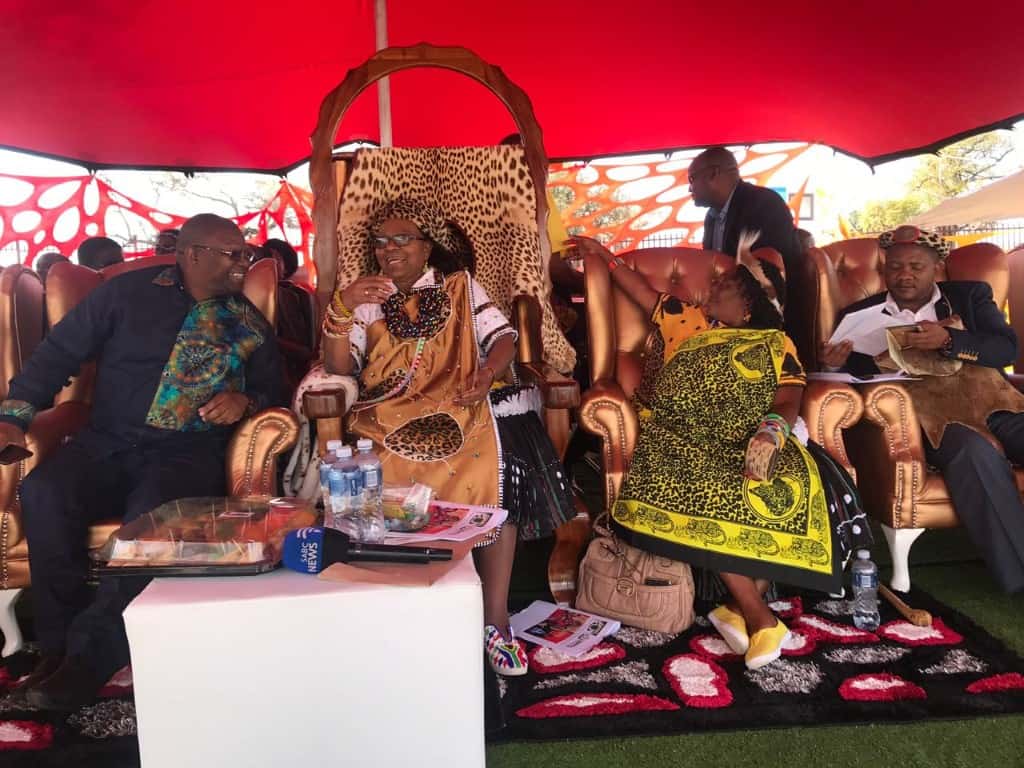
President Cyril Ramaphosa will address mourners at the official funeral of Hosi N’wamitwa ll.
The first female traditional leader among the Vatsonga-Machangana passed away earlier this month, aged 85, after an illness.
She took the throne in 2008 and also served as a member of Parliament.
Ramaphosa recently declared a category two official provincial funeral for Hosi N’wamitwa ll.
The service is taking place at the Valoyi Vatsonga Cultural village in Limpopo and is attended by several high-profile guests, including Ramaphosa, defence minister Angie Motshekga, and EFF leader Julius Malema.
Parliament had previously hailed her “a pioneering traditional leader” and “constitutional trailblazer”.
“South Africa has lost not only a respected monarch of the Valoyi (Nwamitwa) traditional community near Tzaneen in Limpopo, but also one of the quiet architects of our democratic order.
“Hosi Nwamitwa II’s ascension to the throne in 2008 followed a historic and protracted legal battle after the death of her father, Hosi Fofoza, in 1968. Because he had no son, it was assumed – under the apartheid-era male primogeniture rule – that his firstborn daughter could not inherit the throne.
She challenged this deeply entrenched patriarchal system.
“In its landmark judgment of 4 June 2008, the Constitutional Court affirmed her rightful position as Senior Traditional Leader and confirmed that the Constitution restores the dignity and status of women as citizens equal to men. The ruling overturned the exclusionary interpretation of customary succession and aligned traditional leadership with constitutional values of equality and human dignity.
“Through her courage, Hosi Nwamitwa II did not merely inherit a throne – she transformed South African jurisprudence. She rewrote the history of traditional leadership and helped dismantle institutional patriarchy within customary law. Her victory ensured that culture and tradition could evolve within the framework of constitutional democracy.
“Her reign, therefore, became a living demonstration that tradition and constitutionalism are not in conflict, but mutually reinforcing when grounded in dignity and equality.”
About the Author