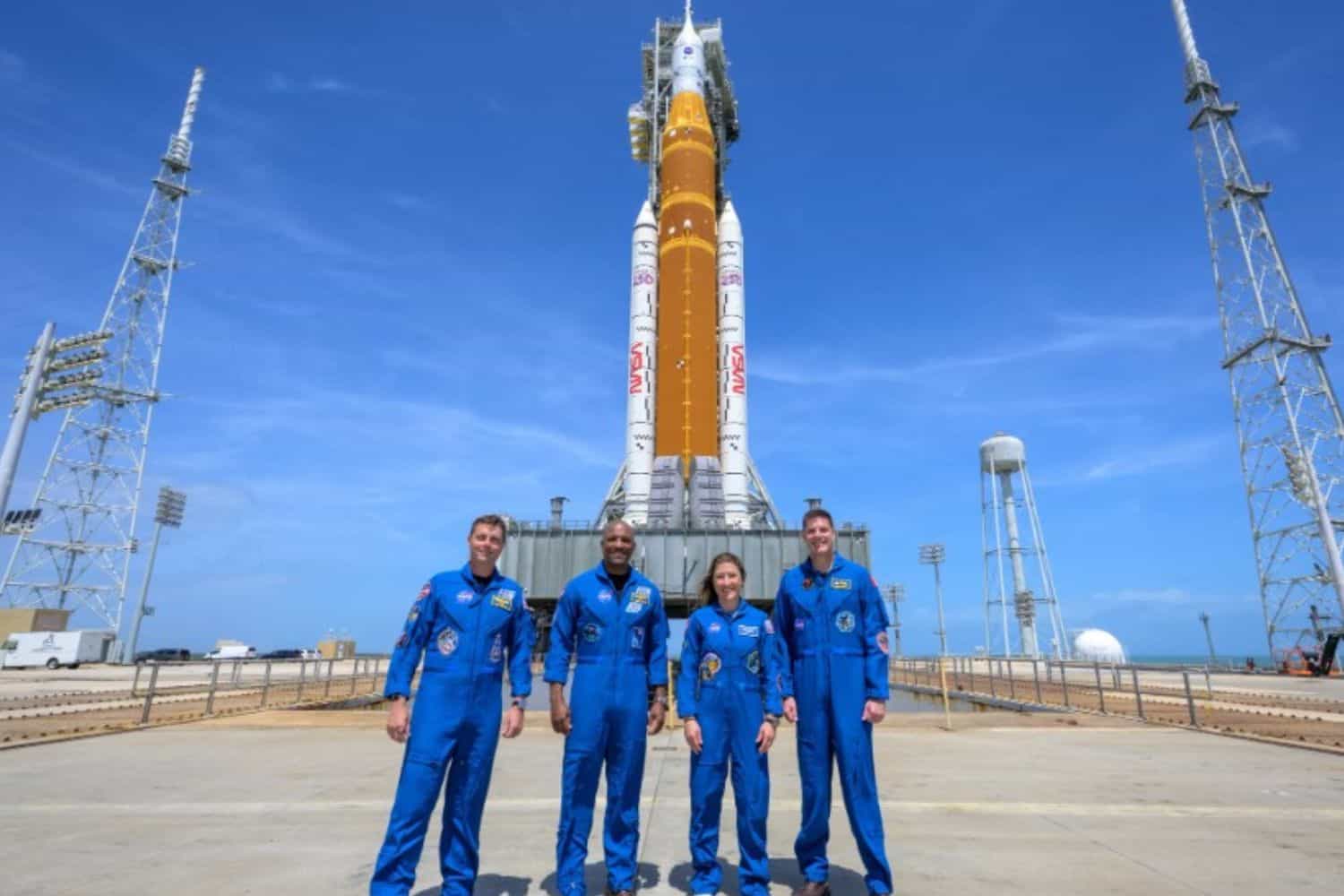
After several years of delays, NASA’s Artemis II mission is poised to carry three Americans and one Canadian astronaut on a journey expected to break the distance record set by the Apollo missions, venturing farther into space than any crew has gone before.
The lunar mission, the first of its kind in more than 50 years, will see the first black person, first woman, and the first non-American embark on a journey to the Moon.
Artemis II
Artemis II is NASA’s first crewed mission under the Artemis programme and will launch from the agency’s Kennedy Space Centre in Florida, United States, on 1 April 2026
It will send NASA astronauts Reid Wiseman, Victor Glover, Christina Koch, and CSA (Canadian Space Agency) astronaut Jeremy Hansen on an approximately 10-day journey around the Moon.
According to local Florida newspapers, some 400 000 people are expected to turn up to watch liftoff, which is currently slated for Wednesday at 6:24 pm local time (22:24 GMT).
ALSO READ: Africa eyes lunar race as NASA prepares Artemis II mission to the moon
Go for launch
NASA said launch teams at NASA’s Kennedy Space Centre in Florida continue completing a sequence of highly choreographed steps to ready the SLS (Space Launch System) rocket and Orion spacecraft for the crew’s journey around the Moon.
“The weather forecast for launch day shows an 80% chance of favourable weather conditions with primary concerns being cumulus clouds, ground winds, and solar weather. NASA and weather officers with the U.S. Space Force’s Space Launch Delta 45 will continue to monitor the weather leading up to liftoff.”
Engineers began the day by finishing critical health checks on the rocket’s four RS‑25 engines, confirming that sensors, connections, and diagnostics were all performing as expected.
Their readiness marks an important milestone as cryogenic operations approach.
More moon missions
The mammoth orange-and-white rocket is designed to enable the United States to repeatedly return to the Moon in the years to come, with the goal of establishing a permanent base that will serve as a platform for further exploration.
“The moon is a witness plate to our entire solar system’s formation,” said astronaut Koch in a press conference over the weekend.
“It’s a stepping stone to Mars, where we might have the most likelihood of finding evidence of past life, but it’s also a Rosetta Stone for how other solar systems form.”
The mission was originally due to take off as early as February.
Watch the launch
NASA broadcast coverage of tanking operations begins on launch day at 7:45 a.m. EDT on NASA’s YouTube channel, as teams load propellant into the SLS rocket. Full launch coverage begins at 12:50 p.m. on NASA+, Amazon Prime, and YouTube.
ALSO READ: NASA Astronauts splash down on Earth after first-ever ISS medical evacuation [VIDEO]