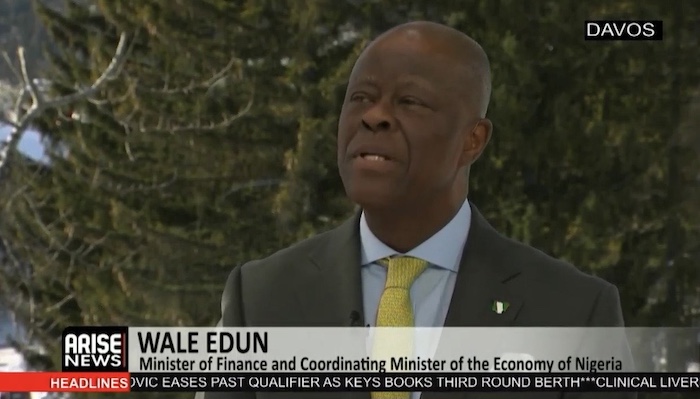
Finance Minister and Coordinating Minister of the Economy, Dr. Wale Edun, has said that Nigeria is stepping up efforts to attract foreign investment and expand its economic footprint, with the government focusing on productivity-driven investments, job creation, and export growth.
In an interview with ARISE News on Thursday in Davos, Dr. Edun said Nigeria is actively positioning itself as a viable destination for foreign direct investment, citing recent global economic diplomacy efforts and reforms aimed at creating a predictable investment climate.
“Investment that increases productivity and grows the economy. You know, let’s take a leap from the fact that the US, I think, recently announced a $1.4 trillion package and a programme of investments for, I think, over 20 years. And for us, it is no different,” Dr. Edun said.
“We’re here to stake our claim for foreign direct investment. And even Mr. President’s global economic diplomacy, which, in fact, led to just last week or so, UAE, we signed a comprehensive economic partnership agreement. These are the ways to attract funds from those that have money to invest, that are looking for profitable, predictable, and reliable investment climates.
“And of course, they’re looking for returns on their investment. And also, we’re looking to do the same. So we’re looking, we have a couple of things in the background. We’re looking to announce perhaps a couple of investments similar to what other people are doing. That’s why we’re here. We’re here to attract investment to Nigeria and also to make the case to Nigerians as well, Nigerians in diaspora and even Nigerians at home.”
Dr. Edun also addressed the potential impact of geopolitical developments, including the speech by former U.S. President Donald Trump and ongoing global economic trends, on Nigeria’s engagement with international investors.
“Well, definitely. We’ve had the, I think they announced for the third year, for the third time, addressing Davos, the president of the United States, of course, the most, perhaps in many ways, most powerful man on the stage in terms of economy, in terms of society. He was here and he made his case for how America was doing, how he felt that he would continue to do well.
“The major audience really were Europe and they, he had most to say for them because once he announced that he was not going to take military action, we had already seen that he has rolled back the import regime, the import tariffs that were imposed last April. So I think the good news was mainly for Europe in that direction. And for us, what would matter is that given our open society and economy and given our free market policies that we are pursuing, what matters is that world trade is growing, global output is growing.
“So we can be part of it. We know Africa, just 3% perhaps of world trade, just 2.5% of global output. But as that increases, that gives us more opportunity for export. I mean, we export just less than $4 billion to the U.S. But it is important and we want it going in the right direction. So to the extent that there was not policies that tightened world trade further, what President Trump had to say also was optimistic and encouraging for us.”
Dr. Edun emphasised that ongoing reforms are designed to benefit Nigerians at home, including through job creation, increased incomes, and enhanced access to technology and infrastructure.
“Well, for the Nigerian at home, the policies that are being followed for them, the ultimate aim is that we have, I would say, rapid, sustained and inclusive growth that creates jobs, that provides greater income for them. And of course, that was increased. So in terms of what we are doing here, we’re looking, first of all, in our own manufacturing sector where, in fact, we are re-industrialising.
“We now have, through the Dangote and other private refineries, we now have petrochemicals, we now have industrial raw materials, which allow us to attract investors to produce domestically for a huge domestic market as well as for exports, and that creates jobs. So there’s that. Then, of course, for our demographic, and you know, we are here today as part of the conversation. We have to take our own place at the table. So when there’s talk of what’s going to be happening in Europe and how they’re going to be, we point out to them the important demographic that by 2050, 25 percent of the working population will be in Africa, and it must be skilled, it must be catered for, it must be accommodated within the world’s social order.”
He highlighted ongoing initiatives to empower Nigeria’s youth and strengthen the country’s technology and services sectors.
“We are here talking to the top technology companies in the world so that they too can invest in Nigeria, invest in our talent, and then we give our youngsters, to the extent that we give them infrastructure, they need fibre optic networks. We have a huge 90,000-kilometre project on the way, and that would allow them, along with other items such as data, such as technology generally, to be able to sell their services across the internet. Exports of services by our young people, it has to be profitable. And then finally, we’re also in the conversation regarding the automated use of libraries.
“We pointed out in conversations here that Microsoft is adding new information, Microsoft at medium scale, you know, somewhere as low as 5 million tonnes. That is the area you want to drive down access to finance, access to skills, and of course, access to markets. So that particular initiative, we call it our world first development programme, where we put out to the world to identify actors, economic actors, and provide them with what they need to increase their productivity.”
Dr. Edun underlined Nigeria’s commitment to maintaining macroeconomic stability while encouraging private sector participation in government initiatives and investments.
“The short answer is yes, it [government asset sales] could be, and it should be. What you are talking about is private sector funding and private sector participation in government, in the sense that the government is stepping back and allowing the private sector to come in, and it’s a broader conversation than if you identified utilities or government-owned companies. The idea is for a stable, predictable macroeconomic environment that encourages the private sector to come in, and we have a very good prospect.
“We focus on having high net returns. If you look at the stock market, there was a great capacity offer centre last year. That is showing that there is the capacity, and that is the way we go for our investors to invest in. So when you see a stable macroeconomic environment, you see in particular a stable exchange rate for years and years. There has always been a one-way bet, pay-to-accelerate, pay-to-accelerate, change it to dollars, and that is no longer the case. There are people who changed their money to dollars last year, but on the other hand, there must be investment opportunities at all levels for the retail investor, as well as the huge large-scale investor in factories and even foreign investors.”
Finally, he said Nigeria’s long-term growth ambitions remain focused on doubling economic output relative to population growth to lift millions out of poverty.
“We’ve got 20 minutes left. We are predicting 4.6 or 8% growth. We hope to achieve that. It’s not where we want to be. We’re looking at 7% per annum growth, because that’s double population growth. That is the level at which we believe that the wealth of Nigerians will be represented. Well, I meant to go quickly and lift millions of Nigerians out of poverty, which is the ultimate aim of this policy.”
Boluwatife Enome
About the Author