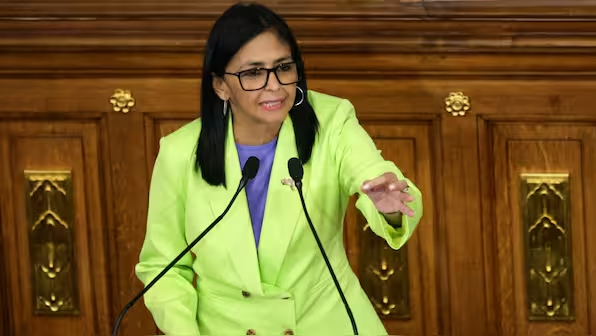
Venezuela’s interim leader, Delcy Rodríguez, has unveiled a major political reform that could see hundreds of prisoners freed under a broad new amnesty law, marking one of her most consequential actions since assuming power earlier this month.
Addressing top justices, government ministers, military officials and lawmakers in a televised event on Friday, Rodríguez said she would urgently send a “general amnesty” bill to the National Assembly.
The legislation is designed to cover offences linked to political violence from 1999 — the start of Hugo Chávez’s presidency — through the present day.
“May this law serve to heal the wounds left by political confrontation fuelled by violence and extremism,” Rodríguez said, calling the measure a step toward national reconciliation and peaceful coexistence among Venezuelans.
In a symbolic move alongside the amnesty announcement, Rodríguez also declared the closure of El Helicoide, the infamous Caracas detention centre long associated with torture and political repression. She said the facility will be repurposed into sports, social and cultural spaces for the local community.
The amnesty plan has drawn mixed reactions. Human rights organisations and relatives of detainees have welcomed steps toward releasing political prisoners but urged transparency and fairness in how the law is applied.
Foro Penal, a Venezuelan prisoners’ rights group, estimates that more than 700 people remain detained for political activities, though only a portion have been formally convicted.
This initiative comes in the wake of a dramatic power shift in Venezuela earlier this month, following the U.S. military capture of former President Nicolás Maduro, thrusting Rodríguez into the presidency and prompting rapid political changes.
About the Author