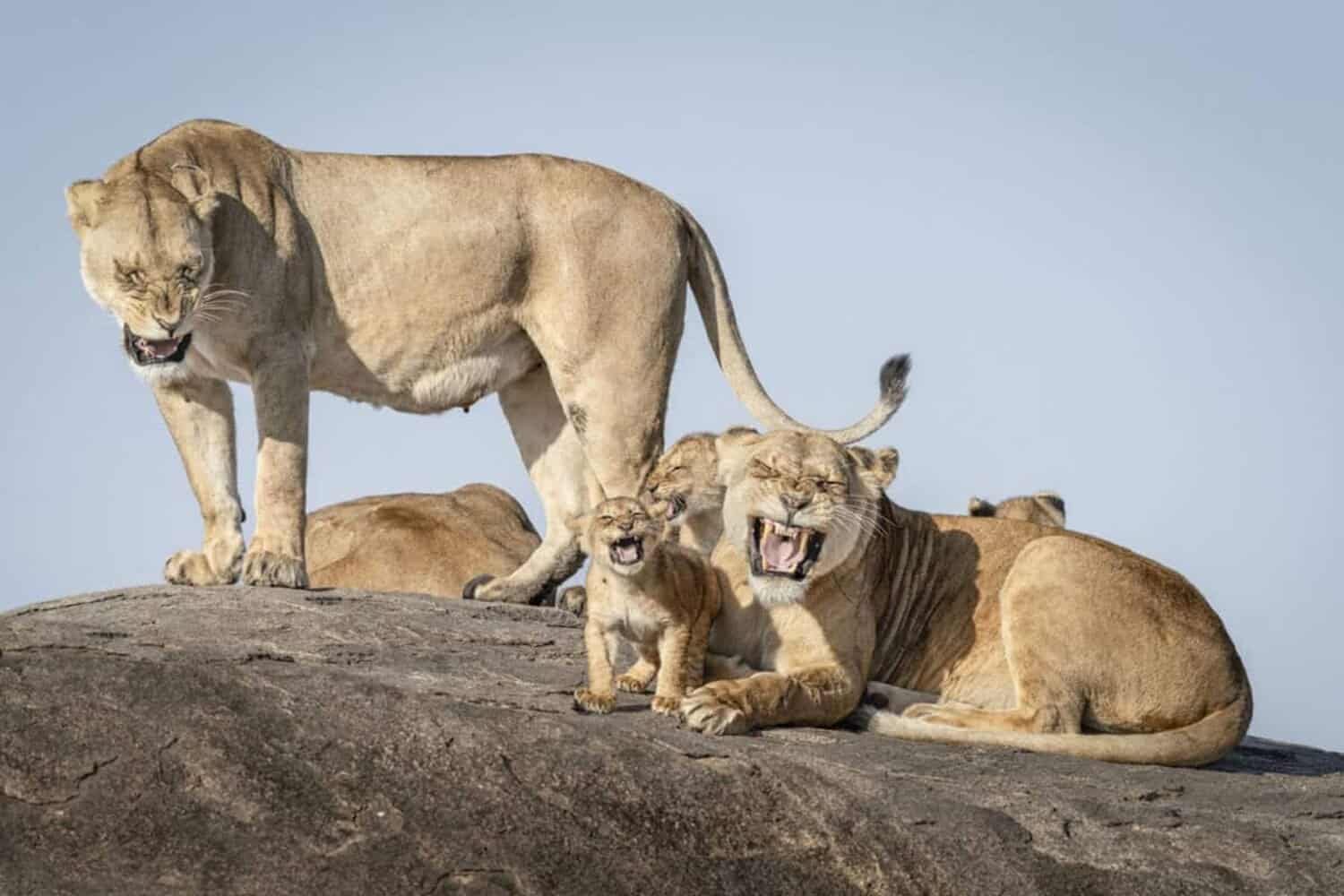
A pride of lions shares a "humorous" moment at the Serengeti National Park, Tanzania. "I captured this image in September 2024, during the dry season, when dwindling food and water can heighten family tensions. One morning near the Semetu Kopjes, we found a pride locked in a lively standoff - hungry cubs clamoring for milk, mothers giving in briefly before retreating in exhaustion. Life in the dry season is no picnic — lions are anxiously waiting for the Great Migration and the feast it promises — but it makes for some incredible wildlife behavior and these cubs were the stars of the show," explains the photographer. Picture: Bret Saalwaechter
Inside South Africa’s protected sanctuaries, a more immediate predator has emerged: the bushmeat trade and a skyrocketing demand for lion body parts.
Where are our lions?
Today, the lion occupies a mere 6% of Africa. This, according to the IUCN Red List of Threatened Species.
With fewer than 25,000 adults remaining across the continent, the species is no longer just vulnerable but in crisis.
In Northern Kruger, the numbers are devastating. Recent surveys reveal a staggering 63% decline in the lion population over the last 18 years. The wild is becoming emptier, and the reasons are as grizzly as they are intentional.
Lion massacre
Over the past decade, reports of targeted poaching of lions for their body parts have become more frequent in parts of Africa.
The year 2025 was a calendar of carnage for the Kruger National Park.
In September alone, poachers poisoned three males; two were discovered as hollowed-out versions of themselves, their heads and paws hacked away. This followed a violent June where attackers slaughtered a male and a pregnant lioness.
In February, a lioness was found in a snare, her tail, skull, and stomach missing. By April, two more lions succumbed to a poisoned carcass; their stomachs were the only prize poachers wanted.
In 2024, officials confirmed seven major incidents resulting in 10 deaths, with half of the victims mutilated for their parts.
These are the results of a growing artisanal trade, according to studies.
A 2024 Panthera survey found that 79% of trade markets now sell lion products. Experts estimate that up to 169 lions are slaughtered annually just to feed this rising demand for parts.
Kruger’s lion share
In the northern reaches of Kruger, the Endangered Wildlife Trust (EWT) and South African National Parks (SANParks) tracked the disappearance in real-time.
In the Nxanatseni North region, the population sat at a fragile 105 individuals in 2023.
Between July and September 2024, the EWT’s Carnivore Conservation team logged over 10 000 km, searching for the ghosts of the bush.
They identified only 74 individuals out of 183 identified in that span. 22 were males and 52 were females.
“Out of the 247 lions detected, 182 could be positively identified, while 65 could not because the photos taken of the individuals were not clear enough for a positive identification,” said EWT.
“Because of the high mortality among lions less than a year old, these were excluded from the survey.”
In Nxanatseni South, densities are slightly higher, roughly accounting for 3.5 lions per 100 km², making a total of 144 lions.
The concern is that the further these animals move from water, and the closer they drift toward human boundaries, the more likely they are to vanish.
“Besides the higher number in the southern Nxanatseni area, the survey again found that lion density decreased the further carnivores are away from water,” said EWT.
“Although poaching incidents were not counted during the study, poached lion were found on the western boundary of the Park,” said EWT this week.
The snare threat
It isn’t just poison and knives. The most cunning threat is the wire snare. A decade-long study, released last year (2013-2023) and based on citizen-scientist data, suggests that as many as 155 lions may have perished in snares within Kruger National Park.
Snares cause slow, agonising deaths for the lions themselves. They also contribute to prey depletion by killing the herbivores lions rely on, and poachers starve the predators that survive the wires.
Data shows these traps are most prevalent along the reserve boundaries, where human activity bleeds into the wild.
Identifying these “high-risk zones” is now the primary mission for de-snaring teams in a race to pull the wire before it tightens around the species’ future.
The data tells us the “where” and the “how,” but the “why” remains a haunting indictment of modern greed.
Interventions
Both EWT and SANParks reported potential actions to address lion poaching.
“The report concludes that the observations are concerning, given the conservation importance of the Kruger lion population.
Among the steps that need to be taken to conserve lions within the Greater Kruger conservation area are an increase in engagement with local communities and local traditional medicine users, alongside stricter law enforcement.
“This may include giving rangers arresting powers and introducing harsher penalties for wildlife crimes,” they said.
About the Author