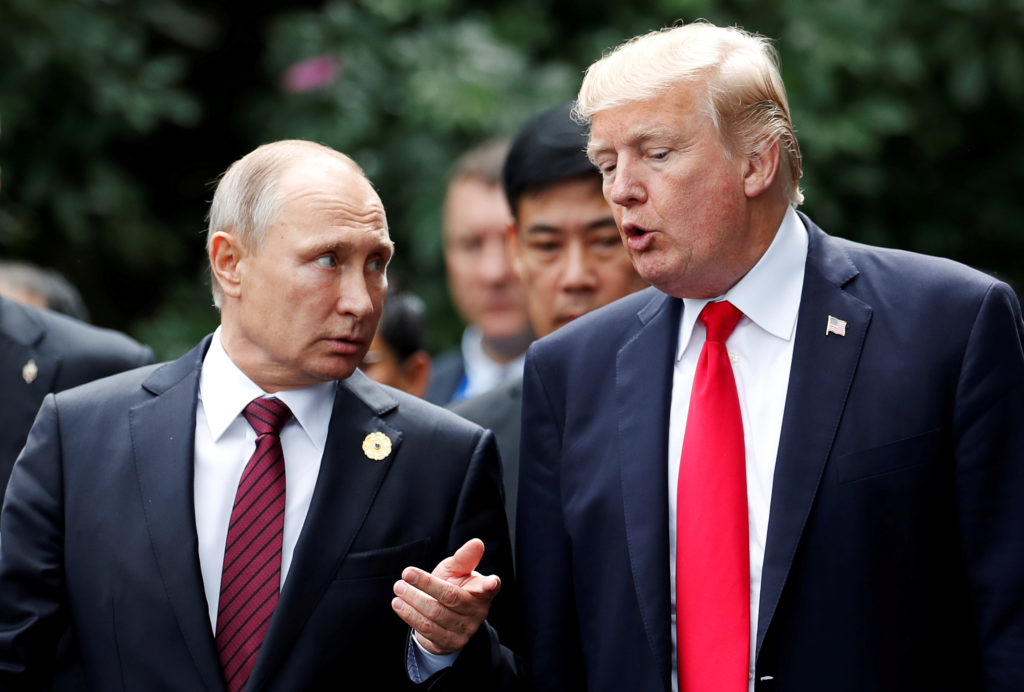
FILE PHOTO: U.S. President Donald Trump and Russia's President Vladimir Putin talk during the family photo session at the APEC Summit in Danang, Vietnam November 11, 2017. REUTERS/Jorge Silva/File Photo - RC1287F1C9B0
The United States and Russia are on the verge of entering an unrestrained nuclear arms race for the first time since the Cold War, unless a last-minute agreement is reached before their final arms control treaty expires in days.
The New START treaty, which limits the number of long-range nuclear warheads and delivery systems each side can deploy, is set to expire on February 5. Its lapse would remove all formal constraints on US and Russian strategic nuclear arsenals, ending a system of controls that has existed for more than five decades.
Russian President Vladimir Putin has proposed extending current missile and warhead limits for one year to allow time for negotiations on a successor agreement. US President Donald Trump has not formally responded, saying instead that “if it expires, it expires,” while arguing that any replacement should be stronger and broader.
Some US lawmakers are urging Trump to reject Moscow’s offer, contending that ending New START would allow Washington to expand its nuclear forces to counter China’s rapidly growing arsenal. Trump has said he seeks “denuclearisation” involving both Russia and China, but Beijing has dismissed the idea, arguing that its far smaller stockpile makes such talks unfair.
Arms control experts warn that treaties like New START play a critical role in preventing misunderstandings and costly escalation. Beyond limiting weapons, the agreements require transparency measures such as data exchanges and inspections, helping both sides better assess intentions and capabilities.
Without such mechanisms, each country would be forced to assume the worst about the other’s nuclear activities, said Nikolai Sokov, a former Soviet and Russian arms negotiator. That dynamic, he warned, could fuel a self-reinforcing cycle of weapons expansion and instability.
Since the Cold War, Washington and Moscow have repeatedly updated and replaced arms control agreements governing the strategic weapons aimed at each other’s cities and military infrastructure. New START, signed in 2010 by President Barack Obama and then–Russian President Dmitry Medvedev, was the latest in that lineage.
With its expiration imminent and no replacement in sight, analysts say the collapse of the treaty could mark a decisive break from decades of nuclear restraint, reopening the door to a dangerous and expensive global arms race.
Erizia Rubyjeana
About the Author