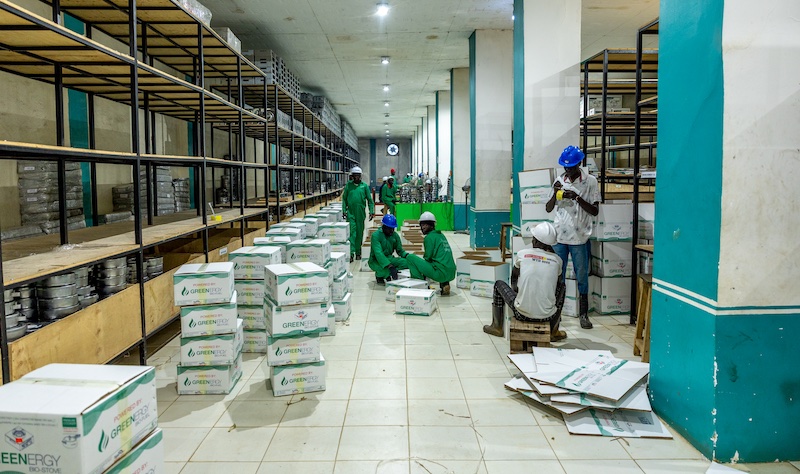
When Bukona Agro Processors opened shop in the Northern Ugandan district of Nwoya, their vision was to turn the region into a hub for industrial-grade ethanol production.
However, for years, one obstacle stood in the company’s way – not raw materials, not markets, but the acquisition process of a certificate of conformity from the Uganda National Bureau of Standards (UNBS).
In 2021, as the managing director, Praviin Kekal, recalls, the company nearly lost a million-litre export order to Vivo Energy Kenya. The challenge was not the ability to produce but the long and uncertain wait for certification.
“We had an order for one million litres of ethanol… but the deal almost collapsed,” Praviin remembers. “We had to go all the way to Kampala for a Q-Mark. We waited for more than a month for the certificate of conformity.”
Transporting samples from Nwoya to Kampala – over 300km – was not just costly, it was time-consuming, unpredictable, and stifling for a business aiming to compete in the regional energy market.
Bukona’s ordeal was shared by many traders when UNBS launched the Northern Regional Food Safety Testing Laboratory in Gulu back in July 2022, and Praviin was among the business leaders who welcomed it with relief and hope.
The regional lab was part of UNBS’ plan to decentralise testing services and support MSMEs across Uganda, starting with food products.
POSITIVE RESULTS
Three years later, Praviin says the Gulu lab has delivered beyond expectations.
“What used to take months, now it takes days,” he says. “Since the laboratory opened, it takes a week to get results. This has helped us greatly.”

This improved turn-around time in certification has not only stabilized Bukona’s operations but has also fuelled ambitious growth. Praviin reveals that Bukona Agro Processors has expanded its operations to produce hydrous ethanol for blending with fuel at a new plant in Malaba in eastern Uganda, one of East Africa’s busiest border points.
“We started manufacturing ethanol for blending with petrol,” Praviin says. “We have a license for blending at Malaba. What we manufacture here will be blended with petrol at the Malaba plant.”
This expansion, he says, would have been much harder to achieve without improved access to testing services. While the lab has significantly accelerated certification timelines, Bukona and other northern-Ugandan-based processors require more specialized testing capabilities.
He, for instance, wants Gas-Liquid Chromatography (GLC) equipment, key for advanced ethanol analysis.
“If Gulu Laboratory has GLC and those testing facilities, we can send samples there and get certified quickly when blending fuel at the border,” he explains.
Bukona also manufactures ethanol cookstoves, the only producer of their kind in Uganda. Yet testing these stoves currently requires travel back to Kampala, through CREEC at Makerere University.
“UNBS doesn’t have that testing facility yet. If such infrastructure can come closer, checking emissions and standards, it would be very good for us.”
FURTHER DECENTRALISATION
The Gulu facility is one of three regional food safety laboratories established by UNBS as part of its decentralization strategy. The others are; Mbale Laboratory opened in October 2022 and Mbarara Laboratory, opened in May 2023.
The establishment of the three regional labs, worth $4.45 million, was fully funded by the Government of Denmark through Trademark Africa (TMA), with additional equipment support from the Vegetable Oil Development Project (VODP) under MAAIF.

For Praviin, the story of Bukona’s growth is inseparable from that of Uganda’s expanding laboratory network. These labs have reduced bottlenecks, cut costs, and given producers the confidence to expand. Still, he insists, matching the pace of industrial growth will require sustained investment.
“Producers are growing. The lab must grow too,” he says.
This is true given that while the compliance numbers continue to grow, the demand for testing and certification services is growing much more. In the 2021/22 financial year, UNBS received 4,527 applications and issued 3,409 permits (75 per cent), while in the 2024/25 financial year, the number had grown to 8,270 applications, and only 5,703 permits were issued (69 per cent), showing a six per cent decline in permits issued.
In an exclusive interview, Patricia Bageine Ejalu, UNBS deputy executive director in charge of Standards, acknowledged that while the Gulu Laboratory is fulfilling its mandate, it still requires additional equipment to fully meet the growing needs of businesses in the northern region.
She noted that UNBS is addressing this gap through the planned introduction of specialised mobile testing laboratories to complement the existing regional facilities.
“Setting up a fully equipped laboratory is a major investment, and it must be aligned with demand. This is why our regional laboratories focus on chemistry and microbiology because they serve the bulk of agro-based products such as food items and cosmetics, which form a significant part of Uganda’s production landscape,” she explained.
She added that expanding into engineering and materials testing requires sufficient volumes to justify the cost of establishing a permanent facility.
“For us to invest in an engineering and materials lab, there must be enough work to make it viable.”
Even so, to bridge this gap, UNBS is turning to mobile testing units.
“We have decided to invest in mobile labs; optimistically starting next financial year so that if a mobile lab is based in Gulu, it can move across the northern region to support whoever needs the service,” she said.
Ejalu added, “These mobile labs will include engineering testing capabilities. Even if a specific factory requires support, the mobile lab can visit them directly. It is not cheap, but it is far more cost-efficient than setting up a full stationary lab.”
She confirmed that Gulu will be among the first beneficiaries of the mobile lab rollout.
“In partnership with Trademark Africa, we are also commissioning border laboratories soon to further strengthen product certification for cross-border trade,” she concluded.
yudaya92@gmail.com
About the Author