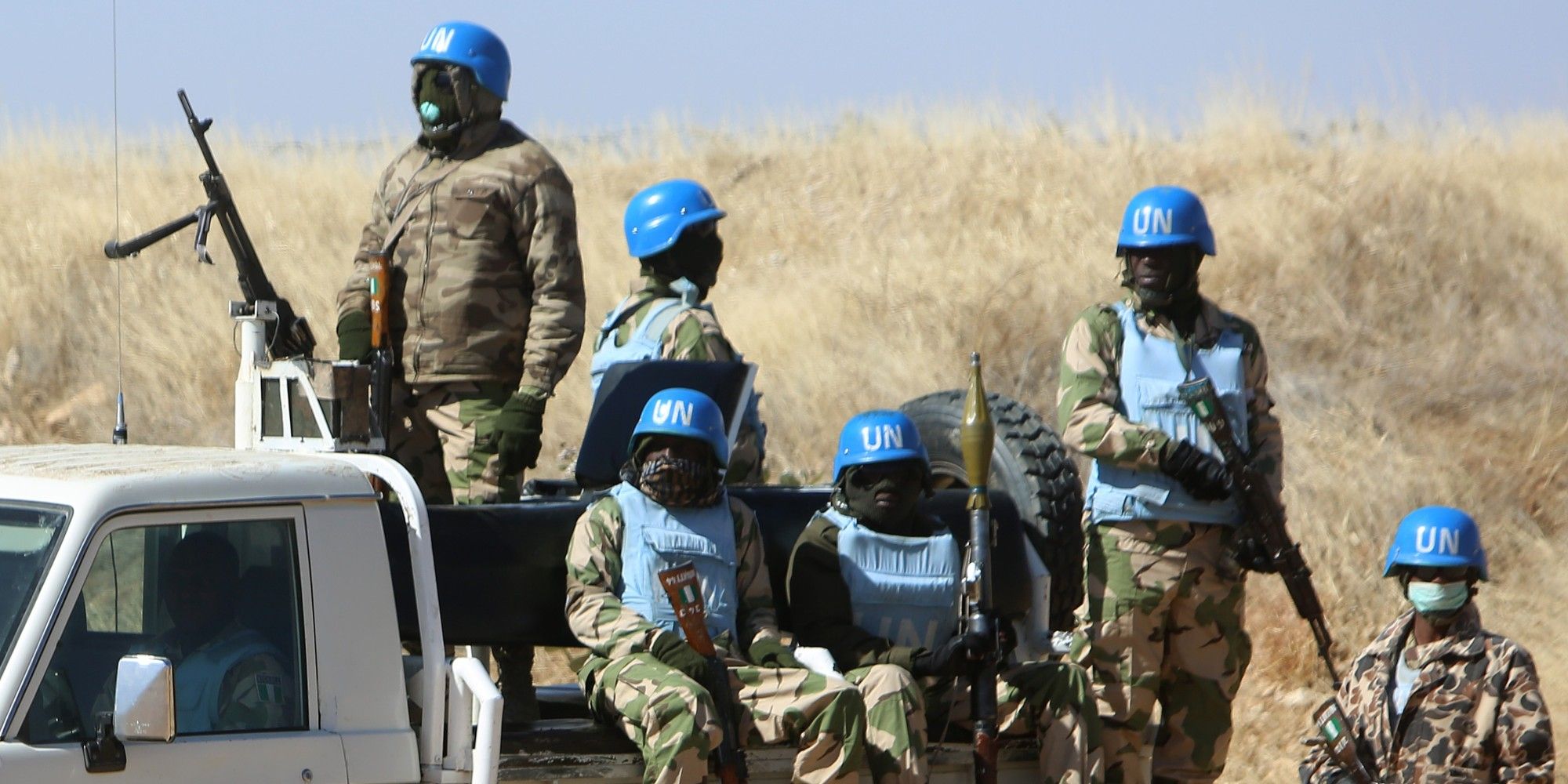
Members of the UN-African Union mission in Darfur (UNAMID) patrol the area near the city of Nyala in Sudan's Darfur on January 12, 2015. Qatar's deputy premier Ahmed bin Abdullah al-Mahmud is on a visit to the war-torn western region of Sudan for the ninth meeting of the committee monitoring the implementation of the Doha Document for Peace Darfur (DDPD). AFP PHOTO / ASHRAF SHAZLY (Photo credit should read ASHRAF SHAZLY/AFP/Getty Images)
More than 36,000 civilians have fled towns and villages in Sudan’s Kordofan region as fighting intensifies east of Darfur, the United Nations reported on Sunday.
The fresh wave of displacement comes barely a week after Rapid Support Forces (RSF) fighters captured the strategic city of El-Fasher.
The central Kordofan region — a vital link between the embattled Darfur states and Sudan’s Khartoum–Riverine heartland — has rapidly become the latest flashpoint in the brutal war between the Sudanese army and the RSF, now entering its second year.
According to the UN’s International Organization for Migration, 36,825 residents were forced to flee five localities in North Kordofan between October 26 and 31 alone.
On Monday, residents reported a dramatic increase in troop movements, with both RSF and army forces amassing across a string of towns and villages.
The rival forces are racing to secure El-Obeid, the North Kordofan capital and a critical military and logistical hub that links Darfur to Khartoum and hosts a key airport.
In a video shared late Sunday, an RSF fighter announced that “all our forces have converged on the Bara front,” referencing the city north of El-Obeid. The RSF claimed to have seized Bara last week.
Suleiman Babiker, a resident of Um Smeima west of El-Obeid, told AFP that RSF vehicle convoys surged sharply after the fall of El-Fasher.
“We stopped going to our farms, afraid of clashes,” he said.
Another resident, who asked not to be named for security reasons, reported a significant buildup of army vehicles and heavy weaponry south and west of El-Obeid in the past two weeks.
Last week, Martha Pobee, the UN’s assistant secretary-general for Africa, warned of “large-scale atrocities” and “ethnically motivated reprisals” by RSF fighters in Bara, echoing patterns documented in Darfur.
RSF forces have been accused of mass killings, sexual violence, and abductions targeting non-Arab communities in areas captured after El-Fasher’s fall.
Sudan’s war has already claimed tens of thousands of lives, displaced nearly 12 million people, and triggered what the UN describes as the world’s largest displacement and hunger crisis.
About the Author