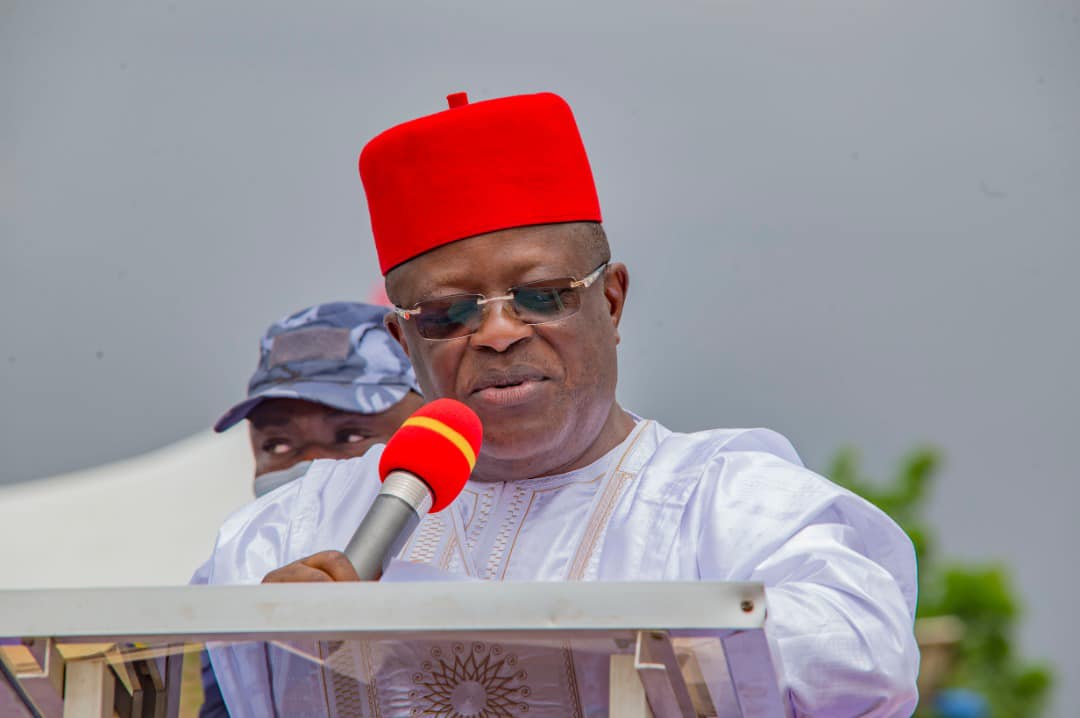
Minister of Works, David Umahi, on Wednesday responded to Senator Enyinnaya Abaribe over his criticism of the multi-trillion Lagos-Calabar coastal road, urging him to study the Procurement Act. Umahi, who stated this during a press conference in Abuja, maintained that due process was followed in the award of the Lagos–Calabar coastal highway project, dismissing allegations of procurement violations.
The minister defended the federal government’s infrastructure projects, particularly in the South-east, describing the claims by Abaribe as an attack on his integrity. He stressed that all statutory requirements, including Environmental and Social Impact Assessment (ESIA), were met.
Umahi stated, “There are three categories of procurement recognised by the Procurement Act. I want Senator Abaribe to go and study it and come back to tell Nigerians whether there was any infringement in the Lagos–Calabar coastal highway.”
The minister said the project was openly advertised, subjected to stakeholder engagement, and certified after an internationally recognised ESIA process. He added that international financiers later adjudged the project “properly packaged, of very high quality, and even undervalued”.
“The project was so credible that when it was presented to foreign financial institutions, it was oversubscribed by over $100 million,” Umahi pointed out.
On project delivery, the minister disclosed that section one of the Lagos coastal road had reached about 85 per cent completion and would soon be opened to traffic. He said the second section was also progressing steadily, while procurement processes were ongoing for other segments.
Umahi highlighted what he described as renewed federal presence in the South-east under President Bola Tinubu, citing major road, bridge, power, and security projects across the zone.
“There was a time the South-east was totally excluded. That has changed. Today, the president has included us, and that inclusion is real and visible,” he said.
He listed projects, such as the Enugu–Onitsha expressway, Enugu–Port Harcourt road, Second Niger Bridge bypass, Abakaliki–Enugu road, and several flyovers and bridges, saying many have either been completed or are at advanced stages.
Umahi stated that increased federal support to states had boosted performance at the sub-national level, pointing to Abia State, as an example.
“The performance you see at the state level is possible because the federal government released more funds to governors,” he said.
On security, the minister disclosed that the president recently approved the establishment of an army training depot in Ebonyi State to help address insecurity in the region. He further declared that ongoing inclusion and infrastructure development had removed the justification for separatist agitation.
“With this level of inclusion, there is no need for Biafra agitation. We are better together in Nigeria,” Umahi said, calling on South-east leaders to speak out against separatist narratives.
While acknowledging that challenges remained across all regions, the minister urged constructive criticism, insisting that the current administration is committed to transparency, national unity, and balanced development.
Minister of State for Works, Bello Goronyo, said Tinubu had demonstrated “uncommon love” for national development through massive investment in infrastructure across all regions.
Goronyo stated, “There is nowhere in this country where projects are not springing up. Nigerians should ask themselves where the president is getting the resources to do all these projects. It is because he wants to develop this country.”
He stressed that infrastructure was the backbone of national prosperity, adding, “There is a Chinese proverb that says infrastructure leads to prosperity. No nation can develop without infrastructure.”
Goronyo cited major road projects across the North-west, including Sokoto, Zamfara, Katsina, Kaduna and Kebbi corridors, stating that some sections have reached about 40 per cent completion with concrete pavements designed to last between 50 and 100 years.
He also commended the president for reviving long-abandoned projects, including the Sokoto–Badagry road corridor, describing it as a dream that lingered for over four decades before the current administration.
The minister praised the security agencies, including the Office of the National Security Adviser, Nigeria Police, and the armed forces, for supporting road inspections and safeguarding construction sites.
However, Goronyo expressed concern over damage to road infrastructure caused by illegal trading, indiscriminate parking of heavy trucks on bridges, and vandalism, calling on Nigerians to take collective responsibility for protecting public assets.
“The president can do all these things, but citizens also have a duty to maintain these roads. Our bridges are not designed for static truck parking,” he said.
He appealed to the Inspector-General of Police to reactivate the Safer Highway Patrol to help protect federal roads nationwide.
Goronyo urged Nigerians to appreciate what he described as “unprecedented infrastructure” delivery under Tinubu, stating that over 1,600 projects are currently ongoing across the country.
He stated, “This is a president with a big heart to unite this country. What we are showing Nigerians is a true reflection of what is on ground.”
Emmanuel Addeh
About the Author