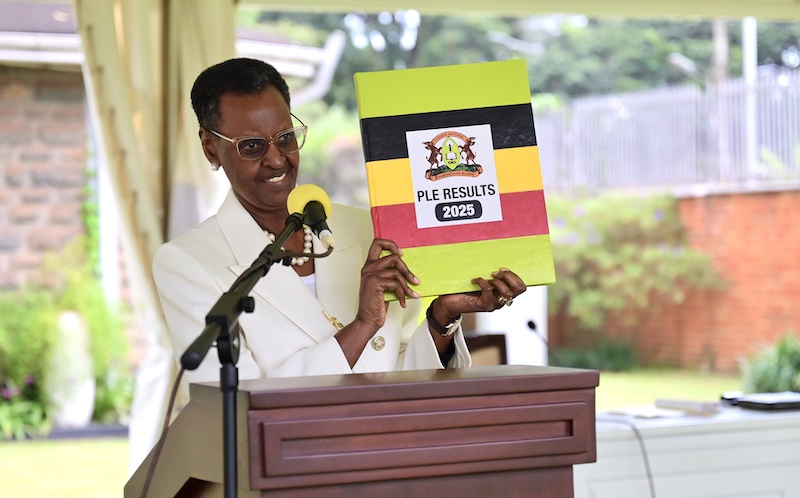
On Friday afternoon, as results from the Primary Leaving Examination (PLE) began circulating across Uganda, the familiar rituals followed.
Parents clustered around noticeboards. Teachers scanned lists for familiar names. In villages and city schools alike, the results marked the end of one chapter and the anxious beginning of another.
But beneath the celebrations and disappointments, the 2025 PLE results tell a deeper, more complicated story about where Uganda’s education system is heading—and where it is still struggling to catch up.
This year, 817,883 pupils sat the PLE, the highest number ever recorded. That figure alone speaks volumes. It represents a 2.6 percent increase from last year and reflects the steady expansion of access to primary education, driven largely by the Universal Primary Education (UPE) programme.
Nearly two in three candidates (63.8%) were UPE beneficiaries, a sign that public schooling continues to carry the weight of Uganda’s education ambitions. Girls remained the majority.
More than half of all candidates (52.4%) were female, continuing a trend that has held for several years. On the surface, this looks like a quiet success for gender parity. But the details complicate that picture.
MANY IN SCHOOL, FEWER TRULY EXCELLING
While more children are reaching the final year of primary school, relatively few are excelling across the board.
Fewer than one in five pupils demonstrated high-level proficiency in all four tested subjects: English, Mathematics, Science, and Social Studies with Religious Education.
Instead, the bulk of candidates—about two-thirds—fell into the “medium ability” range. In simple terms, most pupils showed basic understanding but struggled with deeper reasoning, problem-solving, and applying what they had learned beyond the classroom.
This pattern suggests a system that is succeeding at getting children into school—but still struggling to ensure strong learning outcomes once they are there.
ENGLISH UP, SOCIAL STUDIES DOWN
Performance varied sharply by subject. English was the strongest, with 18.5 percent of candidates reaching the top performance band—a notable improvement from 2024. This suggests gains in reading and language instruction, an encouraging sign in a system where English underpins learning across subjects.
But Social Studies told a different story. It recorded the steepest decline, largely because pupils struggled with questions that required applying knowledge to real- life situations—such as understanding civic rights, climate issues, or national heritage.
According to the Uganda National Examinations Board (UNEB), this points to a slow and uneven shift toward competency-based learning, which emphasizes practical understanding over memorisation.
In many classrooms, especially outside science subjects, teaching methods have yet to fully make that transition. Although more girls sat the exam, boys outperformed girls in most subjects except English. In the top performance bands—Divisions 1 and 2—61.08 per cent were boys, compared with 58.04 per cent girls.
Boys also had a slightly lower failure rate. The gap is not dramatic, but it is persistent. Education experts point to a mix of factors: household responsibilities that fall more heavily on girls, early social pressures, and fewer targeted interventions in subjects like mathematics and science.
The results have renewed calls for gender-responsive teaching, especially in STEM areas, to ensure that increased enrolment for girls translates into equal academic outcomes.
QUIET PROGRESS AT THE MARGINS
One of the most striking—and least discussed—stories in this year’s results is who is being included. The number of Special Needs Education (SNE) candidates rose by 9.3 per cent to 3,636 pupils.
Nearly half of them (48.4%) achieved Division 2, a strong result given the limited resources and support many face. There were also quiet victories behind prison walls.
Inmates from Luzira and Mbarara prisons recorded passes in Divisions 1 and 2, reinforcing the idea that education can be rehabilitative, even in the most restrictive environments. These gains may be small in scale, but they signal a system slowly widening its definition of who deserves access to learning—and success.
WHERE LEARNING BREAKS DOWN
UNEB’s analysis highlights a recurring weakness: application of knowledge. Pupils struggled with practical mathematics like percentages, interpreting written texts, and applying basic science concepts.
Social Studies questions that linked learning to everyday civic life proved especially difficult. The message is clear. Too much learning remains theoretical. Too little is anchored in real-world problem-solving.
This has implications far beyond primary school, affecting how students cope with secondary education, vocational training, and eventually the workplace.
Integrity Under Pressure
The results also exposed ongoing challenges around examination malpractice. UNEB reported cases of bribery, coercion of invigilators, and other evolving forms of cheating. As a result, results from Kampala, Kisoro, and Mukono were withheld pending investigations.
At the same time, districts such as Kyenjojo and Kabarole were praised for reforms and improved compliance— proof that malpractice is not inevitable, but often a matter of local leadership and enforcement.
The tension is familiar: expanding access while protecting credibility. If exams lose public trust, certificates lose their value—and so does the promise education holds for social mobility.
A System at a Crossroads
Taken together, the 2025 PLE results reflect a system in transition. Uganda has made real progress in access, inclusion, and gender parity. But quality remains uneven, and the shift toward competency-based learning is still incomplete.
The challenge now is not simply to enrol more children, but to ensure they leave primary school with skills they can use—to think, reason, and participate meaningfully in society.
As Uganda looks to the future, the lesson from this year’s exams is clear: expansion has opened the door. What happens next depends on whether teaching, curriculum, and accountability can walk through it.
About the Author