On a typical morning in a Ugandan secondary school, the routine is familiar: a teacher walks into the classroom with a handwritten lesson plan, while the chalkboard stands ready for the day’s notes.
If the school is among the fortunate few, there is a small computer lab with outdated equipment. But “having a lab” and “using a lab” are two different things. That single room might be shared by hundreds of eager students.
The internet may work only on some days – if at all. And the electricity could vanish halfway through a sentence, plunging the digital lesson back into the analog world.
For a nation boasting one of the youngest populations on earth, these everyday realities raise an urgent question: how can Uganda prepare millions of young people for a digital economy when the classroom itself is still struggling to stay plugged in?
A mirror to the classroom
We are finally getting a clear look at the scale of this challenge. Between November 2025 and early 2026, a nationwide assessment, implemented by UNICEF, Association of Secondary Schools Headteachers of Uganda (ASSHU) and ministry of Education and Sports in partnership with Mastercard Foundation, unearthed the digital realities and readiness in 3,276 secondary schools.
Covering roughly 78 per cent of the 4,307 long ASSHU secondary school list the study offers the most comprehensive snapshot we’ve ever had of education technology in Uganda.
This wasn’t just a data-gathering exercise for its own sake. The ministry of Education and Sports launched a bold Digital Agenda Strategy (2025–2032), a seven-year roadmap aimed at making high-quality, tech-driven education more than just a luxury for the few.
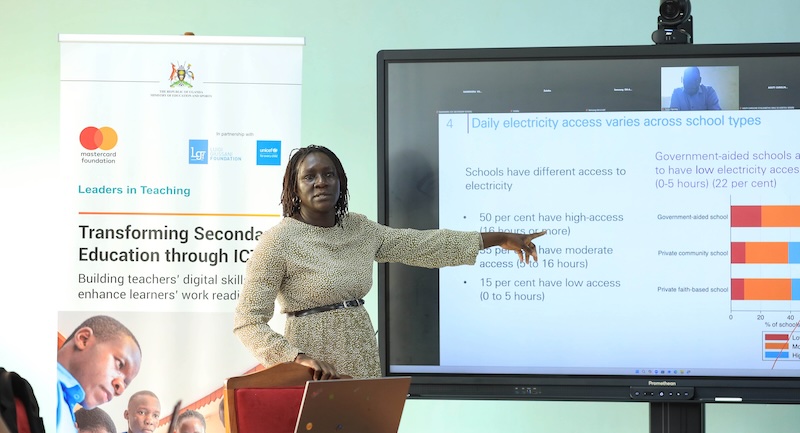
On March 10, 2026, the ICT Innovation Hub in Kampala was busy. Education officials, ASSHU school leaders, and partners from UNICEF, UNESCO, VVOB, gathered to review the findings and validate them.
A system in transition
The findings? Uganda is in the middle of a massive, albeit uneven, digital transition. The good news is that electricity, the literal heartbeat of any digital initiative, has reached most schools.
But “reach” is a flexible term. About half of the schools surveyed have reliable power throughout the school day. Roughly 17 per cent of schools are still living completely off the national grid, surviving on generators or solar panels.
It is a story of progress caught in a tug-of-war with infrastructure. Internet connectivity is even more uneven. More than a third of the schools surveyed have no internet access. In many others, the connection is limited to a single room, usually the computer lab. Only about 12 per cent of schools have internet access across the entire campus.
Even where schools are connected, the quality of the connection can be poor. While many schools can stream simple videos, fewer than half report having internet speeds strong enough to support consistent online learning.
Computers present another challenge. Across the country’s secondary schools, the average ratio is one digital device for every 63 students. Most of those devices are desktop computers stored in laboratories.
About 80 per cent of schools report having at least one computer lab. But the numbers hide big differences. Some schools have 20 computers serving a few hundred students. Others have the same number for more than a thousand learners.
For many teachers, that means digital learning happens only occasionally rather than as part of everyday teaching.
Taken together, Janet Akao Abaneka, UNICEF’s education officer, says the assessment reveals three broad categories of schools. About a quarter of them are considered ICT-ready, meaning they have electricity, computers, and internet connectivity. Another group falls into the middle, schools that have some of these elements but not all. The largest group remains largely unplugged – it lacks the basic infrastructure required for digital learning.
The divide often mirrors Uganda’s geography. Rural schools are more likely to fall into the unplugged category, while urban schools are more likely to have functioning labs and stable connectivity.
Yet despite these gaps, the assessment also reveals a strong belief in the importance of digital skills. Nearly nine in ten school leaders say ICT skills are essential for students’ future employment.

Many schools have begun experimenting with digital learning platforms such as the National Curriculum Development Centre’s e-learning system or private tools like Cyber School Technology. Teachers who use these platforms say they make lessons more engaging and help align teaching with the national curriculum.
But the content available remains limited, and training for teachers has not yet reached the scale required, according to the assessment. In many schools, only a handful of teachers receive ICT training each year.
For policymakers, the assessment has become a guide on how Uganda plans to expand digital learning. Ben Mugisha, a lead ICT specialist and consultant at the ministry of Education and Sports, says the study is helping the government understand what schools need before major investments are made.
“This study is intended to determine what is required on the ground,” he explains. “We are looking at skills, hardware, connectivity, and power so that we can implement the digital agenda based on evidence.”
“Once we have those figures, we can plan properly, Mugisha says.”
The findings will feed into a broader national e-readiness assessment designed to estimate the resources required to implement Uganda’s Digital Agenda Strategy for education over the next several years.
One immediate lesson is that infrastructure decisions must be more precise. Not every school requires the same equipment. Some schools lack electricity entirely, while others have power but need better internet or more devices.
“In some places, the national grid cannot reach,” Mugisha says. “So, we must look at alternatives such as solar energy.”
The assessment is also shaping new policy discussions. Officials are now examining how schools will maintain digital equipment over time, including how to handle computers that become obsolete after several years.
Juliet Atuhairwe Muzoora, commissioner for Government Secondary Education, says sustainability must be built into any digital education strategy.
“When we introduce technologies such as computers or internet services, we must also plan how schools will maintain them,” she says.
The ministry is exploring ideas such as shared ICT hubs where schools can collaborate and support one another. Officials are also considering national standards for devices used in schools to ensure systems are compatible and easier to maintain.
At the centre of many of these efforts is a broader initiative known as the Leaders in Teaching (Litt) Program – ICT component. The five-year program implemented in partnership with Mastercard Foundation, ministry of Education and Sports, and a consortium co led by Luigi Giussani Foundation and UNICEF aims to transform secondary education by strengthening teachers and school leadership.
The program will work with 2,091 secondary schools across Uganda, 10 universities, and 5 teacher training institutions. Its goal is to train 74,800 educators, including both practicing teachers and those still preparing to enter the profession. Dr Tillmann L. Guenther, UNICEF’s adolescent development manager, says the program focuses on the people who shape everyday learning.
“The leaders we are talking about are the teachers and headteachers in classrooms,” he explains. “They are the ones who ultimately determine whether technology improves learning.”
The program operates through four main pillars: recruiting teachers, motivating them, strengthening training, and improving school leadership. Digital technology cuts across all four.
Under the ICT component led by UNICEF, the assessment is already guiding concrete decisions. One example is the selection of 100 schools where new computer labs will be established. Rather than choosing schools randomly, officials will use the assessment data to identify where the need is greatest, whether that means schools with no labs or those where a few computers must serve thousands of students.
“We want to be evidence-driven in how we move forward,” she said. “The data we now have will guide decisions about where and how ICT investments are made,” said Abaneka.
About the Author