Screenshot
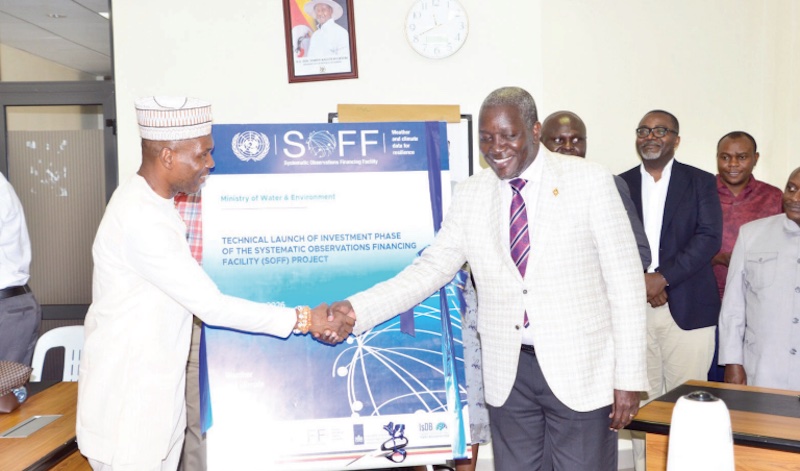
The Department of Meteorological Services (DMS) is set for a major technological improvement following the technical launch of the Systematic Observation Financing Facility (SOFF) project.
The four-year initiative, backed by a $6.3 million (approx. Shs 23.5 billion) grant from the United Nations Multi-Partner Trust Fund (UNMPTF), managed through the SOFF Secretariat, is hosted by the World Meteorological Organisation (WMO).
The SOFF project funds, provided through Islamic Development Bank (IsDB), aims to fix critical gaps in Uganda’s weather monitoring network to ensure compliance with the Global Basic Observing Network (GBON).
It will also ensure that the country’s weather data meet international data-sharing standards. Speaking at the technical launch held at the Ministry of Water and Environment headquarters in Luzira, Kampala, on January 30, Dr Bob Alex Ogwang, the Commissioner for the Department of Meteorological Services, emphasized that the project is a foundational step toward protecting lives through precision forecasting.
A significant portion of the project is dedicated to capacity building. Dr Ogwang highlighted that DMS staff will undergo intensive training in software engineering, station maintenance, and “nowcasting”—the ability to provide highly localized, short-term weather warnings.
This ensures that the technology remains functional long after the initial four-year investment phase ends, providing Ugandans with more accurate and timely alerts for extreme weather events.
FROM PLANNING TO ACTION
Speaking on behalf of the minister of State for Environment (MWE), Beatrice Anywar, the permanent secretary Dr Alfred Okot Okidi declared that the project marks a transition from “planning to action.”
“The onset and cessation of seasonal rainfall have changed; temperatures are gradually rising in all regions of the country,” Dr Okidi noted.
“These changes have resulted in devastating impacts, including loss of lives and destruction of infrastructure. “The SOFF project is designed to bridge the gap in weather data collection, which remains uneven across the country.
According to experts, the current limitations in weather observation coverage have long constrained the accuracy of forecasts for hazardous events.
A GLOBAL COLLABORATION
The project is a result of a strategic partnership between MWE, KNMI, and IsDB. Dr Okidi lauded the IsDB as the implementing entity and the KNMI for its role as a peer advisor. He also credited the World Meteorological Organisation (WMO) for its leadership in the global SOFF initiative.
“This will ensure that every Ugandan is protected by an early warning system that ensures prompt and early actions,” Dr Okidi said.
The head of the Islamic Development Bank and the visiting delegation’s head, Dr Issahaq Umar Iddrisu, hailed Uganda’s environment being the pillar for regional development.
“The Bank selected Uganda because of her favourable environment for investments and development,” Dr Issahaq Umar Iddrisu said, adding that the Bank continues to support Uganda in her journey to achieve Vision 2040.
As the technical launch concluded, officials emphasized that the success of the project would depend on continued collaboration between all the partners to ensure the sustainability of these high-tech systems.
About the Author