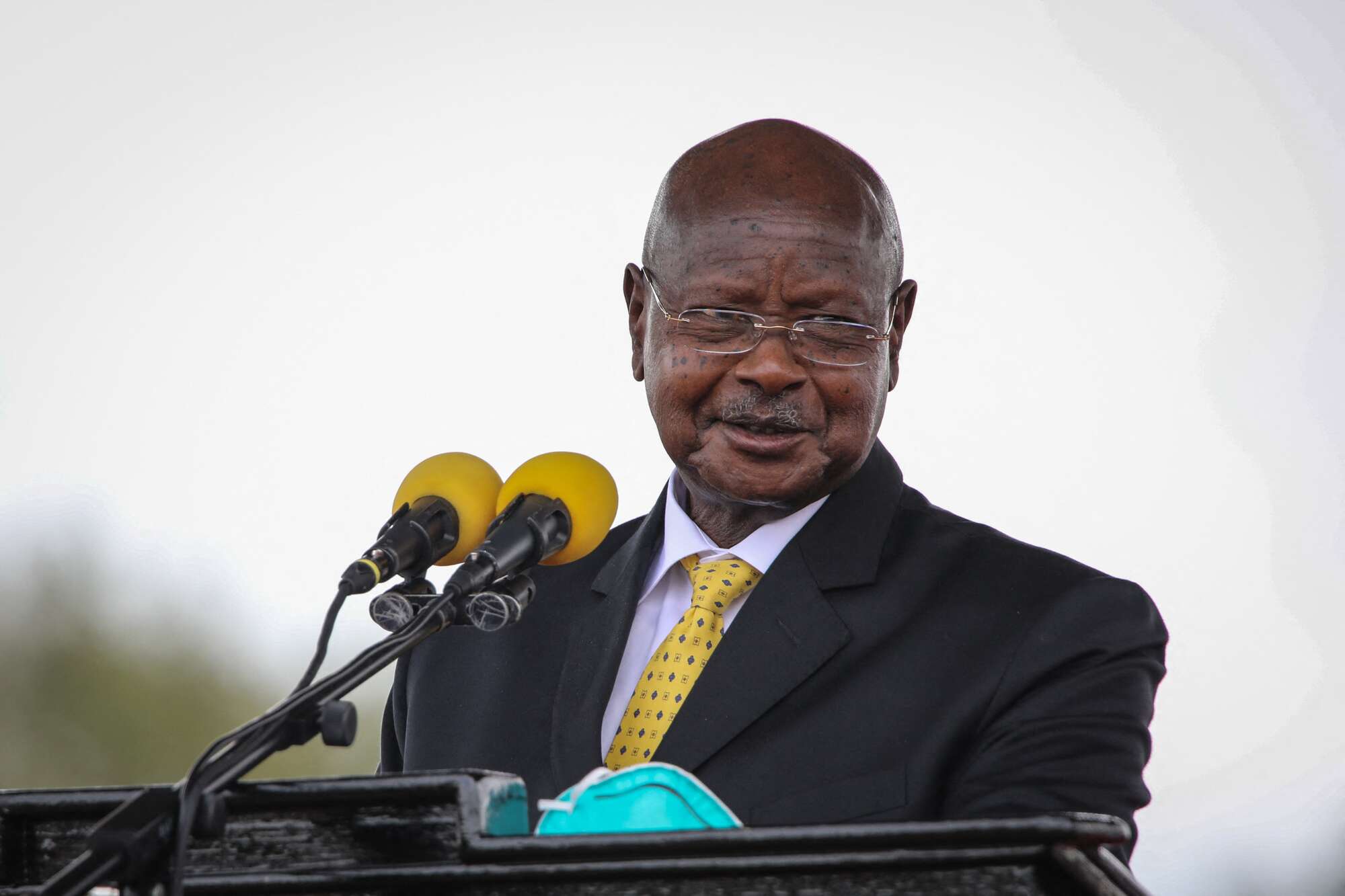
Ugandan President Yoweri Museveni speaks during the inauguration ceremony for his sixth term at Kololo Ceremonial Grounds in Kampala, Uganda, on May 12, 2021. (Photo by Badru KATUMBA / AFP)
Yoweri Museveni’s administration on Monday assured Ugandans of uninterrupted Internet access but also warned it will not hesitate to step in and shut it down once abused during the polls that kick off next Thursday.
Mr Nyombi Thembo, the Uganda Communications Commission (UCC) executive director, told journalists at the government-run Uganda Media Centre in Kampala on Monday that the regulator had not received any instruction from the government to disrupt internet services as Ugandans head to the 2026 General Election.
A January 2 unsigned document, titled, Public Notice, which Mr Nyombi dismissed as false and misleading, had warned of disruption to internet access, mobile money and banking services as the country heads to the January 15 elections.
But Mr Nyombi reassured that the government won’t switch off the internet during the General Elections that kicks off Thursday next week and run until February 6.
“We have not got any directive from the government to switch off the internet during or after the elections,” Mr Nyombi said. He added: “Nobody in the government has told UCC to prepare or do anything related to an internet shutdown. If such a decision were to be taken, UCC would come out earlier to brief the country and explain why.” Mr Nyombi said internet services would remain stable and urged media houses, digital users, and consumers to use the online platforms responsibly to avoid actions that could prompt regulatory intervention.
“Anybody who would weaponise our internet to do things that would be a problem to the country will be the one to blame for any disruption,” he warned. He also called on Ugandans to remain calm and operate within the existing UCC regulations. Despite UCC’s reassurance, public anxiety remains uneasy following previous experience with the 2021 General Election, when the government imposed a nationwide internet blackout just a day to the presidential polls, affecting Twitter, now X, Facebook, WhatsApp, and Instagram users, among other social media platforms.
A year later, a report dubbed, Global Cost of Internet Shutdowns, published by TOP10VPN, a tech firm that tracks internet disruptions across the globe, showed that Uganda lost more than Shs390 billion due to the 100-hour shutdown, which affected an estimated 10.6 million users across the country. The report also showed the shutdown led to a surge in demand for Virtual Private Networks (VPNs) by 1,343 percent, with telecom companies and banking sectors bearing the brunt of the shutdown.
No live streaming, broadcasts
At the same briefing, Dr Aminah Zawedde, the ICT and National Guidance ministry permanent secretary, cautioned media practitioners and digital users against live streaming and broadcasting of riots, unlawful processions, and violent incidents. “Broadcasters and online media practitioners are reminded that live broadcasting and streaming or streaming of riots, unlawful processions, and violent incidents are prohibited, as they can escalate tensions and spread panic,” Dr Zawedde said. She added: “The dissemination of inciting, hateful, or violent content is unlawful and attracts enforcement action.” Dr Zawedde urged all stakeholders to use digital and broadcast platforms in the interest of truth, stability, and the public good, warning that irresponsible use could undermine the credibility of the electoral process.
“Freedom of expression must be exercised responsibly and within the framework of the law. Any violations will be addressed in accordance with the law, including regulatory sanctions where necessary,” Dr Zawedde said. She also cautioned politicians, journalists, and the public against sharing unverified or premature election results. Dr Zawedde urged stakeholders and the general public to rely on only official declarations by the Electoral Commission (EC).
“As we move closer to the polling day, I urge media owners, editors, journalists, digital publishers, and the public to rely on verified information and official sources and act responsibly online and offline and reject misinformation intended to cause fear or division,” she said.
Mr Nyombi said the government is yet to issue a licence to Starlink Global Internet Services Ltd, which will enable the satellite internet provider to fully operate in Uganda. Starlink applied for the licence more than two years ago. The UCC executive director said the delay was forced by Starlink’s failure to fully meet pre-licensing requirements, particularly those related to enhancing connectivity in hard-to-reach areas. “Licensing is not a one-off event. It involves several processes. We asked Starlink for documentation and clarification, and they have provided most of the information. We are yet to clear them,” Mr Nyombi said.
He said the delay was not linked to the 2026 elections but to regulatory requirements under the UCC Act and Licensing Regulations, which apply to both local and foreign service providers. Mr Nyombi’s comments come a few days after a leaked memo issued on December 19, 2025, by the Uganda Revenue Authority (URA), instructing customs officers to restrict the importation and clearance of Starlink communication equipment unless accompanied by a clearance letter from the Chief of Defence Forces (CDF), Gen Muhoozi Kainerugaba. The directive kicked up a public debate and concern about why the Gen Muhoozi-led Uganda Peoples’ Defence Forces (UPDF) would involve itself in the importation of civilian communication gadgets.
Several Ugandans interpreted the move as part of the broader efforts to control information flow ahead of next week’s presidential and parliamentary elections, amid fears of a potential repeat of the internet shutdown during the 2021 polls. Starlink has since come out to emphasize that any prior use of its services in Uganda was without the company’s approval, hence violated its terms of service, as the same happened before the completion of the regulatory licensing. The US-based company said it’s still engaging with the Ugandan authorities to finalise the licensing process before any lawful rollout of its services in the country.
Search for options
The fear of a shutdown has left Opposition politicians and human rights activists weary. At the weekend, the leader of the largest Opposition political party, the National Unity Platform (NUP), Mr Robert Kyagulanyi, alias Bobi Wine, launched an offline vote-monitoring application (app) known as “Bitchart” aimed at facilitating communication and tracking the election results next week. Mr Kyagulanyi said the app is designed to operate without internet access, relying on Bluetooth technology to share information such as images of Declaration Results Forms, election updates, and other related polling day data.
About January 15, 2026 polls
Ugandans head to the polls on January 15, 2026, to elect a president, Members of Parliament (MPs), and local government leaders across cities, municipalities and districts for another five-year term. According to the EC data, there are 21,681,491 million registered voters.
The Commission has nominated 83,597 candidates to contest for 45,505 positions across presidential, parliamentary, and local government elections. Eight candidates are running for the presidency, including incumbent Museveni of the National Resistance Movement (NRM), Mr Robert Kyagulanyi Ssentamu of the National Unity Platform (NUP), Mr Nathan Nandala Mafabi of the Forum for Democratic Change (FDC), and Mr Mugisha Muntu of the Alliance for National Transformation (ANT). Others are Mr Robert Kasibante (National Peasants’ party), Mr Mubarak Munyagwa (Common Man’s party), Mr Frank Bulira (Revolutionary People’s party) and Mr Joseph Mabirizi (Conservative party)
About the Author