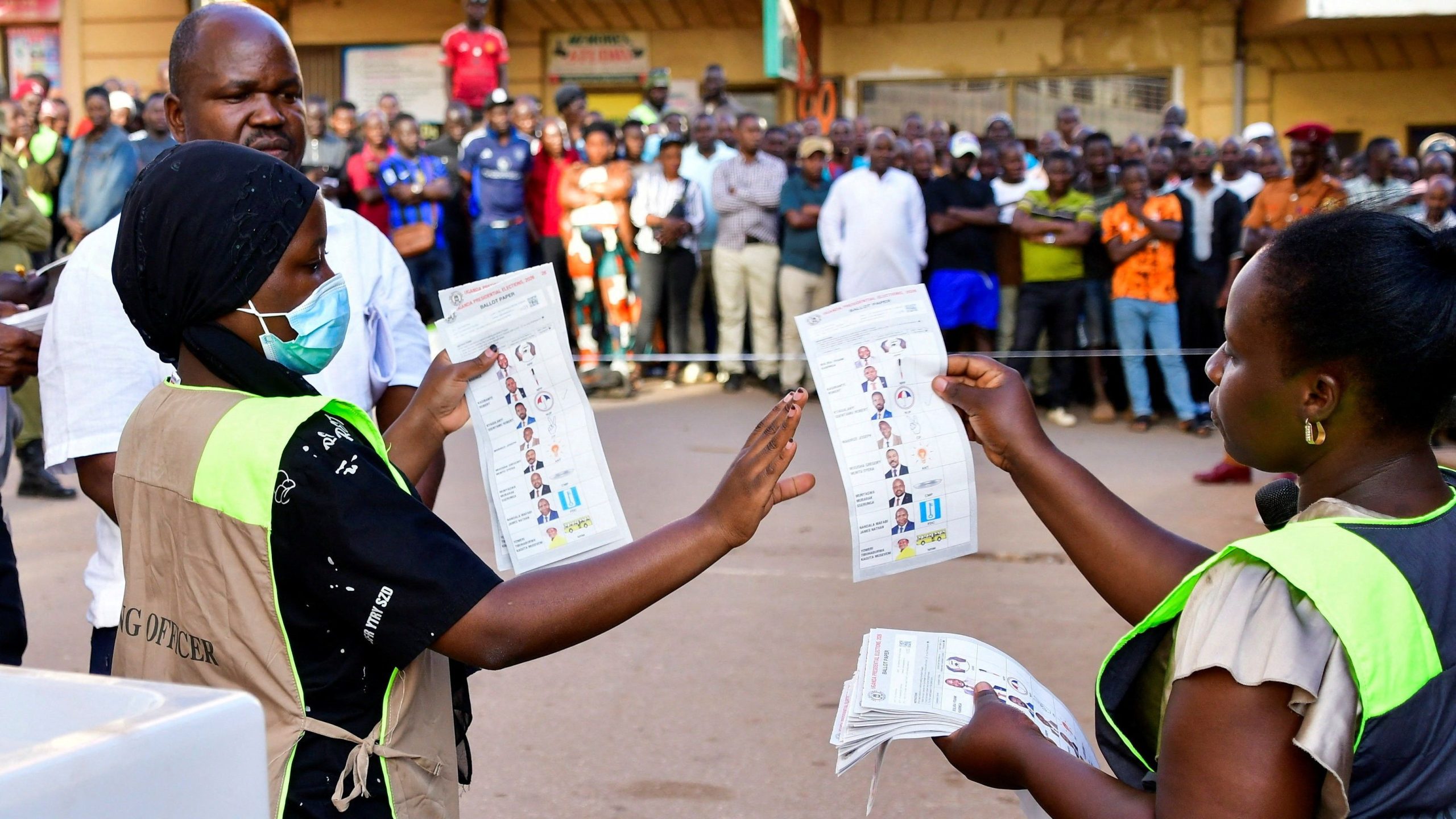
Votes are being counted across parts of Uganda after presidential and parliamentary elections marked by delays, an internet shutdown and opposition allegations of rigging.
Presidential challenger Bobi Wine alleged widespread irregularities during the vote, claiming serious malpractice without providing documentary evidence.
“Massive ballot stuffing reported everywhere,” Wine said in a post on social media.
The authorities have not responded to his allegations of electoral fraud, nor to his claim that “many” polling agents and supervisors from his National Unity Platform party were “abducted, and others chased off polling stations”.
Voting was disrupted by delays of up to 4 hours in some areas, which officials blamed on malfunctioning biometric machines used to verify voters’ identities. Some voters and observers linked the problems to the nationwide internet shutdown, shortages of voting materials and equipment failing to arrive at polling units on time.
As a result, several polling stations closed later than scheduled. The electoral commission said anyone who joined the queue by 17:00 local time was allowed to vote. Earlier, the commission apologised for what it described as “technical glitches” and said efforts were underway to resolve them.
Uganda’s long serving leader Yoweri Museveni, 81, who has been in power since 1986, is seeking a seventh successive term. He is facing a challenge from Wine, a 43 year old pop star turned politician.
The electoral commission said the presidential results would be announced by 16:00 local time on Saturday.
In Kampala, voting had ended by 18:00 local time at polling stations visited by the BBC, despite the delays. While official turnout figures have not been released, the disruptions suggested some voters may have left without casting ballots.
Others expressed frustration but remained determined to vote.
“I’m angry because I have not voted up to now. We are meant to start at seven, but up to now [08:00] we haven’t started. The ballots papers are not even there, I don’t even know what to say,” said Kaweesi Ismail, a voter in Kampala.
Election chief Simon Byabakama ordered officials to rely on the national voters’ register where biometric verification failed. The problems appeared to affect both governing party strongholds and opposition areas.
Casting his vote in Rwakitura Village in western Mbarara region, Museveni said he also encountered difficulties.
“I put my thumbprint on the machine but it did not accept it. However, my face was accepted instantly by the machine. The machine works,” he said.
Asked whether he would accept the election outcome, the president added: “This is one of the manipulations we have to find out why, what was the problem?”
“We are now verifying whether this was deliberate,” he said.
Although the contest is largely seen as a two candidate race between Museveni and Wine, analysts say the president is likely to extend his rule, having won all 6 previous elections.
Wine has pledged to fight corruption and push through wide ranging reforms, while Museveni argues he remains the main guarantor of stability and development.
The campaign period was marked by repeated disruption of opposition activities. Security forces have been accused of assaulting and detaining Wine’s supporters. Police spokesperson Kituuma Rusoke rejected those claims, accusing supporters of the National Unity Platform of being disruptive.
Internet access was suspended earlier in the week. Uganda’s Communications Commission said the move was necessary to prevent misinformation, fraud and incitement to violence, a decision condemned by the UN human rights office as “deeply worrying”.
The NUP dismissed the explanation, accusing authorities of trying to prevent the opposition from mobilising and sharing evidence of alleged fraud. The party said it launched an offline vote monitoring app called Bitchat, which uses Bluetooth to share images of results forms and voting data without internet access.
Museveni, a former guerrilla leader, has benefited from constitutional amendments removing age and term limits, allowing him to continue running for office.
Wine, whose real name is Robert Kyagulanyi, lost to Museveni in the 2021 election and rejected the outcome, alleging fraud.
Alongside the 2 frontrunners, 6 other candidates are contesting the presidency. Voters are also choosing a new parliament, with 353 seats at stake.
For many voters, the economy remains the top concern. Uganda’s population is largely under 30, and while average incomes are rising, job opportunities remain limited. Concerns over infrastructure, education and healthcare access have also featured prominently.
Human rights groups including Amnesty International and the United Nations say opposition supporters have faced escalating harassment, including arrests on politically motivated charges. Amnesty described the conduct of security forces during the campaign as “a brutal campaign of repression” ahead of the vote.
Faridah Abdulkadiri
About the Author