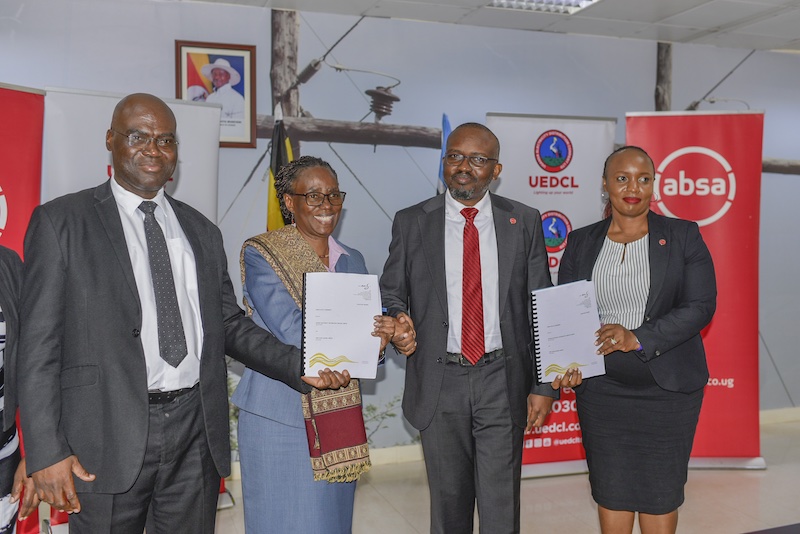
Uganda Electricity Distribution Company Limited (UEDCL) and Absa bank have signed a memorandum of understanding that grants the power distributor a loan of Shs 190 billion ($50 million) to upgrade the country’s electricity distribution network.
This signing comes as the ministry of Energy and Mineral Development and the ministry of Finance, Planning and Economic Development, who are shareholders in the power distributor, approved UEDCL’s request to borrow from Absa bank to put in place a reliable, affordable and efficient power distribution network.
Speaking at the event, Paul Mwesigwa, the managing director of Uganda Electricity Distribution Company Limited, noted that the loan agreement with Absa bank will benefit Ugandans, and it shows that UEDCL can get the capital needed to upgrade the distribution network from financial institutions such as Absa.
“So, it is quite important that we celebrate this milestone, and we believe it is for the benefit of the country at large. At UEDCL, we are very proud that the bank, having done an assessment of our governance, seen our creditworthiness, and how we manage the business, has done an assessment, and this loan is tagged to our balance sheet. That is a fundamental demonstration that a government company can go to the market, look for the funding, and the money is tagged on the balance sheet because of the performance of the institution, and we pray that we shall not misbehave,” Mwesigwa said.
He added: “We shall be able to put this money to use and also pay back it in time because, in our funding portfolio, we have just done our five-year strategic plan, and the network needs about $995 million in the next five years,” Mwesigwa noted.
Mwesigwa highlighted that the funds are going to be used to finance projects such as substations, and improving both the feeders and transformers that are overloaded.
“In the pipeline are several areas that have been heavily affected, including Kasangati and Gayaza, where the allocated funding will be used to construct a substation around Magigye and Kasangati. In addition, Nakasero hill, Kololo, William street, and Makerere have been earmarked for a fairly large substation at Nakasero hill aimed at stabilizing power supply within Kampala’s urban centers.”
Mwesigwa noted that further designs also cover areas in Mukono, Nantabulirwa village and surrounding locations. As a result, within the next two years, he expects most parts of the country to experience improved and stable electricity supply.
Mwesigwa further noted that the benefits of this partnership to the country highlighted that the reduction in the financing source from 28 per cent to eight per cent has a fundamental payback to the population in the form of lower tariffs, while at the same time stabilizing the electricity network.
He emphasized that the country’s energy supply has increased as a result of network optimization, with power supply rising by 13 per cent to a peak of 1,115 megawatts from 986 megawatts in the short term.
Mwesigwa also pointed out that although increased power purchases from the transmission system have at times placed stress on the network, funding of this nature will help normalize those pressures, strengthen system reliability, and ensure sustainable supply.
He added that this makes the partnership a positive step forward, one that will deliver long-term benefits to the country and its population. Speaking at the event, UEDCL board chairperson Lydia Ochieng-Obbo lauded the partnership with Absa bank, saying this is another example of how the private sector can work with government entities.
David Wandera, the chief executive officer of Absa, noted that Absa bank strongly believes that electricity ignites growth by supporting industrial growth and development and improving the livelihood of Ugandans.
“In Absa, we believe that we are part of or partners in empowering Uganda’s tomorrow. We are proud that in partnering with UEDCL through this facility, we are playing a significant role in transforming the sector, the industrial sector, people’s livelihoods and the growth of the country.”
About the Author