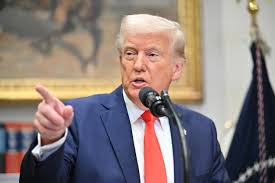
The US Supreme Court has agreed to hear a landmark case challenging the legality of President Donald Trump’s directive to restrict birthright citizenship, a move that could reshape one of the most enduring pillars of US constitutional law.
On Friday, the justices accepted an appeal filed by the Justice Department after a lower court blocked Trump’s executive order instructing federal agencies not to recognize the citizenship of children born on US soil unless at least one parent is an American citizen or lawful permanent resident.
The Supreme Court’s decision to take up the case places it at the center of a constitutional battle that could redefine the interpretation of the 14th Amendment, ratified in 1868 after the Civil War.
The lower court had ruled that Trump’s policy violated both the 14th Amendment and federal law, siding with parents and children whose citizenship rights were at risk.
The plaintiffs, part of a nationwide class action, argued that the president overstepped his authority by attempting to alter a constitutional guarantee.
The justices are expected to hear arguments during the current term, with a final ruling anticipated by the end of June. A date for oral arguments has not yet been set.
Trump signed the directive on January 20, his first day back in office, as part of a sweeping set of measures aimed at reducing both legal and illegal immigration—issues that have long fueled political debate. Critics have accused him of using immigration policy to target racial and religious minorities.
For more than a century, the 14th Amendment has been widely understood to grant automatic citizenship to anyone born in the United States.
The Trump administration argues, however, that the clause does not extend to children of immigrants who are in the country illegally or temporarily, such as students or visa holders.
White House spokesperson Abigail Jackson said the case carries “enormous consequences for the security of all Americans and the sanctity of American citizenship,” adding that the administration looks forward to making its case before the Court.
Civil rights groups strongly oppose the directive. Cecillia Wang, national legal director of the American Civil Liberties Union and attorney for the plaintiffs, said: “No president can change the 14th Amendment’s fundamental promise of citizenship. We look forward to putting this issue to rest once and for all in the Supreme Court this term.”
The administration contends that longstanding interpretations of birthright citizenship have encouraged illegal immigration and facilitated “birth tourism,” in which expectant mothers travel to the US to secure citizenship for their children.
Opponents, however, cite the 1898 Supreme Court ruling United States v. Wong Kim Ark, which affirmed that children born in the US to non-citizen parents are entitled to citizenship under the 14th Amendment.
They also argue that Trump’s order violates the Immigration and Nationality Act, which codifies the established interpretation of the Citizenship Clause.
This is not the first time the Supreme Court has been drawn into Trump’s battle over birthright citizenship. Earlier this year, the administration challenged the authority of lower courts to issue nationwide injunctions against presidential policies.
In June, the Court limited the scope of such injunctions but left the underlying citizenship question unresolved.
The Supreme Court has recently sided with Trump in several immigration disputes, allowing contested policies to take effect while legal battles continue, including ending certain humanitarian protections, expanding deportation powers, and permitting aggressive domestic enforcement actions.
With the question of birthright citizenship now before the nation’s highest court, a defining constitutional issue is set for resolution—one that could shape the legal framework of American identity for generations to come.
About the Author