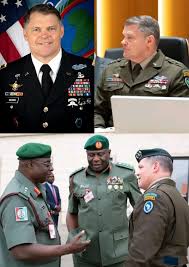
As militant violence continues to threaten stability across West Africa, the United States has reinforced its security partnership with Nigeria by expanding intelligence sharing and increasing military support as part of a broader counter-terrorism strategy.
U.S. Africa Command (AFRICOM) Deputy Commander, Lieutenant General John Brennan, said the enhanced cooperation includes additional deliveries of military equipment and expanded intelligence sharing to support Nigerian operations against Islamic State–linked groups. He noted that U.S. assistance is focused on helping Nigerian forces conduct air and ground operations in both the northwest and northeast of the country.
Brennan said American support following recent U.S. strikes in northwestern Sokoto State would center on intelligence cooperation to aid Nigerian air operations. He added that similar support is ongoing in the northeast, where Boko Haram and its splinter faction, the Islamic State West Africa Province (ISWAP), have carried out a prolonged insurgency since 2009. He described ISWAP as the most serious militant threat in the region.
“From Somalia to Nigeria, the problem set is connected. So we’re trying to take it apart and then provide partners with the information they need.
“It’s been about more enabling partners and then providing them equipment and capabilities with less restrictions so that they can be more successful”, he added.
Political sensitivities were evident during a recent U.S.–Nigeria Joint Working Group meeting in Abuja, where U.S. Under Secretary of State Allison Hooker urged Nigerian authorities to improve protection for Christian communities.
Brennan later clarified that U.S. intelligence support is not limited to protecting any particular religious group.
Beyond Nigeria, Brennan said the United States continues limited intelligence engagement with military authorities in parts of the Sahel, including Burkina Faso, Mali and Niger, despite reduced formal cooperation following military coups in the region.
“We have actually shared information with some of them to attack key terrorist targets. “We still talk to our military partners across the Sahelian states, even though it’s not official”, he said.
He also ruled out establishing new U.S. military bases in West Africa, saying Washington is focused on providing targeted support rather than maintaining a permanent military presence.
About the Author