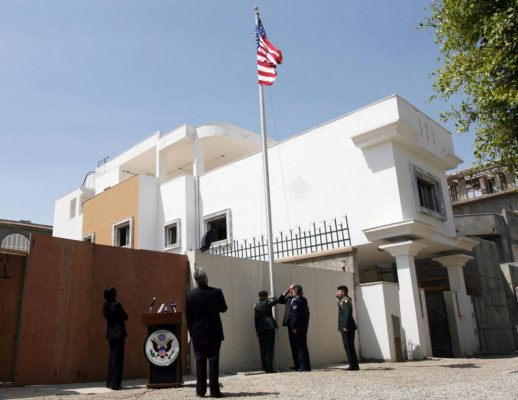
The United States Embassy in Nigeria has cancelled all visa appointments scheduled for Wednesday, March 4, 2026, citing the heightened risk of protests in Abuja amid escalating global tensions following the conflict between the United States and Iran.
In a statement published on its website, the embassy warned of potential demonstrations within the Federal Capital Territory and advised American citizens in Abuja to remain indoors.
“The U.S. Embassy in Abuja informs U.S. citizens that there is a high potential for protests in Abuja tomorrow due to the current conflict with Iran,” the statement read. The embassy further noted that previous protests by some groups had occasionally escalated into violent clashes involving security forces.
As a precautionary measure, the embassy urged all U.S. citizens residing in Abuja to stay at home on Wednesday, March 4, 2026.
The advisory follows the killing of Ali Khamenei, Iran’s Supreme Leader, in airstrikes reportedly carried out jointly by the United States and Israel.
The strikes also reportedly claimed several other high-ranking Iranian officials, triggering swift military retaliation from Tehran, which responded by launching missiles targeting U.S. military installations across parts of the Gulf region, including Saudi Arabia.
The escalating confrontation, which began with the coordinated U.S.–Israeli operation over the weekend, has entered its fifth day with no clear sign of de-escalation.
Donald Trump stated that negotiations with Iran were no longer possible, despite earlier diplomatic signals from Tehran suggesting willingness to engage in talks.
In a post on Truth Social, Trump wrote, “Their air defence, air force, navy, and leadership are gone. They want to talk. I said ‘Too late!’”
The remark followed an earlier statement in which he suggested openness to dialogue, even as joint U.S.–Israeli military operations against Iran continued.
Trump told reporters at the White House during a meeting with Friedrich Merz that the strikes had inflicted extensive damage on Iranian military infrastructure.
“Just about everything has been knocked out,” he said, adding that intelligence indicated Iran may have been preparing to launch an attack prior to the strikes. This comment appeared to contrast with earlier remarks by Secretary of State Marco Rubio, who suggested that Israel initiated the operation.
Trump further claimed that the pre-emptive strikes may have forced Israel’s strategic hand.
Addressing concerns over potential leadership succession in Iran, Trump warned that the worst-case scenario would be the emergence of another leader similar in ideology to the late Khamenei.
“I guess the worst case would be that someone even more hardline takes over. That is something we want to avoid,” he said.
The U.S. president also claimed that two waves of airstrikes had eliminated individuals previously considered potential successors to Khamenei.
Meanwhile, Iranian authorities rejected any possibility of negotiations with Washington, with senior aide Mohammad Mokhber stating that Iran had “no basis for talks” with the United States, adding that the country was prepared to sustain its resistance.
Iranian state authorities announced a three-day funeral programme for Khamenei, who died at the age of 86. The state funeral will begin with public mourning rites at the Imam Khomeini Grand Mosque in Tehran before his burial in his hometown of Mashhad.
About the Author