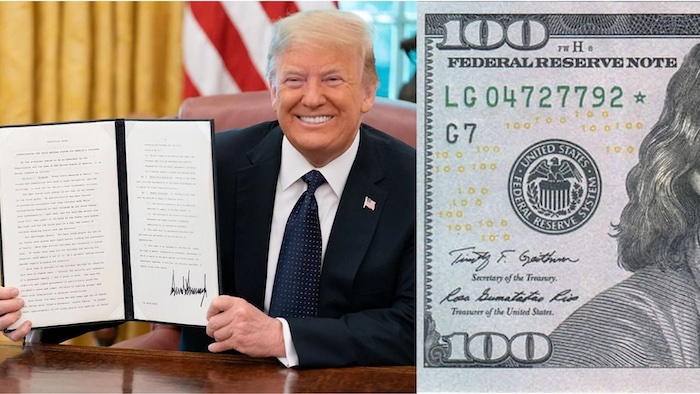
The United States Department of the Treasury has announced that future U.S. paper currency will carry the signature of Donald Trump — a historic move that will make him the first sitting American president to have his signature printed on circulating banknotes.
Traditionally, signatures appearing on U.S. dollar bills belong to the Treasurer of the United States and the Treasury Secretary. Under the new arrangement, Trump’s signature will replace that of the Treasurer, while the signature of current Treasury Secretary Scott Bessent will remain.
According to the Treasury Department, the first redesigned notes — beginning with the $100 bill — are expected to enter production in June 2026 as part of activities marking the 250th anniversary of American independence, also known as the semiquincentennial.
In a statement announcing the decision, Bessent said the move reflects what the administration describes as a defining period in U.S. economic policy.
“Under President Trump’s leadership, we are on a path toward unprecedented economic growth, lasting dollar dominance, and fiscal strength and stability,” Bessent said.
He added that placing Trump’s name on U.S. currency was intended to symbolize what officials describe as a historic national milestone.
“There is no more powerful way to recognize the historic achievements of our country and President Donald J. Trump than U.S. dollar bills bearing his name.”
The decision marks a major departure from a 165-year tradition in which only Treasury officials signed U.S. paper currency. While the portraits and main design of the notes will remain unchanged, the signature change represents one of the most visible symbolic alterations to American money in modern history.
The announcement also follows recent moves to introduce commemorative currency linked to the 250th anniversary, including a proposed gold coin featuring Trump’s image. Unlike circulating paper notes, however, federal law still prohibits the portrait of a living president from appearing on standard U.S. currency.
Critics have described the development as another example of Trump placing a personal stamp on national institutions, while supporters argue it reflects his political and economic legacy during a landmark period in American history.
About the Author