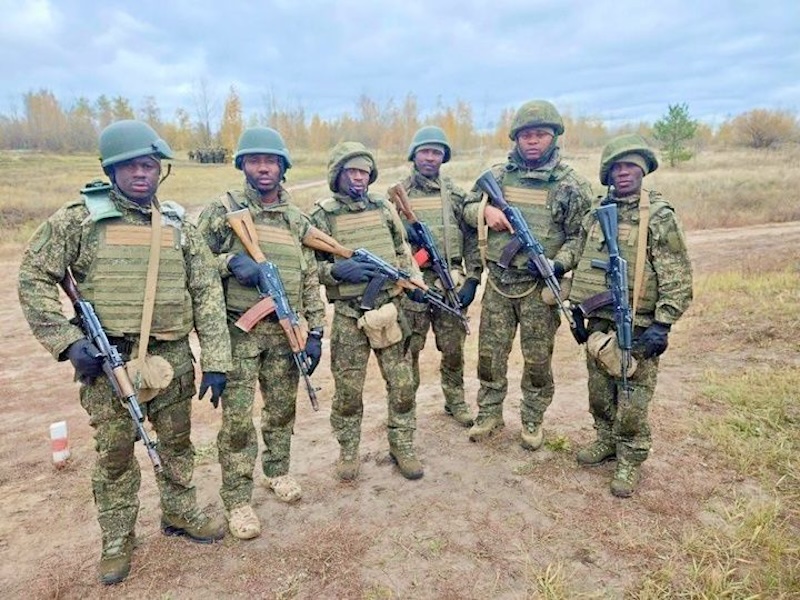
Two more Ugandans have been killed while fighting on the Russian side in Ukraine, a new report indicates.
A report titled ‘The Business of Despair’ released on February 11, 2026, indicates that seven Ugandan nationals were recruited to fight on the side of Russian forces in Ukraine and of these, two were killed. The investigative report was authored by a Swiss non-government organisation called INPACT.
Those killed, according to the report, are 44-year-old Michael Atuhaire and 38-year-old Ashraf Damulira. This brings to three the number of Ugandans reported killed in Ukraine, although the government of Uganda said it was unable to repatriate the bodies of Ugandans who fell at the battle front in Ukraine.
Speaking to the Daily Monitor on February 8, foreign affairs state minister Henry Okello Oryem said the government was unable to repatriate the bodies of such people. Oryem’s comments came after he was contacted over the death of Edson Kamwesigye, who was killed in early February in Ukrainian strikes while fighting in the Russia-Ukraine war.
Kamwesigye’s family was seeking government support to help them repatriate the body of their son. Kamwesiga reportedly died in Kupiansk, in Ukraine’s Kharkiv region, an area that has seen intense fighting between Russian and Ukrainian forces. His death was confirmed through identification details and images circulating on social media.
Identification details shared on social media indicate that he was from Kibombo village, Nyakaina parish, Buyanja sub-county, Rukungiri district. He was born on June 19, 1980. When contacted about the matter, Uganda’s Embassy in Moscow said matters pertaining to Ukraine were transferred to Uganda’s Embassy in Berlin. Efforts to get a comment from the embassy in Berlin were futile.
Although the actual number of Ugandans fighting on the Russian side in Ukraine is not known, videos of men singing Luganda and Swahili songs have emerged online. At the height of the illegal recruitment across Africa in August 2025, Uganda’s security intercepted a group of Ugandans who were en route to the Ukraine war through Moscow.
Two suspected Russian recruiters were arrested but later released. After the incident, the Chief of Defence Forces (CDF) Gen Muhoozi Kainerugaba warned Ugandans against being recruited. After the arrest, Muhoozi warned Ugandans against being recruited as mercenaries in foreign wars.
In a message posted on his X page after the incident, Muhoozi warned: “Ugandans are forbidden from being recruited to participate in the Russia-Ukraine conflict. Anyone who dares will be punished severely.”
Despite the CDF’s warning, it appears some Ugandans used other means to leave the country. In February this year, videos of men dressed in military wear in a snowy wilderness singing Ugandan war songs in Luganda and Kiswahili surfaced online.
Kenya most affected in East Africa
The country that lost the most citizens at the war front was Kenya with 10, followed by Burundi with six, DR Congo with three and Uganda with two. Rwanda, Somalia and South Sudan had none.
Continental problem
According to the INPACT investigative report, migration to Europe, investigators obtained several files containing lists of recruits from Africa, including one more comprehensive file with a list of 1,417 nationals from African countries with their full names, date of birth, military registration number, the date they signed their military contract in Russia, and their citizenship.
“A second list detailing those killed in action. It includes the name, date of birth, military service number, contract signing date, recorded date of death, number of months enlisted before death, citizenship, and unit of affiliation within the Russian army,” the report read.
The report also detailed the number of Africans who have been killed at the frontline in Ukraine. According to the analysis, the countries with a significant number of citizens at the Ukraine-Russia war from are Egypt with 361, Cameroon 335 and Ghana 234. Othe
The same report indicates that at 94, Cameroonian nationals suffered the highest number of deaths, followed by Ghanaians at 55 and Egyptians (52). According to the report, in the 18-25 age group, 60 African recruits were killed in action in Ukraine, with the number of listed recruits killed while fighting in the Russian army totalling 316.
“The duration of service of those killed in action averages only six months, highlighting the fate of many African recruits as cannon fodder for the frontline. Over 50 recruits served only a month before being killed (51 total), while the longest duration listed was 19 months, undertaken by an Egyptian national and another from Benin before their deaths,” the report read.

The report indicated that recruits killed in action came from 37 different military units. Most of these units were involved in costly assaults in Ukraine, such as the 1008th Motorised Rifle Regiment of the 6th Motorised Rifle Division of the 3rd Army Corps, to which five soldiers killed in action were attached.
The 3rd Army Corps regiment was involved in notable battles west of Klishchiivka in February 202429 and south of Chasiv Yar30 in October 2024. The highest number of deaths took place in the 7th Independent Motorised Rifle Brigade of the 3rd Army, accounting for 49 recruits killed in action.
South Africans rescued
French news agency AFP reported on Tuesday that South Africa’s president Cyril Ramaphosa expressed “heartfelt gratitude” to his Russian counterpart Vladimir Putin for the return of men who were lured into fighting alongside Russian forces in Ukraine.
Pretoria in November said it had received “distress calls” from 17 men who were trapped in the epicentre of the fighting in Ukraine’s Donbas region after being tricked into joining mercenary forces.
Four of the men landed back home last week, and 11 were expected to return soon, according to the presidency, while two remained in Russia.
“President Ramaphosa has expressed his heartfelt gratitude to President Vladimir Putin, who responded positively to his call to support the process of returning the men home,” the presidency said in a statement.
“The investigation into the circumstances that led to the recruitment of these young men into mercenary activities is ongoing,” it said.
South African law prohibits its citizens from fighting for a foreign country’s army without government authorisation.
Girls not left out
Three months after Russia’s invasion of Ukraine, the country rolled out the Alabuga Start programme, a work study programme that targets girls aged 18-23 from developing countries such as Uganda, Kenya, Rwanda, Phillipines, Tanzania, South Africa, South Sudan, among others. In Uganda, it is advertised as a scholarship on the ministry of Education website. So far, Uganda has sent 267 girls.
However, the scheme has come under attack by rights organisations that describe it as a tool for mobilizing cheap labour for war factories located in Russia’s Tartarstan region.
In 2024, the Institute for Science and International Security (ISIS), an organisation based in Washington DC, released a report indicating that the programme was used to recruit foreigners to the factories that produce Shahed-136 drones for the Russian military, which has been on a full-scale fight with Ukraine since February 23, 2022 (exactly four years ago).
The rights organisations say the factories in Tartastan are a legitimate target by Ukraine, exposing the girls, who are living in nearby hostels, to attacks.
Since April 2024, Ukraine has carried out drone strikes on Tartastan, injuring an unspecified number of people, including Africans housed there. The most recent attack on Tartastan took place three days ago when a Ukrainian drone hit an oil facility.
Russia bans recruitment
On Wednesday, an investigation carried out by an independent Russian news website Important Stories found that a “blacklist” of countries from which Russian recruiters are no longer allowed to hire fighters began being distributed last month. The report, published on Monday, said the list contains 36 countries, mostly in Africa and Asia.
Among the blacklisted countries are key Russia allies China and Iran, as well as Qatar, Saudi Arabia, Syria, Afghanistan, Brazil, Venezuela and Cuba, the outlet reported.
Notably, one member of the NATO military alliance also appears on the list, with Turkish nationals being among those barred from signing contracts with the Russian military, according to Important Stories.
About the Author