Screenshot
Ndibalekera Maria Judith, “Counselor,” as everyone in her neighbourhood in Kisenyi, Kampala, affectionately calls her, carries a pitiable past too.
The nineteen-year-old speaks openly now, but the memories arrive with a sting. There was a time, she admits, when she toyed with the very dangers that circle her community: street-hardened habits that destroy girls.
When she talks about those years, she gets emotional. What broke her, long before the streets tried to claim her, was home. She lived through the terror of a father who drank too much.
“He beat our mother and insulted us every day,” she said.
The violence drove their mother away. Maria and her two sisters stayed behind until the abuse became unbearable. They fled too. Reaching her home had already told its own story.
To get there, you balance over trenches choked with flowing garbage, weave past a welding workshop where sparks fly and metal screams, and tiptoe through a path littered with sharp scraps.
Only then do you reach the old, storied building she calls home. Halfway in, men and women sit drinking in broad daylight. Maria noticed me taking it all in and smiled. She’d insisted we enter through the front.
“The backyard is worse,” she said gently. “That’s where you find the real drug users and prostitutes. I talk to them whenever I can. I counsel them. That’s why they call me a counsellor.”
Her skill did not come from textbooks. It came from surviving, and from the ‘Girls Empowering Girls’ (GEG) ‘mentoring’ sessions she attended faithfully, absorbing the language of healing, learning how to steady others.
GEG is a Government of Belgium-funded urban social protection programme targeting Adolescent girls who are both in and out of school, led by Kampala Capital City Authority (KCCA) with support from UNICEF.
Maria grew up in Kisenyi, one of Kampala’s most densely populated areas, where families often live in small rooms and stable income can be hard to find. She was 16 when her family began to unravel during the 2020 COVID-19 lockdowns. Schools were closed, and tension at home rose sharply. Her mother left home and her girls behind!
“We were still children,” Maria recalls. “But we had to start thinking like adults.” With no stable support, the sisters learned to fend for themselves. “I told my sisters we couldn’t just sit,” she says.
“If we stayed, we would starve.” She began taking informal work: washing dishes, cleaning homes, and helping in small eateries. The pay was little, but it helped her buy food for the family.
The turning point came in 2022 during what Maria thought was an ordinary walk. She and her sisters wandered toward Bat Valley, hoping to find something—food, work, or simply a distraction. Instead, they stumbled upon a registration exercise for the Girls Empowering Girls programme.
Launched in 2019, Girls Empowering Girls was built around three core objectives: to support girls to transition safely into adulthood; to ensure they access education and skills training; and to empower them to achieve their goals.
Designed as Uganda’s first urban social protection programme targeting adolescent girls, it supports both those in school and those who have dropped out. To date, the programme has reached 4,017 girls across two cohorts in Kampala’s five divisions: Nakawa, Central, Makindye, Rubaga, and Kawempe.
“I saw many girls and parents gathered,” Maria says. “I thought, maybe this is something that can help us.”
Registering was not easy. Maria had no parent present and no documents. She persuaded a neighbor to lend her a phone. She called her grandmother, who helped her reach her mother.
“I told her life was very hard for us,” Maria says. “That we needed help.”
Her mother returned soon after. With support from programme staff and community leaders, the sisters were enrolled. Maria belongs to cohort two, which runs from 2023 to 2026. Through the programme, the family began receiving small cash transfers, alongside mentoring and referrals to health and social services. The support was modest, but steady.
“It was the first time we could plan,” Maria says. Maria chose to wait a year before resuming her studies so she could help her mother start small income-generating activities.
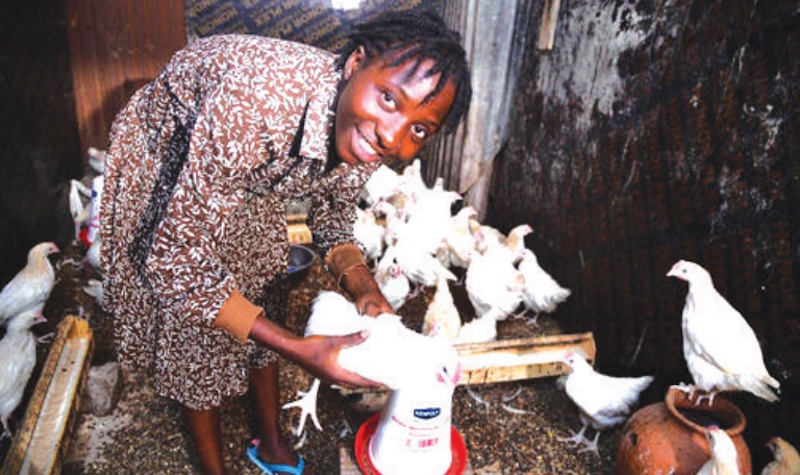
They began making samosas and fruit juice, later adding a small poultry project. The earnings were gradual but consistent. Today, Maria earns about UShs 120,000 (US$34) a month. She saves part of it. Her mother, Doola Nassimu, noticed the change quickly. “She became more confident,” Nassimu says.
“She woke up early. She planned her money. She wanted to go to school and do well.” For Maria, the juice business became more than income. It trained her in routine, responsibility, and leadership, skills she says she kept building through mentoring sessions on goal setting, budgeting, and handling pressure.
As her confidence grew, she began mentoring other young people facing stress, violence, or school dropouts. She joined the Children’s Reference Group (CRG), a platform that brings young people’s voices into decision-making, where she now serves as an adviser on environment and culture.
Maria also discovered a talent for public speaking. At first, she was nervous, especially when asked to speak in English, so she chose Luganda. “I told them this is my language,” she says.
“And I am proud of where I come from.” Since then, she has emceed UNICEF and community events. She has also joined a local football academy and started a dance group to keep children off the streets.
Maria is preparing to complete her Senior Six in 2026. With the programme ending in 2026, she worries about where she will mobilize Shs 800,000 (US$222) to begin her first term in Senior Six without the cash transfers. Still, she talks about the future as something she can build.
HOW MENTORSHIP HELPED AMANI RECLAIM HER PATH
In Kabalagala, south of the capital, Kampala, Amani Shalom describes a different kind of pressure, not from the street, but from a mistake that could have pulled her out of school.
Amani is in Senior Three at Kansanga Seed Secondary School. She joined Cohort Two of the ‘Girls Empowering Girls’ programme and became a mentee of Mentor Sharon. In the slums of Kabalagala, where small shops and houses sit shoulder to shoulder, she learned early how quickly a single problem can shake a young person’s confidence.
She was still in lower secondary school when she became the treasurer of a small savings group. The idea came from her mentor, who taught her that saving, even small amounts, could protect girls from risky choices and give them independence. But another member disappeared with the group’s money.
The pressure fell squarely on Amani. Demands came. Anxiety followed. Her concentration at school slipped. One afternoon, walking home from class, she says the stress nearly overwhelmed her.
“I was scared,” she says. “I didn’t even know how to explain it at home.” Instead of facing it alone, she turned first to her mentor. Together, they spoke to her father and local leaders. The situation was resolved, but the lesson stayed.
“My father told me this was something to learn from,” Amani recalls. “He said saving changes your life slowly.”
She kept saving, and she started mentoring other girls. The confidence Amani gained through mentoring soon turned into action. She learned that businesses do not need large capital to begin.
With savings of Shs 7,000 (US$2), a small top-up of Shs 10,000 (US$2.7) from her mother, and encouragement from her mentor, she started selling sugar cane in her neighbourhood. Later, she added porridge sales after spotting demand among neighbours. The income changed everyday choices.
Amani now buys her own school shoes and sanitary supplies and sometimes helps with food at home.
“Now I can plan,” she says. “I don’t feel helpless.” Both girls describe the same shift in different words: from reacting to each day to planning for the next.
The stories of Ndibalekera Maria Judith and Amani Shalom highlight the life-changing impact of the Girls Empowering Girls programme, an urban social protection initiative implemented by Kampala Capital City Authority (KCCA) with support from UNICEF and funded by the Government of Belgium.
Designed to keep vulnerable adolescent girls in school and protect them from exploitation, the programme combines cash transfers, mentorship, counselling, and referrals to essential social services.
Through this support, Maria and her sisters were able to return to school, start small income-generating activities, and rebuild stability after family breakdown and poverty threatened to push them onto the streets.
Amani, meanwhile, received mentorship that helped her overcome a financial crisis, stay focused in school, and start a small business that now supports her basic needs. Together, their experiences show how targeted social protection can help girls in Kampala’s most vulnerable communities move from survival to planning, confidence, and hope for the future.
About the Author