President Donald Trump has said he will no longer impose tariffs on European countries that opposed his push for the United States to acquire Greenland, signalling a temporary easing of tensions with key allies as negotiations over the Arctic territory continue.
In a post on his Truth Social platform on Wednesday, Trump said the decision followed a “very productive meeting” with NATO Secretary General Mark Rutte. He described the outcome as beneficial to both the United States and its allies, although Rutte has not publicly confirmed the details of any agreement reached.
“This solution, if consummated, will be a great one for the United States of America, and all NATO Nations,” Trump wrote, adding that further information would be released as discussions progress.
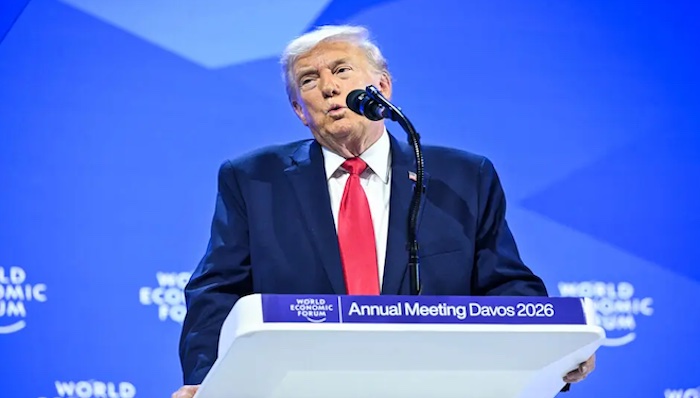
Earlier the same day, speaking at the World Economic Forum in Davos, Switzerland, Trump reiterated his interest in securing Greenland but insisted that the United States would not use military force to do so. Instead, he called for immediate negotiations, arguing that control of the territory is vital to US national security.
Danish Foreign Minister Lars Løkke Rasmussen welcomed the shift in tone, saying the day had “ended on a better note than it began.” He added that Denmark was ready to engage in talks to address American security concerns in the Arctic while respecting what he described as the kingdom’s “red lines.”
Trump said US Secretary of State Marco Rubio and Special Envoy Steve Witkoff would report directly to him as negotiations continue. He offered no specifics on whether the talks would involve a sale, lease or other arrangement, or how Denmark and Greenland would respond to any proposal.
However, details began to emerge in subsequent interviews. Trump told CNBC that any deal would last “forever” and could include access to mineral rights as well as cooperation on the proposed Golden Dome missile defence system, designed to protect the US from long-range missile threats across land, sea and space.
Greenland’s strategic location and its largely untapped reserves of rare earth minerals, critical for technologies such as mobile phones and electric vehicles, have been repeatedly cited by the Trump administration as key motivations for its interest.
Speaking later to CNN in Davos, Trump said a framework for a Greenland deal was “pretty far along” and would deliver “real national security and international security,” though he stopped short of confirming whether it involved full American ownership of the territory. He has previously rejected the idea of leasing Greenland, arguing that “you defend ownership. You don’t defend leases.”
According to the New York Times, one option under discussion would grant the US ownership of limited areas of land where it could establish military bases, in an arrangement likened by officials to British bases in Cyprus. Under existing agreements with Denmark, the US already has broad military access to Greenland and maintains more than 100 permanent personnel at its Pituffik base in the territory’s northwest.
NATO spokeswoman Allison Hart said Trump and Rutte had discussed the “critical significance of security in the Arctic region” and confirmed that negotiations involving Denmark, Greenland and the United States would proceed, with the stated aim of preventing Russia or China from gaining an economic or military foothold on the island.
Trump had earlier threatened to impose sweeping tariffs on goods from several NATO members, including Denmark, Germany, France and the UK, unless a deal was reached on Greenland. Those measures, which were to begin on 1 February and escalate later in the year, now appear to be off the table.
The episode unfolded against broader tensions at Davos, where Trump clashed rhetorically with several world leaders. French President Emmanuel Macron criticised the US president’s tariff threats as “fundamentally unacceptable,” prompting Trump to accuse France of exploiting the United States. He also took aim at Canadian Prime Minister Mark Carney, dismissing calls for “middle powers” to band together and warning that Canada’s security depended on US support.
Despite the sharp exchanges, Trump insisted the United States preferred negotiation over coercion on Greenland, even as he made clear that Washington expected a deal that met its full security objectives.
Melissa Enoch
About the Author