US President Donald Trump has linked his push to take control of Greenland to his failure to win the Nobel Peace Prize, as tensions over the Arctic island threaten to reignite a trade war with Europe.
Trump has intensified pressure on Denmark, a fellow NATO member, insisting the US should take sovereignty over Greenland and warning of punitive tariffs against countries that block the move. The European Union is now weighing retaliatory trade measures.
The dispute risks further straining the NATO alliance, already under pressure from the war in Ukraine and Trump’s criticism of allies he says do not spend enough on defence. It has also unsettled EU US trade relations, only recently stabilised after last year’s tariff standoff.
In a written message to Norwegian Prime Minister Jonas Gahr Stoere seen by Reuters, Trump linked his stance to the Nobel Peace Prize decision.
“Considering your Country decided not to give me the Nobel Peace Prize for having stopped 8 Wars PLUS, I no longer feel an obligation to think purely of Peace, although it will always be predominant, but can now think about what is good and proper for the United States of America,” he wrote.
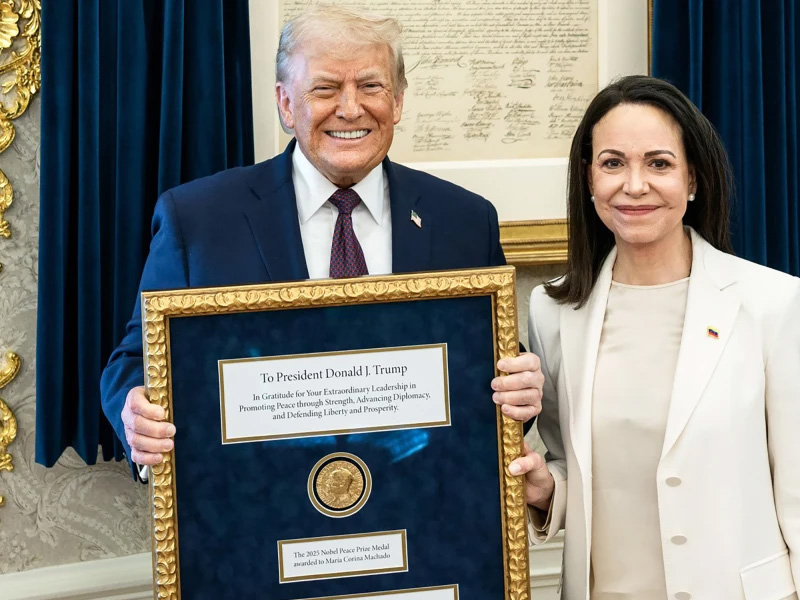
The Norwegian Nobel Committee awarded the 2025 Nobel Peace Prize to Venezuelan opposition leader Maria Corina Machado, not Trump. She presented her medal to Trump last week during a White House meeting, though the committee said the prize cannot be transferred, shared or revoked.
Trump repeated claims that Denmark cannot protect Greenland from Russia or China.
“… and why do they have a ‘right of ownership’ anyway?” he wrote, adding: “The World is not secure unless we have Complete and Total Control of Greenland.”
On Saturday, Trump vowed to impose escalating tariffs from February 1 on EU members Denmark, Sweden, France, Germany, the Netherlands and Finland, as well as Britain and Norway, until the US is allowed to buy Greenland.
EU leaders will meet at an emergency summit in Brussels on Thursday. Options include tariffs on 93 billion euros of US imports that could automatically take effect on February 6, or deployment of the bloc’s Anti Coercion Instrument, which could restrict access to EU markets, public tenders or services.
An EU source said tariffs currently command broader support than anti coercion measures, where views remain “very mixed”.
German Finance Minister Lars Klingbeil and French Finance Minister Roland Lescure pledged a united response.
“Germany and France agree: we will not allow ourselves to be blackmailed,” Klingbeil said.
“Blackmail between allies of 250 years, blackmail between friends, is obviously unacceptable,” Lescure added.
British Prime Minister Keir Starmer urged calm dialogue and said he did not believe Trump was considering military action.
“A tariff war is in nobody’s interests,” Starmer said, signalling Britain would not retaliate.
Russia declined to comment directly but said it was hard to disagree with experts that Trump would “go down in… world history” if he took control of Greenland.
Markets and European industry have been rattled by fears of renewed trade volatility.
“This latest flashpoint has heightened concerns over a potential unraveling of NATO alliances and the disruption of last year’s trade agreements with several European nations,” said Tony Sycamore, a market analyst with IG.
Oliver Burkhard, chief executive of submarine maker TKMS, said the row should push Europe towards greater independence.
“I believe that there are, of course, nicer ways than nudges like that, but it is probably necessary, to put it in my own words, to get a kick in the shin to realise that we may have to suit up differently in the future,” he said.
Faridah Abdulkadiri
About the Author