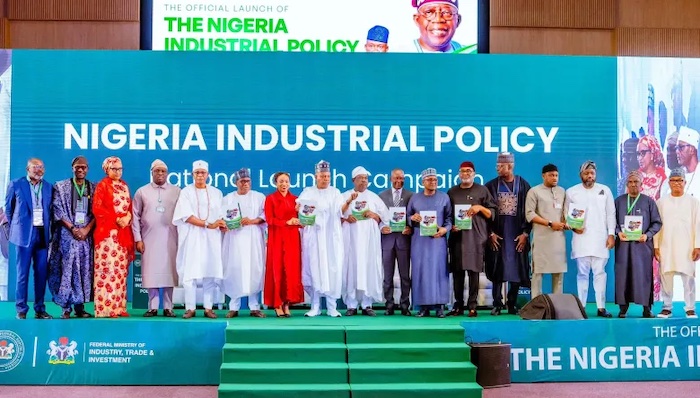
President Bola Tinubu on Tuesday unveiled the Nigeria Industrial Policy 2025 and directed relevant ministries, departments and agencies (MDAs) to ensure its speedy and effective implementation.
The President described the policy as a comprehensive roadmap for re-engineering the nation’s industrial base, unlocking value across sectors, and placing production, competitiveness and job creation at the centre of Nigeria’s economic strategy.
Speaking at the official launch at the International Conference Centre, Abuja, Tinubu—represented by Vice President Kashim Shettima—said the policy already provides a clear implementation architecture, stressing that policies often fail not at conception but at execution.
He lamented that for years Nigeria had struggled with fragmented value chains, high production costs, infrastructure deficits, policy inconsistency and weak coordination between government and industry.
“This stops now,” the President declared, noting that industrialisation requires deliberate action, coherence across energy, trade, infrastructure, finance, skills and innovation, as well as strong collaboration between government and the private sector.
Tinubu emphasised that the administration would judge the policy’s success not by documentation but by tangible outcomes.
“This administration will not measure success by the number of documents we produce. We will measure success by the number of factories that open their gates at dawn, by the jobs created for our young men and women, by the exports that leave our ports bearing the mark of Nigerian excellence, and by the value retained within our own economy,” he said.
He outlined the policy’s priorities to include strategic sector focus based on Nigeria’s comparative advantages, value chain development to move from raw material exports to finished goods, integration of micro, small and medium enterprises into industrial growth, alignment of infrastructure and energy with industrial needs, and strengthened skills, technology and innovation.
The President urged the private sector to invest with confidence and responsibility, deepen local value chains, create jobs and partner with government in building a productive economy.
Tinubu commended the Minister of State for Industry, Senator John Owan Enoh, for what he described as disciplined leadership and clarity of purpose in driving the policy process, and applauded industry stakeholders for contributing to a document grounded in practical realities.
In his remarks, Enoh said the policy marks a turning point in the drive to build an industrial Nigeria that produces, competes and prospers.
Chairman of the Dangote Group, Alhaji Aliko Dangote, welcomed the initiative, describing it as progressive and supportive of domestic manufacturing. He expressed optimism about the country’s foreign exchange outlook, predicting that the naira could appreciate to ₦1,000 to $100 this year.
Dangote noted that increased investor confidence driven by foreign exchange stability and reforms has renewed interest in Nigeria but stressed the need to protect indigenous industries to enable them to thrive.
United Nations Resident and Humanitarian Coordinator in Nigeria, Mohamed Malick Fall, said the policy reflects ongoing collaboration between Nigeria and the United Nations Industrial Development Organization (UNIDO) to position the country as a key player in regional and global value chains.
President of the Manufacturers Association of Nigeria (MAN), Otunba Francis Meshioye, also commended the launch, assuring that manufacturers would support effective implementation, particularly in promoting indigenous entrepreneurship.
By Line
Deji Elumoye in Abuja