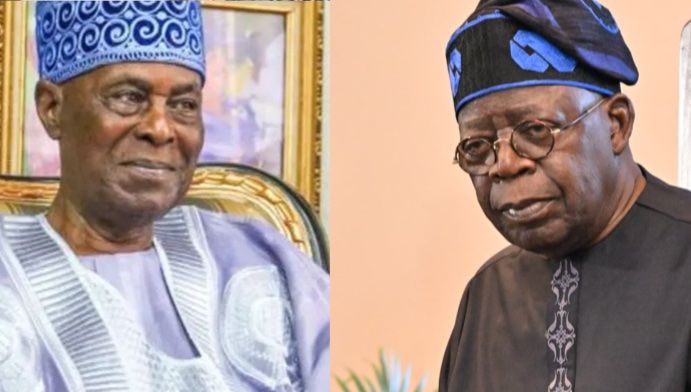
Otunba Adekunle Ojora, one of Nigeria’s most influential post-independence business leaders and a prominent member of the Lagos royal aristocracy, on Wednesday died at the age of 93, marking the end of a long era in which he stood at the intersection of corporate leadership, public service and traditional authority.
President Bola Tinubu has condoled with the government and people of Lagos State over the passing of the business tycoon, and community leader.
The President, in a statement issued by his Adviser on Information and Strategy, Bayo Onanuga, commiserated with the immediate family members, the Ojora and Adele royal families of Lagos, and business associates of the departed business titan.
Tinubu highlighted the late Ojora’s life, marked by humility, perseverance, hard work, tenacity, and generosity, which greatly helped his career in the public and private sectors.
The President noted Ojora’s significant contributions to both the private and public sectors, particularly his role in advising governments—national and subnational—on best practices for safeguarding the future of institutions.
Tinubu said the passing of Otunba Ojora was a significant loss to the country, the private and public sectors, and traditional institutions and prayed for the repose of his soul and comfort for his family.
Also on Wednesday, the Ojora family of Lagos announced the passing of its patriarch, the Otunba of Lagos and Lisa of Ife. In a press release Ojora returned to his creator early Tuesday morning, submitting to the will of Almighty Allah.
The statement, signed by Mrs. Toyin Ojora-Saraki on behalf of the family, described the late traditional leader as a man who lived a dignified life and served his community with honour. “He was 93 and will be buried in Lagos according to Islamic rites,” the family said.
Otunba Ojora is survived by his wife, Erelu Ojuolape Ojora, his children, grandchildren, and great-grandchildren. The family urged members of the public to join them in prayers, asking Allah to grant the deceased mercy, reprieve in the grave, and a place in Aljannah Firdaus.
Born in 1932, into the Ojora and Adele royal families of Lagos, Ojora was from an early age groomed for leadership. His royal lineage conferred on him several traditional titles, reflecting his standing within the Yoruba traditional hierarchy and his role as a custodian of culture and heritage.
Ojora was educated in the United Kingdom, where he studied journalism at Regent Street Polytechnic in London. He began his professional career with the British Broadcasting Corporation (BBC) in the early 1950s, gaining experience in international broadcasting at a time when few Nigerians occupied such roles abroad.
On his return to Nigeria in the mid-1950s, he worked with the Nigerian Broadcasting Corporation (NBC) and later served in information and public communication roles in Ibadan, then the administrative capital of the Western Region.
His transition from media into corporate life marked the beginning of a distinguished business career. Ojora joined the United Africa Company in the early 1960s, rising rapidly to become one of the earliest Nigerians to hold executive-level positions in a major multinational operating in the country.
He later held several public sector and quasi-public appointments, including roles in urban governance, real estate development and shipping, which broadened his influence in Nigeria’s economic management during the early post-independence years.
Ojora became most widely known for his long tenure as chairman of AGIP Nigeria Limited, a position he assumed in 1971. Under his leadership, the company became a major force in Nigeria’s downstream oil sector.
He remained at the helm until 2002, overseeing the company through periods of significant regulatory and structural change in the oil and gas industry. Beyond AGIP, he built a wide investment portfolio spanning oil and gas, manufacturing, insurance, shipping, real estate and services, and served on the boards of numerous Nigerian and multinational companies.
Regarded as a consummate boardroom strategist, Ojora was a strong advocate of corporate governance, Nigerian participation in enterprise and long-term capital formation. He was a fellow of several professional bodies in Nigeria and abroad and received national recognition for his contributions to economic development.
However, despite his influence, he consistently avoided partisan politics, preferring to shape national development through business leadership and institutional building.
Deji Elumoye, Emmanuel Addeh and Sunday Ehigiator
About the Author