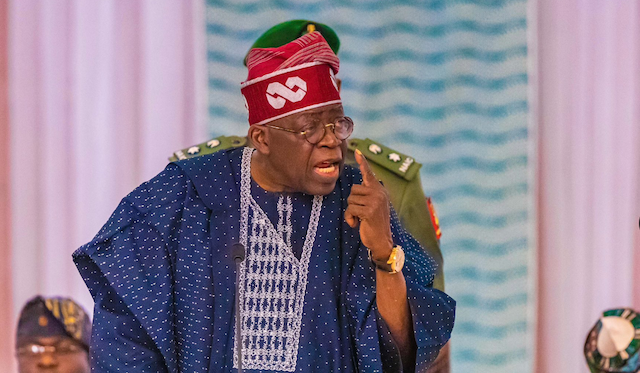
President Bola Ahmed Tinubu has described himself as a die-hard democrat, insisting that all political actors must submit to the rule of law if democracy is to thrive in Nigeria.
Tinubu made the remarks on Wednesday night while addressing leaders of the All Progressives Congress (APC) National Working Committee and executives, as well as members of the Inter‑Party Advisory Council (IPAC), during an interfaith breaking of fast at the Presidential Villa in Abuja.
Declaring his commitment to democratic ideals, the president said his political journey had been shaped by decades of struggle, sacrifice, and dedication to the rule of law.
“I followed the leadership destiny that God has done and chosen for me. There’s no doubt about that. I’m a die-hard democrat, and I follow that belief wholeheartedly, committedly, to a united country; Nigeria. That principle and that philosophy will live and die with me,” Tinubu said.
The president traced his democratic credentials to the pro-democracy struggle during Nigeria’s military era, recalling his involvement with the National Democratic Coalition (NADECO) that opposed the regime of former military ruler Sani Abacha.
According to him, many politicians who fought for democracy endured persecution, detention, and exile.
“We are all democrats and we all subscribed to this democracy voluntarily, willingly, and we’ve been at it selflessly in the last 26 years. Some of us have the bruises from it, struggling for it. We went to detention, we protested… We went on exile and all of that. We formed NADECO. We got here,” he stated.
Tinubu emphasised that party affiliation must remain voluntary and should not attract intimidation or threats from political opponents.
“We are all democrats, voluntarily – party alliances, party ideologies or no ideology, party boat, party platform, in whichever form – it’s voluntary. Be persecuted for it. So, no threat from any democrat,” he said.
The president’s remarks came amid controversy surrounding the Electoral Act 2026, which he signed into law on February 18 after it was passed by the National Assembly of Nigeria.
Opposition parties and civil society groups have criticised some provisions of the legislation, including the optional electronic transmission of election results and the introduction of new requirements for party membership registers.
Tinubu, however, defended the decision, saying democracy requires adherence to the rule of law and respect for legislative decisions.
“The Rule of Law must prevail in any democracy. Yes, Rule of Law. Majority will have their say and their way, and minority will have their say and might not have their way. That is the sweetness, the essence of democracy,” he said.
He urged political actors to engage in constructive dialogue rather than confrontation.
“Argue it, debate it intellectually, interrogate each other honestly and sincerely, but we are committed to the same thing—peace and stability of the country—and we adhere to it.”
Explaining his decision to assent to the electoral reform law, Tinubu said he had little choice given the overwhelming support the bill received in parliament.
“That I signed the Electoral Act, I have no choice. I don’t want to throw the country into turmoil of argument. There is an overwhelming majority by the National Assembly that passed the law.”
He added:
“If I have serious question or reservation about it, I would have raised it. But I have none. I submitted myself to the principle of Rule of Law, democracy. I signed, the rest is history. We’ll meet at the polls.”
The president also noted that he had spent years in opposition without threatening political rivals, stressing that democratic competition must remain peaceful.
“I’m a registered voter. I’m on the same platform with you, or not, I’m going to stick to my platform. When it was against me years past, I toed the line,” he said.
Tinubu acknowledged that politics could be intense but insisted that stability and respect for democratic institutions must prevail.
“The game is sweet only when you are winning. It’s alright, we must accommodate one another, we must help one another. We must strengthen the platform. But democracy is it? Yes, there must be peace, stability and commitment to Rule of Law,” he said.
Earlier, IPAC National Chairman Yusuf Dantalle praised Tinubu as a “listening father and an inclusive president,” while raising concerns about some provisions of the Electoral Act.
Dantalle disclosed that IPAC had previously worked quietly with the Independent National Electoral Commission(INEC) during the 2023 elections to prevent potential crises during the collation process.
He specifically urged the government to reconsider three provisions of the new law: the requirement for political parties to submit digital membership registers containing National Identification Numbers 21 days before primaries, the removal of indirect primaries, and the withdrawal of government subventions to political parties.
“We are not saying give us money to go and spend, no, but prudently what we can use to take care of administration of our political parties. You are a product of multi-party democracy, Your Excellency,” Dantalle said.
He also appealed for federal assistance to relocate IPAC from its current rented office, noting that the council had helped quietly resolve many political disputes to allow the government focus on governance.
Deji Elumoye
About the Author