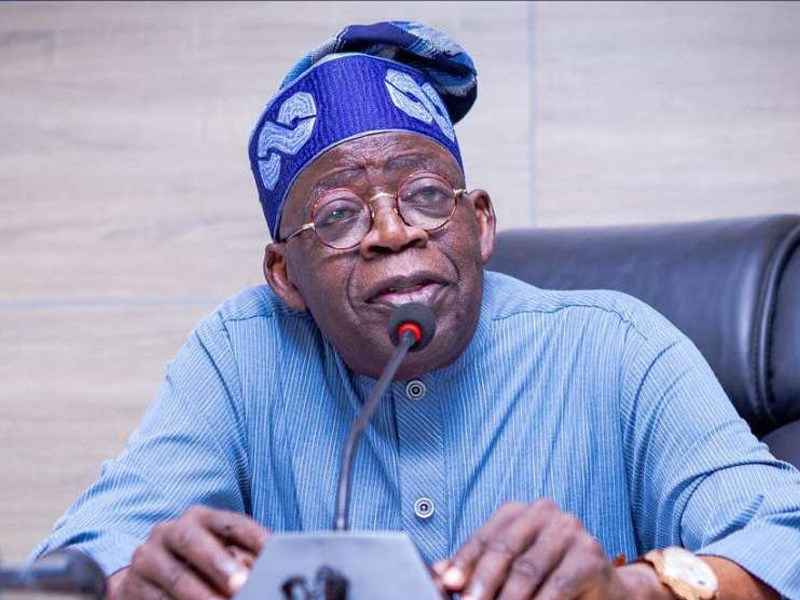
President Bola Tinubu has declared Nigeria’s security cooperation with the United States as strategic, focusing on counterterrorism and civilian protection while respecting the country’s sovereignty.
He affirmed this on Monday at the 4th International Conference of the Centre for Islamic Civilisation and Interfaith Dialogue at Bayero University, Kano.
He was represented at the event by the Minister of Information and National Orientation, Mohammed Idris.
“Our security alliance with the United States is strategic, focused on protecting vulnerable communities, and operationally led by Nigerian troops,” he said.
Speaking on the prevailing national challenges, the president also urged Nigerians to eschew narratives that portray the country as intolerant of religious freedom.
He said: “We must strengthen our resolve for a more united country. Recent attempts to misrepresent Nigeria as a nation that undermines religious freedom must be firmly resisted.
He urged Nigerians to uphold shared values and peaceful coexistence, describing unity as the foundation for lasting peace.
He asserted that national security is closely linked to unity and mutual respect among citizens.
“Our national security is tied to our unity, our togetherness, and our respect for religious diversity. We must forge a united front against those who seek to divide us,” he said.
He reiterated the current administration’s commitment to protecting lives and property and confronting criminality across the country, noting his administration was working assiduously to protect life and property and to execute the fight against terror with all that is at its disposal.
The president urged Nigerians to embrace unity, religious tolerance, and peaceful coexistence as critical pillars for national security and development.
He noted that over 7,000 trained forest guards had been deployed nationwide to deny criminals access to forest corridors, adding that at the same time, efforts were ongoing to entrench community policing through state policing, in line with constitutional processes.
He commended the Centre for Islamic Civilisation and Interfaith Dialogue and the Sultan Bello Mosque, Kaduna, for sustaining dialogue that promotes peace and national cohesion.
“This conference continues to uphold the ideals of our nation’s peace and unity through dialogue. I am honoured by this invitation,” he said.
He lauded the conference’s focus on the legacy of the late Sheikh Mahmud Abubakar Gummi as timely and instructive, noting that the renowned Islamic scholar played a significant role in promoting national unity during critical moments in Nigeria’s history.
“Sheikh Gummi understood the intersection of faith and politics and worked closely with authorities after independence and the civil war to promote oneness and peaceful coexistence,” Tinubu said.
He described Sheikh Gummi as a distinguished scholar, reformer, and national figure whose influence extended beyond religious circles.
Tinubu said: “He was a teacher, a reformer, an advisor, and a prodigious writer. He mentored generations to believe in the indivisibility of Nigeria, in work and in worship.”
It would be recalled that following the declaration of a national security emergency in November 2025, President Tinubu said security operations had been expanded and reinforced in states affected by banditry and terrorism.
“We have optimised intelligence-led operations to disrupt and dismantle terrorist and criminal networks,” he said.
The event had in attendance eminent Islamic scholars, including the National Chairman of the Jama’atul Izalatul Bidi’aWa’Ikamatul Sunnah (JIBWIS), Sheikh Abdullahi Bala Lau; the Chief Imam of Kano State, Professor Shehu Ahmad Galadanci; the Vice Chancellor of the Bayero University, Kano, Professor Haruna Musa; Sheikh Ahmad Mahmud Gummi, and General Abdulkadir Mahmud Gummi (rtd), among others.
Olawale Ajimotokan
About the Author