President moves to end overlapping budgets, promises cleaner planning and stronger fiscal discipline
President Bola Ahmed Tinubu has announced that Nigeria will fully transition to a single annual budget cycle beginning in April 2026, marking a major shift in the country’s fiscal management framework.
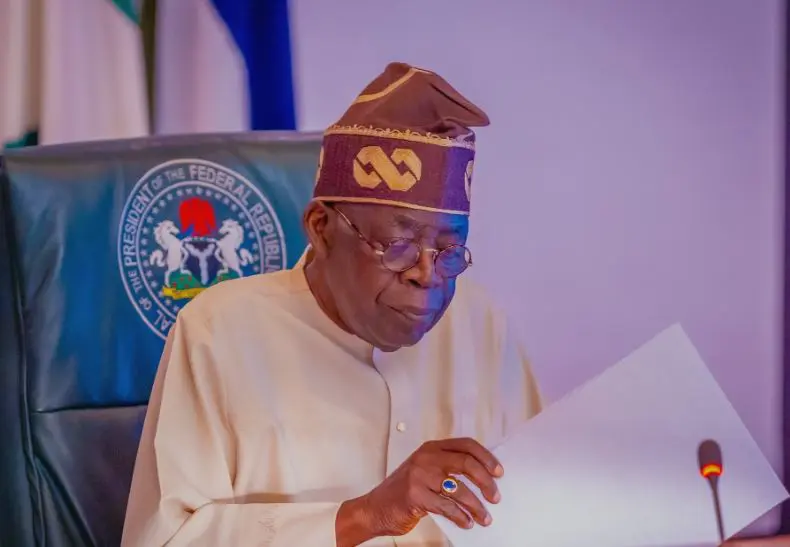
The announcement was made on Friday while the President presented the 2026 Appropriation Bill to a joint sitting of the National Assembly.
According to Tinubu, the reform is aimed at eliminating the long-standing practice of overlapping budgets, which he said has complicated planning, slowed project execution, and weakened accountability across government institutions.
What the President said
Addressing lawmakers, Tinubu said the government was determined to end the practice of running multiple budgets simultaneously, which has distorted capital planning and delayed fund releases to Ministries, Departments and Agencies (MDAs).
“We are terminating the habit of running three budgets in one inflow,” the President said.
“By March 31, 2026, all capital liabilities from previous years will be fully funded and closed. From April, Nigeria operates on a single budget, backed by a single revenue cycle. No overlaps, no excuses, no rollovers culture.”
He explained that the decision forms part of a broader fiscal reform agenda designed to reset Nigeria’s budget calendar and strengthen public financial management.
Tinubu noted that extending the current framework until March 31, 2026, would provide sufficient time to clear outstanding capital obligations inherited from previous budgets.
Once these liabilities are settled, he said, Nigeria would be positioned to return to a cleaner and more disciplined single-cycle budgeting system.
The President added that the move builds on existing reforms, including budget revisions, adjustments to capital targets, and efforts to improve revenue mobilisation.
What you should know
Earlier, President Tinubu formally requested the House of Representatives to repeal and re-enact the 2024 and 2025 Appropriation Acts, alongside a proposal to extend the 2025 budget to March 31, 2026.
In his letter to lawmakers, Tinubu explained that the proposal seeks to repeal the ₦35.06 trillion 2024 budget and replace it with a revised expenditure figure of ₦43.56 trillion.
Under the revised 2024 framework, ₦1.74 trillion is allocated to statutory transfers, ₦8.27 trillion to debt servicing, ₦11.27 trillion to recurrent expenditure, and ₦22.28 trillion to capital projects, with implementation running until December 31, 2025.
The President also proposed reducing the 2025 budget from ₦54.99 trillion to ₦48.32 trillion, while extending its implementation period to March 31, 2026.
In June, the Senate approved a second extension of the capital component of the 2024 budget, moving the deadline from June 30, 2025, to December 31, 2025.
Nigeria’s January-to-December budget cycle, widely regarded as a benchmark of fiscal discipline was introduced during the tenure of the 9th National Assembly. However, implementation challenges led the National Assembly, on December 18, 2024, to approve an extension of the 2024 budget to June 2025.
Most recently, the Federal Government directed MDAs to carry over 70 per cent of their approved 2025 capital allocations into 2026, as part of efforts to align spending with the new budget cycle.
About the Author