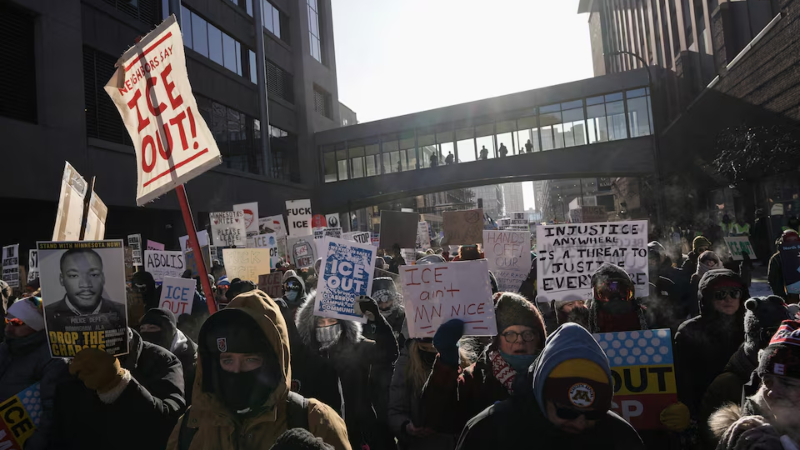
Thousands of demonstrators took to the streets of Minneapolis on Friday, defying bitter subzero temperatures to demand an end to President Donald Trump’s intensified immigration enforcement in the city.
With temperatures plunging to as low as minus 29 degrees Celsius (minus 20 Fahrenheit), organisers said as many as 50,000 people participated in the march—though the figure could not be independently verified. Many protesters later moved indoors to the Target Center, a downtown sports arena that can hold up to 20,000 people.
The protest, branded “ICE OUT!”, was billed as a statewide show of defiance and a general strike. Organisers said dozens of businesses across Minnesota shut their doors for the day as workers joined marches and rallies following weeks of sometimes violent confrontations between demonstrators and agents of US Immigration and Customs Enforcement (ICE).
“It is 23 degrees below zero, but the stores are closed and demonstrators are out braving the coldest day on record since 2019, all to send a simple message to ICE: get out,” said Al Jazeera correspondent John Hendren, reporting from Minneapolis.
The demonstrations came just a day after US Vice President JD Vance visited the city to voice support for ICE officers and urged local leaders to help ease tensions. Vance has defended the agency’s actions, portraying immigration officers as victims of what he described as “far-left” hostility, and insisting ICE is carrying out a critical mission to detain immigration violators.
Tensions escalated further at Minneapolis–Saint Paul International Airport, where dozens of clergy members were arrested after kneeling on a roadway, singing hymns, and praying in protest. Police said the demonstrators ignored repeated orders to clear the road. Organisers said about 100 clergy members were arrested without resistance, zip-tied, and transported by bus.
Protest leaders said one of their key demands is legal accountability for the ICE agent who shot and killed Renee Good, a US citizen, earlier this month while she was monitoring ICE operations from her vehicle. Clergy and activists also called on President Trump to withdraw the roughly 3,000 federal law enforcement officers deployed to the region.
Faith in Minnesota, a nonprofit group involved in organising the protests, said the arrests were also meant to draw attention to airport and airline workers who they claim were detained by ICE while on the job. The group urged airline companies to stand with Minnesotans in calling for an immediate end to the federal surge.
Across the state, bars, restaurants, and shops closed in solidarity, in what organisers described as the largest coordinated protest yet against the federal government’s actions.
“We are facing a full federal occupation through the arm of ICE on unceded Dakota land,” said Rachel Dionne-Thunder, vice president of the Indigenous Protector Movement, speaking alongside Indigenous, faith, labour, and community leaders who demanded ICE’s withdrawal and a thorough investigation into Good’s death.
President Trump, a Republican elected in 2024, campaigned on a promise to aggressively enforce immigration laws, arguing that his predecessor, Democratic President Joe Biden, had failed to secure the border.
Critics say Trump’s expanded use of federal law enforcement in Democratic-led cities has deepened political polarisation, particularly following controversial detentions, including those of US citizens and schoolchildren.
Despite Minnesota being home to numerous Fortune 500 companies, many major corporations have so far remained silent on the immigration raids.
About the Author