Statistics South Africa (StatsSA) has adjusted the minimum financial thresholds that citizens need to meet for basic survival.
StatsSA has been tracking the national poverty lines since 2006 and, on Thursday, released its revised measurements for the first half of 2026.
Its latest release detailed three bands based on an internationally accepted cost-of-goods metric and the minimum consumption required for individual welfare.
The amounts are per person per month and are based on the same basket of goods used to gauge the consumer price index.
Three poverty thresholds
StatsSA stated that the poverty lines were set based on the cost of basic needs and their relationship to welfare and the consumption expenditure for food and non-food components.
The extreme poverty line “refers to the amount of money that an individual will need to afford the minimum required daily energy intake”.
StatsSA states that this daily energy intake for an adult performing light physical activity should be a minimum of 2 100 kilocalories (kcal).
“This estimation required three essential data inputs, namely the quantity of each food item consumed, the caloric value of each item per 100 grams, and its price per 100 grams,” StatsSA explained.
StatsSA believes that 2 100 kcal can be achieved by spending at least R855 per person per month.
The second and third thresholds include non-food items, calculated from the average estimated expenditures of “households whose consumption behaviour will anchor the cost of basic needs”.
“The averaged median non-food consumption expenditure of each reference group of households was added to the food line to produce the lower bound poverty line (LBPL) and the upper bound poverty line (UBPL),” stated StatsSA’s report.
StatSA deduce the LBPL to be R1 415 per person per month and the UBPL to be R2 846 per person per month based on May 2025 prices.
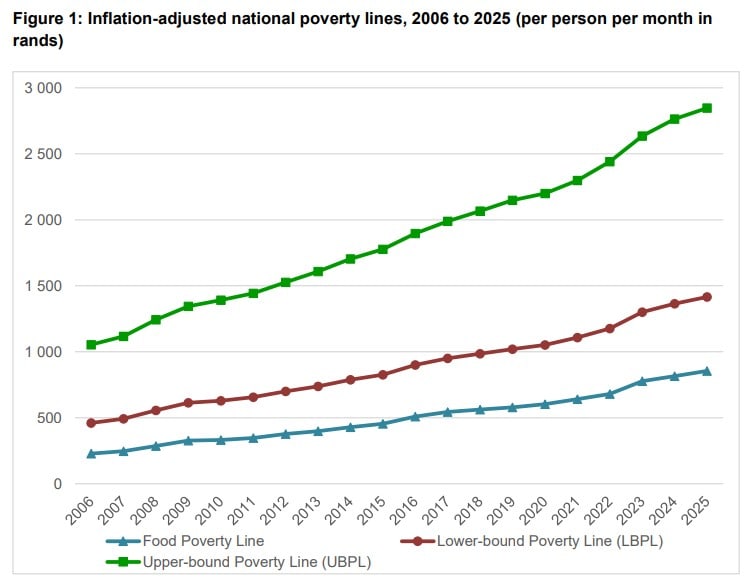
Above: Poverty thresholds have all tripled in the last 20 years. Picture: StatsSA
‘Food alone does not define poverty’
The purpose of the setting such thresholds is to monitor developmental policies and measure ‘’expenditure-based dimension of poverty”.
StatSA stressed that the poverty thresholds were not linked to the calculation of subsidies, setting of the national minimum wage or used to determine social grants and their relevant eligibility thresholds.
The report is not tied to expendable income as basic calorie requirements do not necessarily vary across income groups.
“Even when caloric intake remains constant, household food expenditure varies: higher-income households tend to spend more per calorie due to their preference for branded, convenient, and premium products.
“Food alone does not define poverty. People also require access to basic non-food necessities such as shelter, healthcare, clothing, transportation, and education,” the statisticians explained.
International poverty
The World Bank states that as of August 2023, the international extreme poverty line was US$2.15 — roughly R1 050 as per this week’s exchange rate.
The bank added that as of September 2025, an estimated 831 million people around the world still lived on less than that amount, but had decreased from roughly 2.3 billion in 1990.
“The world has experienced substantial but uneven progress in poverty reduction over the past three decades.
“However, the pace of poverty reduction since then has been quite different across regions,” the World Bank states.
In 1990, 53% of the poorest people on Earth lived in East Asia and the Pacific, followed by 28% in South Asia and 14% in Sub-Saharan Africa.
While the overall number of extremely poor people has decreased, Sub-Saharan Africa now accounts for 59% of the world’s poorest, followed by South Asia at 24% and North Africa and the Middle East at 6%.
As of 2023, StatsSA reported that 66.7% of South Africans lived below the UBPL, while 17.6% fell below the extreme poverty line.
NOW READ: Poverty and the curse of age and location
About the Author