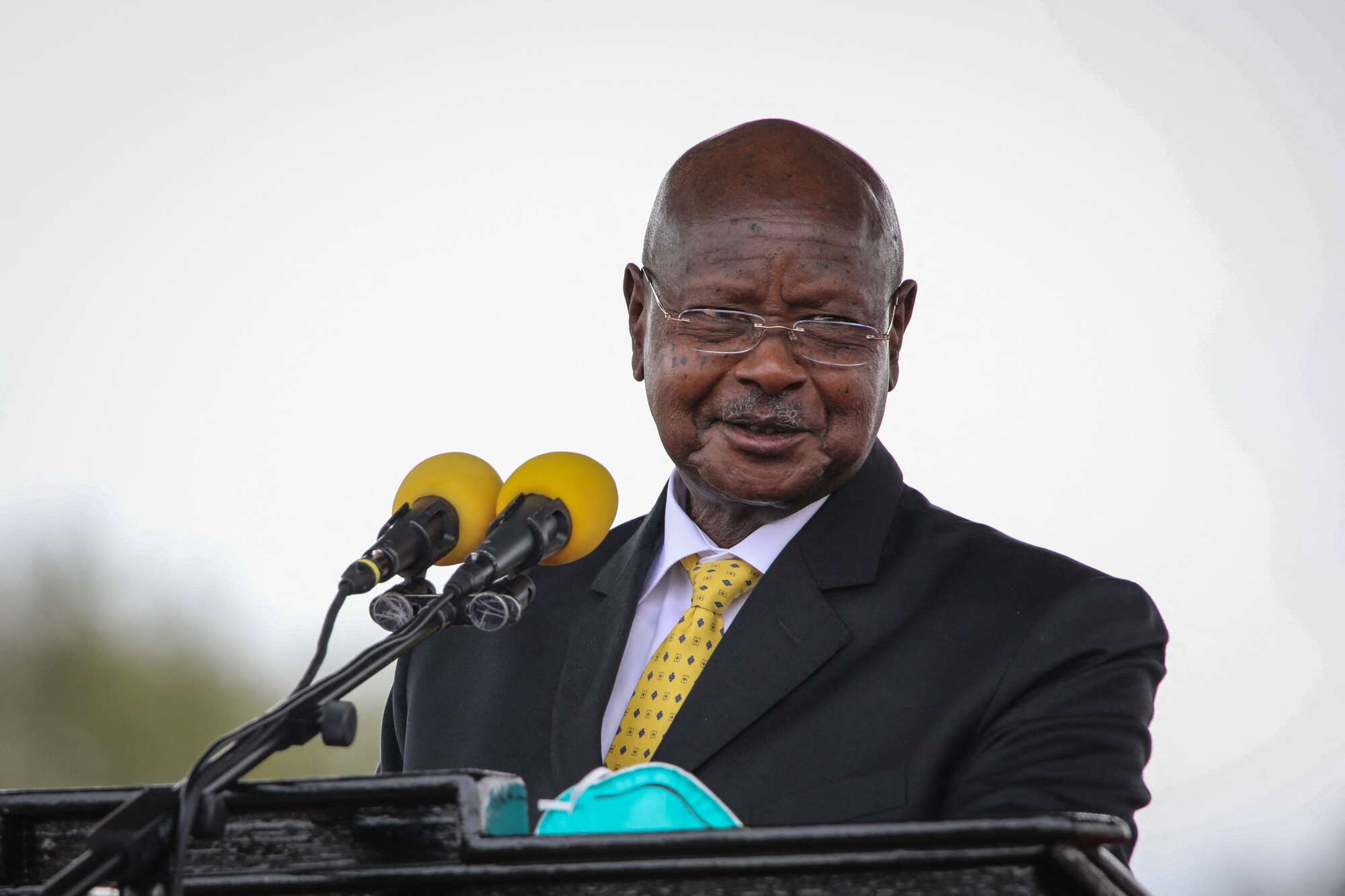
Ugandan President Yoweri Museveni speaks during the inauguration ceremony for his sixth term at Kololo Ceremonial Grounds in Kampala, Uganda, on May 12, 2021. (Photo by Badru KATUMBA / AFP)
Ugandan President Yoweri Museveni has once again alleged that the National Unity Platform (NUP) led by his two-time challenger, Robert Kyagulanyi, popularly known as Bobi Wine, printed one million fake votes locally and imported 1.7 million from Dubai in the 2021 General Election.
“When you hear that there’s opposition. There’s no opposition in Uganda. It’s just cheating. After the last election, we discovered that this NUP group had infiltrated 2.7 million fake votes into the system. One million was printed at Nkrumah Road [inKampala] here, and 1.7 million was printed in Dubai and brought here. So, that’s why I have been insisting on Biometric Verification Voter Machines. There were some problems with coordination on how to use them, but they actually work. They used them in Bulambuli in the presidential elections and they worked very well, and I was able to defeat my indisciplined sons, Bobi Wine and Nandala [Mafabi] who was trying to confuse our people there, very clearly,” the president said.
Museveni has been in power since 1986. The opposition has rejected the recent presidential poll results as fake and accused Museveni’s son, Gen Muhoozi Kainerugaba of leading the military to rig for him.
After casting his ballot on January 15 during the tense elections held under internet shutdown, Museveni expressed significant disappointment and raised concerns about potential “sabotage” following the widespread failure of the Biometric Voter Verification Kits (BVVK).
President Museveni, who has been in power for four decades and is a staunch advocate of the use of biometric machines in elections, faced technical issues firsthand at his polling station in Rwakitura, Kiruhura District, where the machine rejected his thumbprints. He was eventually verified through facial recognition.
He publicly questioned if the failure was “deliberate”. He suggested that some Electoral Commission (EC) staff might have sabotaged the process by failing to submit operator biodata to the machines in time.
The President ordered formal inquiries into the technical breakdowns to determine whether the delays were accidental or a result of mismanagement.
The Leader of Opposition in Parliament, Joel Ssenyonyi questioned why the expensive machines failed nationwide during the January 15 election but worked in recent local council polls.
Kyagulanyi criticised the failure of the BVVK describing it as a calculated attempt to facilitate fraud.
After voting in Magere, Wakiso District on January 15, 2026, Kyagulanyi stated that the government had “wasted billions of taxpayers’ money” on technology that ultimately did not work.
He argued the failures were “no accident” but part of a larger plan to create chaos in Opposition strongholds and “throw a spanner in the works.”
He claimed the breakdown allowed for “massive ballot stuffing” and other irregularities because the Electoral Commission (EC) reverted to manual verification, which he argued is more susceptible to manipulation.
Kyagulanyi linked the kit failures to the nationwide internet shutdown, questioning how machines reliant on connectivity were expected to function while the government intentionally cut off the network.
The Electoral Commission declared Mr Museveni the winner with a significantly increased margin compared to previous years. The former guerrilla leader got 7,946,772 votes (71.65 per cent). Mr Kyagulanyi, who finished second with 2,741,238 votes (24.72 per cent), rejected the results after escaping from his home in Magere following a January 16 night raid by the military.
Mr Kyagulanyi’s whereabouts are unknown. However, Gen Muhoozi who’s the Chief of Defence Forces (CDF), says they want him dead or alive.
About the Author