Small-scale fishers and coastal communities are fighting back against TotalEnergies’ ultra-deepwater oil and gas exploration off South Africa’s West Coast, as a landmark court case puts marine livelihoods and environmental rights at the centre of a growing national debate.
For generations, families along South Africa’s West Coast have cast their nets into the same waters their parents and grandparents did before them.
Now, they say, those waters and the livelihoods they sustain are under threat.
As a landmark court case unfolded this week in the Western Cape High Court in Cape Town, small-scale fishers from communities stretching from Port Nolloth to Doringbaai made their voices heard, warning that ultra-deepwater oil and gas exploration in the Deep Western Orange Basin (DWOB) could devastate the fishing industry and the coastal way of life that depends on it.
Ernest Titus from Lambert’s Bay on the West Coast put it plainly.
“For generations, our families have relied on traditional fishing to put food on the table and these decisions directly affect our ability to provide for our children and support our communities,” he said.
“The risks to marine life and long-term sustainability are simply too great.”
The applicants – The Green Connection, Natural Justice and Aukotowa Primary Fishing Cooperative – are challenging the environmental authorisation granted to TotalEnergies for the DWOB project, arguing the approval process was unlawful and inconsistent with constitutional and environmental obligations. Judgment will be delivered in due course.
Fishers fear for their futures
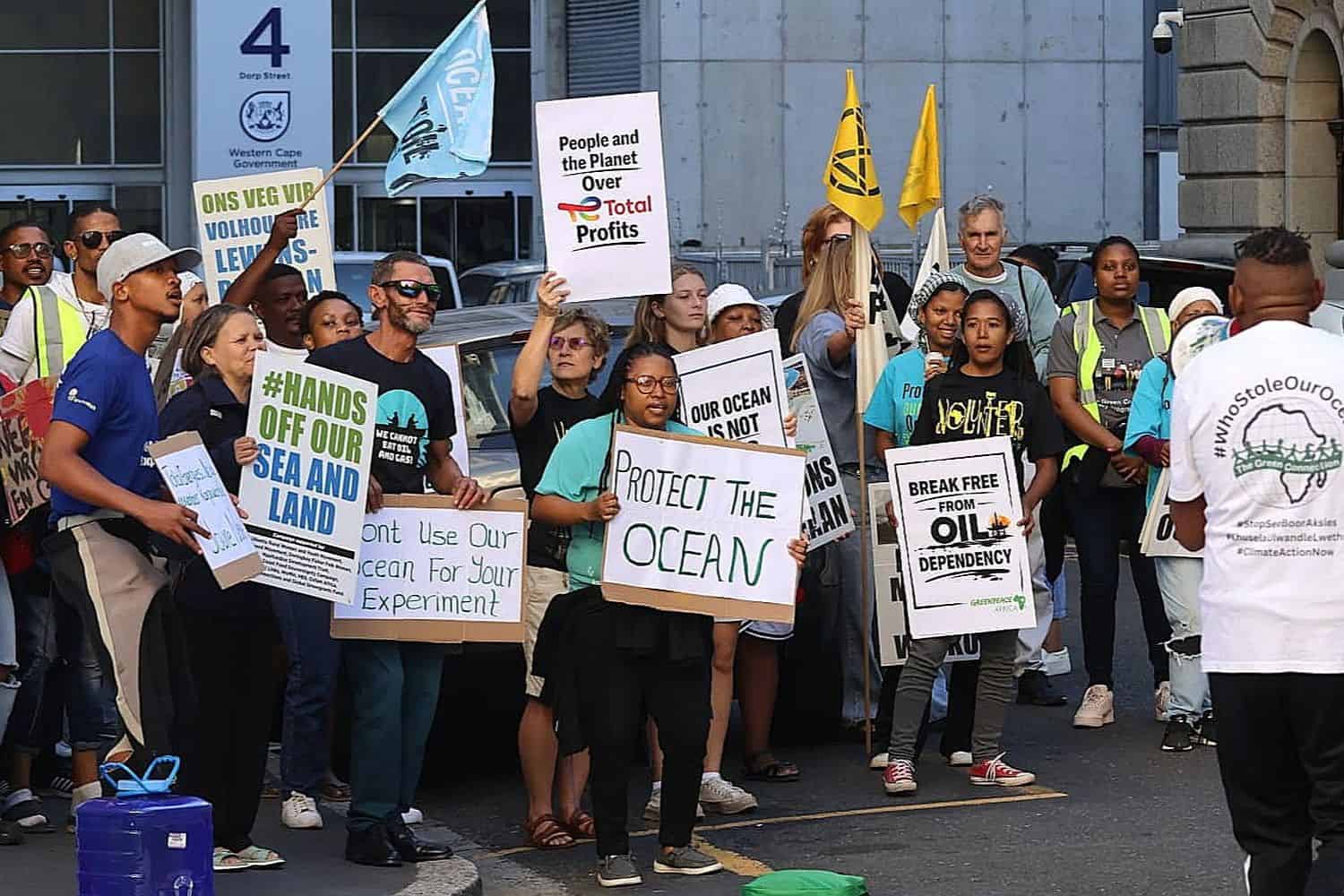
Ahead of the hearing, nearly 100 small-scale fishers and coastal community members held a peaceful demonstration outside the High Court, with solidarity actions also taking place across parts of the Eastern Cape and KwaZulu-Natal.
For many, the stakes could not be higher.
Walter Steenkamp from the Aukotowa Fisheries Cooperative in Port Nolloth said communities along the West Coast are already contending with declining fish stocks and the compounding effects of climate change.
“The state failed to meaningfully assess how this project will affect our livelihoods, food security, cultural heritage and constitutional rights – effectively prioritising corporate interests over vulnerable fishing communities,” he said.
Steenkamp added that the environmental impact report appears to significantly downplay the risks of drilling at depths greater than 2 000 metres, conditions entirely unprecedented in this region.
“Without robust, site-specific scientific evidence and a blow-out contingency plan that has been properly tested in South African waters, the approval of this project violates the precautionary principle,” he said.
Andries Booysen from Elandsbaai echoed this concern.
“As traditional fishers, our livelihoods depend on the sea. The government must consider the impact on small-scale fishers and local communities. Our children’s futures and the sustainability of the fishing industry are at risk,” he said.
“We urge the department to stop oil and gas exploration in our oceans.”
ALSO READ: WATCH: Helicopter crash at Table Mountain National Park
Inside the courtroom
The legal battle traces back to October 2023, when the department of mineral and petroleum resources granted TotalEnergies environmental authorisation for the DWOB project.
The applicants, together with five other appellants, challenged that decision, but their appeals were ultimately dismissed by the Minister of Forestry, Fisheries, and Environment
The Green Connection’s outreach ambassador, Neville van Rooy, said the environmental assessment fell short of what the law requires.
“The environmental impact assessment simply did not deal with these heightened risks,” he said. “We believe that the law supports the rights of small-scale fishers who are already on the frontline of climate impacts, especially since this project introduces new threats that, in our view, were never properly assessed.”
Central to the applicants’ argument is that the state assessed only the exploration phase in isolation, whereas the National Environmental Management Act requires a full lifecycle assessment, including the climate impacts of eventual extraction and combustion.
They further contend that the so-called “bridge fuel” narrative relied on by the state is both outdated and scientifically unsupported, and that approving new fossil fuel projects runs counter to South Africa’s net-zero commitments and the International Court of Justice’s guidance that states must avoid significant harm to the climate system.
Natural Justice’s programme manager, Melissa Groenink-Groves, pointed to an additional legal failing, the oversight of the Integrated Coastal Management Act.
“Both the director-general and the minister failed to apply the mandatory criteria relating to coastal public property, the public interest and intergenerational justice, rendering their decisions unlawful,” she said.
“The public trustee duty compels the state to safeguard coastal public property for current and future generations, not hand it over to corporations on the basis of incomplete or inadequate assessments.”
“Our lives depend on the ocean”
For coastal communities from Port Nolloth to Doringbaai, the case is deeply personal. Justin Montzinger, a social and environmental activist from Port Nolloth, said his community is deeply anxious about the direction of regulatory decisions.
“Our main focus is the ocean, as our lives depend on it. Oil exploration could harm marine life and affect the well-being of our people. We want to ensure a safe and sustainable future for our oceans,” he said.
Deborah De Wee, environmental activist and founder member of Spirit of Endeavour in Doringbaai, was equally direct. “The ocean is the livelihood of indigenous fishers and provides our income and healthy food.
“Pollution threatens our children, grandchildren, and the continuation of our culture. We must protect our oceans for future generations,” she said.
Titus summed up the community’s hope as the court prepares to deliberate.
“We hope the final outcomes will protect our oceans and preserve these resources for future generations.”
READ NEXT: South Africa’s waste crisis demands urgent circular economy shift, says deputy minister
About the Author