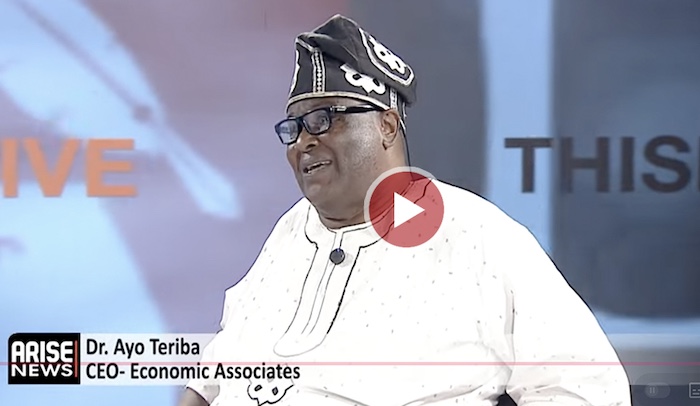

Chief Executive Officer of Economic Associates, Ayo Teriba, has sharply criticised the National Bureau of Statistics (NBS) over its latest inflation figures, describing the revised methodology as “arbitrary, senseless and unprecedented globally,” even as he projected that Nigeria remains firmly on course to achieve single-digit inflation by the first quarter of 2026.
Speaking in an interview with ARISE NEWS on Sunday, Teriba said the recent decision by the NBS to revise previously announced year-on-year inflation figures upwards by about three percentage points across 11 months lacked economic logic and damaged the credibility of official data.
“I don’t see any sense in what they have done. I don’t see any global methodology they are talking about,” Teriba said.
“They have now added between 2.9 and 3.1 percentage points to all the year-on-year inflation figures they announced since January. I don’t know any country that has come back to do that before. It is arbitrary.”
The NBS had announced that Nigeria’s headline inflation stood at 15.15 per cent in December 2025, down from 17.16 per cent in November, following a methodological adjustment from monthly to year-on-year calculation. While the International Monetary Fund (IMF) praised the adjustment as consistent with international best practice, Teriba strongly disagreed.
He said earlier rebased inflation figures released by the NBS up to November 2025 had integrity, but errors introduced during the rebasing exercise in February 2025 were never properly corrected.
“I have always defended the integrity of the data released by the Nigerian Bureau of Statistics, including the CPI rebasing announced in February 2025,” he said.
“But they made two clear errors. First, the suggestion that the index for December 2024 was 100 was wrong. They did not rebase to December 2024. The index was already 100 around June.”
Teriba also faulted the claim that inflation jumped sharply between December 2024 and January 2025.
“They implied the index jumped from 100 in December to 110 in January 2025, which is most implausible. There was no technical adjustment. The index rose to 116 by December and then dropped to 110 in January.”
According to him, the latest revision exaggerated inflation levels without altering price trends.
“What sense is there in marking up inflation figures already announced for 11 months by three percentage points each?” he asked.
“If you raise everything by three percentage points, it does not change the trend of prices. It is senseless. I’ve never seen it happen anywhere in the world.”
Despite his criticism, Teriba insisted that inflation was already much lower than officially reported and that Nigeria remained close to achieving single-digit inflation.
“If inflation in December should have been 12.4 per cent and not 15.5 per cent, then we are just one step away from single-digit inflation,” he said.
“Whether it happens in January or not, single-digit inflation will be with us in Nigeria by the end of the first quarter, and we should remain there for the year.”
He credited the progress on inflation control to monetary authorities rather than statistical revisions.
“That commendation should go to the Central Bank, not the NBS. It should go to the Economic Management Team and to the President,” Teriba said.
On global economic risks, Teriba dismissed alarmist forecasts by the World Economic Forum (WEF), urging caution against panic.
“The World Economic Forum is not a prophet. Economic predictions are conditional,” he said.
“Global crises may or may not occur, and even if they do, the impact on Nigeria should not be exaggerated.”
Turning to Nigeria’s recent removal from the European Union’s high-risk financial list, following its earlier delisting by the Financial Action Task Force (FATF), Teriba described the development as a major credibility boost for the country.
“The EU followed the FATF’s verification of improved enforcement against money laundering and terrorism financing,” he said.
“It reflects increased scrutiny by the Central Bank of Nigeria and other regulators. It is commendable.”
He argued that the reforms were driven by domestic economic necessity rather than external pressure.
“They did not do this to please the FATF or the EU. They did this in the interest of the stability and efficiency of Nigeria’s foreign exchange market,” Teriba said.
“These reforms have been ongoing since late 2023, leading to exchange-rate stability, naira strengthening, transparency and increased inflows.”
While acknowledging the collaborative role of multiple agencies, Teriba maintained that the Central Bank played a leading role.
“It is a fair comment that many agencies contributed,” he said.
“But what is new is the reform effort spearheaded by the Central Bank under Governor Yemi Cardoso. Nobody can deny that the CBN has played a leading role.”
The economist concluded that Nigeria’s recent gains in inflation moderation and financial credibility were structural and sustainable, warning that confidence could be undermined if statistical credibility is not carefully preserved.
Boluwatife Enome
About the Author