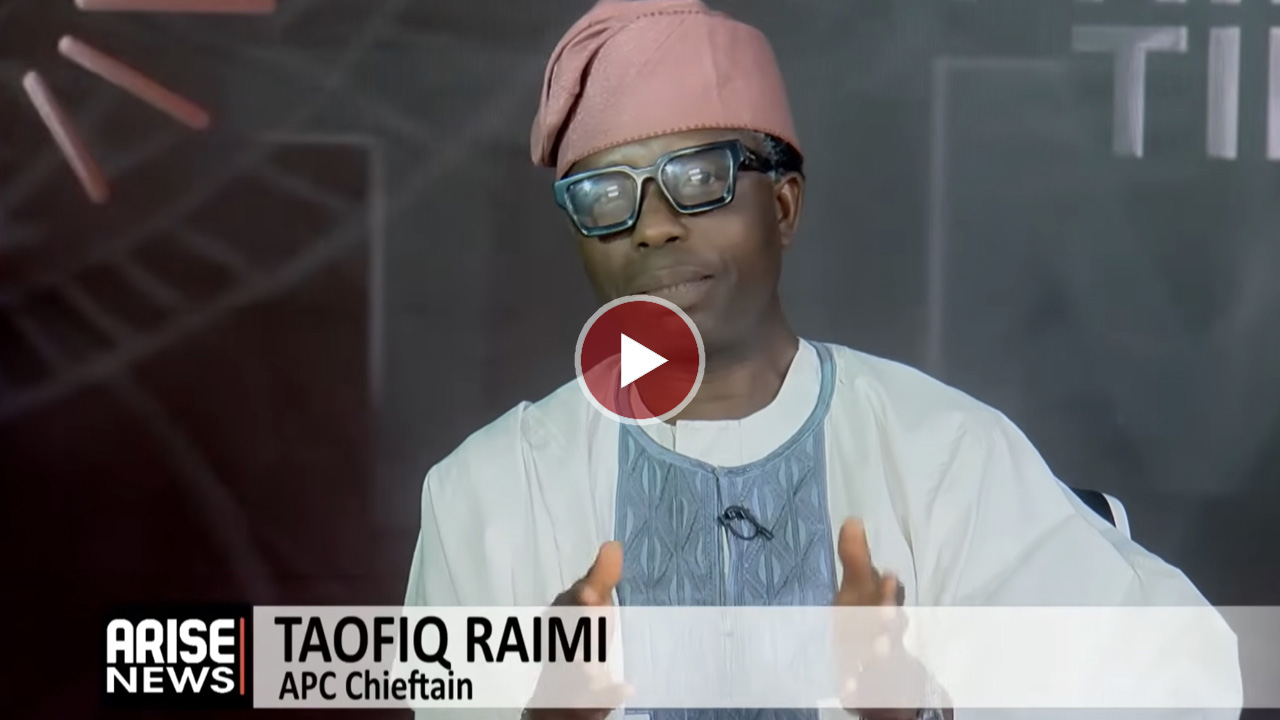

A chieftain of the All Progressives Congress (APC), Dr Taofiq Raimi, has described President Bola Tinubu’s 2026 New Year address as “highly promising” and grounded in verifiable economic indicators, saying it signals renewed hope and a more robust phase of national recovery.
Speaking during an interview on ARISE News on Friday, Raimi said the President’s speech demonstrated clarity of purpose, realism and focus on governance rather than politics.“The President’s 2026 New Year speech, to me, is highly promising and factual,” Raimi said. “I believe that the cont
ent of it, if strategically pursued, is very real.”
He explained that the President’s decision to first review the performance of 2025 strengthened the credibility of the address.
“You cannot know where you are if you do not assess where you are coming from, and it will be difficult to estimate where you are going if you do not appreciate where you are currently,” he said. “That is why the speech was well crafted.”
Raimi pointed to specific economic data cited by the President as evidence that reforms were yielding results.
“By the end of December 2025, GDP growth was about four per cent,” he said. “Inflation declined to less than 15 per cent, and our foreign reserves grew to about 45.4 billion dollars. These are clear indicators.”
He added that stability in the foreign exchange market and improved crude oil production further reinforced the administration’s economic trajectory.
“We now have more stability in foreign exchange, and crude oil production has also improved,” Raimi said. “These are not assumptions; they are empirical facts.”
According to him, the most significant aspect of the speech was the outlook for 2026, particularly on security, economic growth and national unity.
“The President spoke about a more robust and renewed fight against insecurity,” he said. “He acknowledged the partnerships Nigeria has secured, including support from the United States and other global partners, in tackling terrorism.”
Raimi stressed that security remained foundational to economic development.
“Without peace and security, the economic growth we expect cannot be achieved,” he said. “That acknowledgement is very commendable.”
On economic projections, he said the administration expected further improvements in macroeconomic conditions.
“The President believes inflation will continue to come down, interest rates will reduce, and that will create an enabling environment for businesses to thrive,” Raimi said.
He also highlighted the President’s emphasis on unity and inclusive growth.
“He spoke about national unity and cooperation, and about economic empowerment for not less than 8,000 people per ward,” he said. “With 8,808 wards in Nigeria, that translates to over 10 million Nigerians being directly empowered.”
Raimi described the address as inclusive and non-partisan.
“This speech was not political,” he said. “Rather than talking about politics, the President stayed focused on governance.”
Summing up his assessment, Raimi said the message was clear.
“For me, the speech inspires renewed hope,” he said. “It says to every Nigerian: if you are in Nigeria, I am your President, and you will benefit from my presidency.”
Responding to criticisms about revenue targets and fiscal discipline, Raimi dismissed claims of contradiction between the President and the Minister of Finance.
“There is no contradiction,” he said. “The President was referring to expected revenue for a particular period, while the Minister spoke about a different component of revenue after distribution.”
He added that the administration had never denied existing challenges.
“One thing you must give to this President is that he does not deny where there are issues,” Raimi said. “This administration is a work in progress.”
On insecurity, Raimi argued that the current government inherited long-standing challenges.
“Nigeria’s insecurity crisis did not start in 2015 or with this administration,” he said. “It dates back as far as 2002.”
He defended foreign military collaboration, describing it as pragmatic.
“What matters is that the problem is solved,” he said. “Whether it is intelligence cooperation, equipment or intervention, we welcome anything that will end insecurity.”
Raimi also reaffirmed the President’s support for state policing.
“The President believes in decentralising the police system,” he said. “If the National Assembly and state assemblies agree, state police can become a reality.”
On tax reforms, Raimi said the policy was widely misunderstood.
“The tax reforms are designed so that the rich pay more,” he said. “Anyone earning below ₦800,000 per year is exempted.”
He explained that even middle-income earners would pay minimal tax.
“Someone earning ₦1.2 million annually may end up paying about ₦2,000 per month,” he said. “There is a lot of misinformation.”
Raimi concluded that sustained public education was essential.
“That is why the implementation was delayed,” he said. “There has been enough sensitisation, but some people choose to politicise everything the government does.”
Boluwatife Enome
About the Author