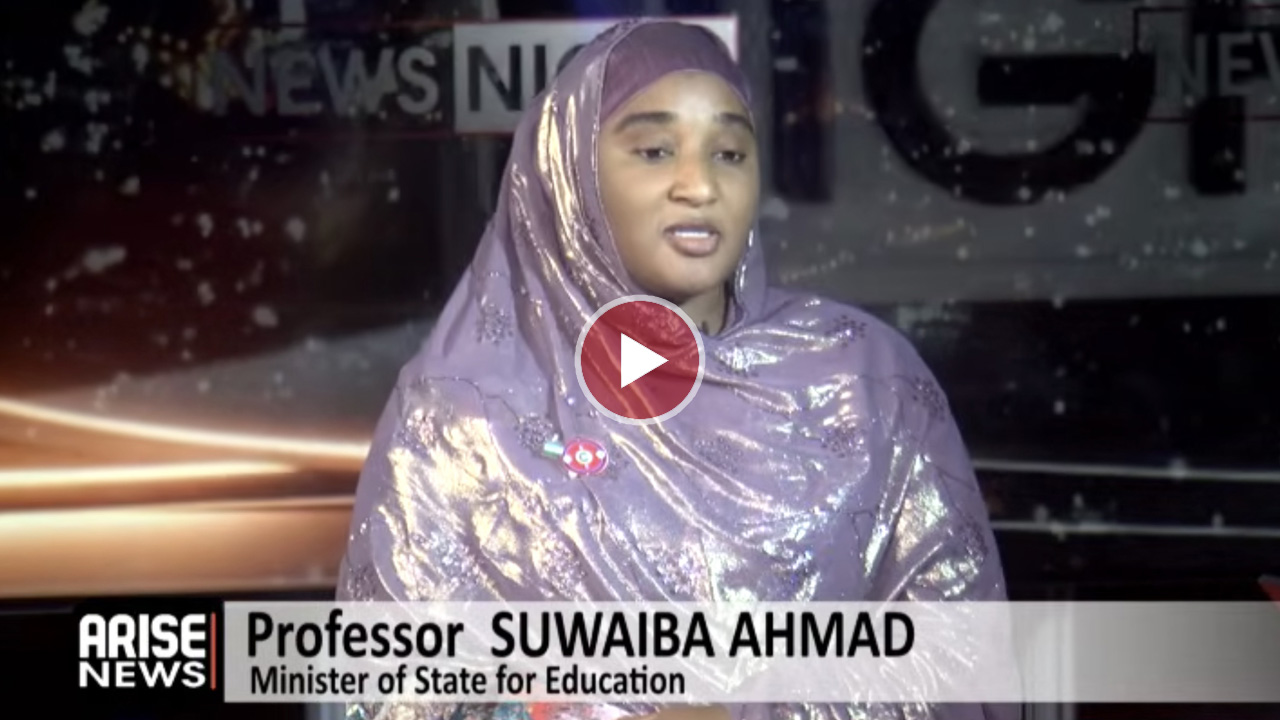

The Minister of State for Education, Professor Suwaiba Ahmad, has assured that the newly signed agreement with the Academic Staff Union of Universities (ASUU) will be fully implemented, with all financial components already captured in the 2026 budget, as part of efforts to end recurring strikes and restore stability to Nigeria’s public university system.
In an interview with ARISE News on Thursday, Ahmad explained that the Federal Government deliberately set aside the controversial 2009 agreement framework and opted for a fresh renegotiation process anchored by high-level officials who fully understood governance realities and implementation capacity.
“It’s important that we did that, and it’s because of that that we are here celebrating this great achievement,” she said.
Explaining why the 2009 agreement repeatedly failed, Ahmad said earlier negotiations were flawed from inception.
“If you look at the composition, you discover that the committees from 2009 to 2012, and even the subsequent negotiations, the government representatives were not really high-level officers that could negotiate on behalf of government,” she said.
She added: “For this kind of negotiation, you need people who understand governance, understand what is possible, and understand what government can actually implement. When people negotiate without full information, implementation becomes a problem.”
According to her, the present administration corrected that flaw by reconstituting the renegotiation team.
“The first thing we did was to reconstitute the renegotiation team, identify people that understand governance, the position of government, what is available and what can be implemented, and get them to renegotiate. That was exactly what we did,” Ahmad stated.
Addressing concerns about sustainability — particularly the agreed 40 per cent allowance — the minister said President Bola Ahmed Tinubu personally approved the deal before it was signed.
“Before we entered into this agreement, Mr President was briefed and he agreed to it. He gave us the go-ahead to include it in the budget, which is ideally what should be done before finalising any agreement,” she said.
Ahmad stressed that the increment was not a salary increase but an allowance.
“It’s not a salary increment. It’s an allowance given to academic staff. The 40 per cent was agreed, all calculations were done, and it has been captured in the budget with effect from January 1, 2026,” she explained.
She added: “Apart from that, the consolidated allowance and the CARTA allowance have also been approved. The Professor allowance has been approved. All of this has been captured.”
On the issue of multiple academic unions such as CONUA and others, Ahmad acknowledged the complexity but urged alignment.
“Individuals have a right to create unions. We cannot say we recognise only one union. Multiple unions exist everywhere,” she said.
However, she clarified government’s position.
“At the university level, the most popular academic union is ASUU, and the discussions and negotiations were with ASUU,” she said.
Ahmad warned that selective implementation would be impractical.
“You cannot have a lecturer in one department benefiting and another not benefiting because they belong to different unions. It will be very difficult to implement that way,” she said.
“That is why we are pleading with the unions to sit together, align, and allow government to deal with an umbrella body. Engagement is easier for us that way,” Ahmad added.
The minister insisted that the government has no intention of reneging on any part of the agreement.
“All the agreements we reached with ASUU are agreements we intend to implement 100 per cent. There is no agreement we reached that we do not intend to implement,” she said.
She dismissed concerns about possible challenges.
“I don’t see any challenge in what we agreed, unless something else comes up. The agreement was signed because we know government can implement it, and mechanisms are already in place to ensure full implementation,” Ahmad stated.
She concluded by welcoming ASUU’s assurance of industrial peace.
“It’s encouraging that ASUU has said there will be no strike notice while implementation is ongoing. That shows confidence in the process,” she said.
Boluwatife Enome
About the Author