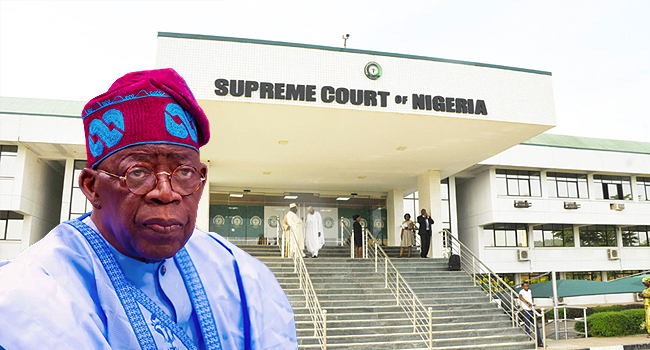
The Supreme Court has affirmed the constitutional authority of the President to declare a state of emergency in any state of the federation where law and order have broken down or where there is a looming threat of chaos or anarchy.
In a closely split decision of six to one, the apex court ruled that the President may, during the subsistence of a state of emergency, suspend elected officials—provided such suspensions are for a clearly defined and limited period.
Delivering the lead majority judgment, Justice Mohammed Idris held that Section 305 of the 1999 Constitution empowers the President to adopt extraordinary measures to restore peace, stability, and constitutional order in any state placed under emergency rule.
He noted that the Constitution does not expressly define the scope or nature of such extraordinary measures, thereby conferring broad discretion on the President to act as circumstances demand.
The judgment arose from a suit filed by Adamawa State and ten other states governed by the Peoples Democratic Party (PDP), challenging the legality of the state of emergency declared by President Bola Ahmed Tinubu in Rivers State.
During that emergency, elected state officials—including Governor Siminalayi Fubara—were suspended for a six-month period.
Earlier in the judgment, Justice Idris upheld the preliminary objections raised by the defendants—the Attorney General of the Federation and the National Assembly—regarding the competence of the suit. He held that the plaintiff states failed to establish a valid cause of action capable of invoking the Supreme Court’s original jurisdiction.
Consequently, the suit was struck out for want of jurisdiction. Nonetheless, the court proceeded to consider the substantive issues and ultimately dismissed the case on its merits.
In a dissenting opinion, however, Justice Obande Ogbuinya disagreed with the majority and held that the suit succeeded in part. While conceding that the President possesses the constitutional power to declare a state of emergency, Justice Ogbuinya maintained that such power does not extend to the suspension of elected state officials, including governors, deputy governors, and members of state legislatures.
The decision underscores the far-reaching emergency powers of the President while also highlighting ongoing judicial debate over their constitutional limits.
About the Author