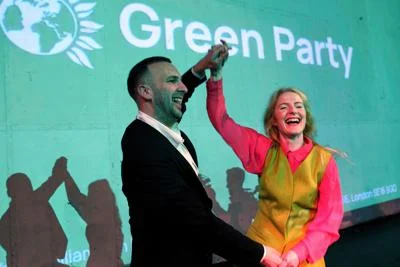
Prime Minister Keir Starmer has suffered a significant political setback after the Green Party of England and Wales captured a parliamentary seat long dominated by the Labour Party (UK) for nearly a century, marking a dramatic shift in voter sentiment.
Green Party candidate Hannah Spencer won the Gorton and Denton by-election with 40.7% of the vote, pushing Labour into third place with 25.4%. The populist-leaning Reform UK, led by Nigel Farage, finished second with 28.7%.
The result represents a historic breakthrough for the Greens, as it is the first time the party has secured a parliamentary by-election victory in northern England. The win increases the party’s representation in the 650-seat House of Commons of the United Kingdom to five seats.
Reacting to the defeat, Labour Party chair Anna Turley described the outcome as “clearly disappointing.” Prominent political analyst John Curtice called the result a “seismic moment,” warning that Britain’s political landscape may be entering one of its most uncertain periods since the end of the Second World War.
Starmer had personally campaigned in the constituency, reportedly preventing Andy Burnham, the Manchester mayor, from running while making the seat’s retention a test of his leadership.
The loss adds to growing political pressure on the prime minister following recent controversies, including criticism surrounding the appointment of Peter Mandelson as ambassador to the United States.
Historically regarded as part of Labour’s so-called “Red Wall,” the Gorton and Denton constituency had delivered more than half of its votes to Labour in the 2024 general election. However, sluggish economic performance, policy shifts, and internal party tensions are believed to have contributed to the erosion of support.
While governing parties often experience by-election losses, the scale of this defeat to a left-wing challenger underscores the growing fragmentation of Britain’s traditional two-party dominance. Recent national polling indicates that five parties—including the Greens, Reform UK, and the Liberal Democrats—are now attracting double-digit voter support.
Although Starmer is not expected to face an immediate leadership challenge, political attention is shifting toward the May local and regional elections in Wales and Scotland, where further Labour losses could intensify calls for strategic change within the party.
The outcome highlights the volatility of the British electorate, with traditional party loyalties weakening and emerging political movements reshaping the country’s political future.
About the Author