Spain has called on the European Union to move towards the creation of a joint European army, arguing that a unified force would be a more effective deterrent than the bloc’s existing patchwork of national militaries.
Spain’s Foreign Minister, José Manuel Albares, made the call in comments to Reuters on Wednesday ahead of a series of meetings at the World Economic Forum in Davos, saying Europe must show it is capable of defending itself against military and economic coercion.
Albares said the EU should first focus on integrating its defence industry by pooling together its tangible military assets, before moving towards what he described as a “coalition of the willing” among member states.
Addressing concerns over whether European citizens would be prepared to mobilise militarily, Albares acknowledged the sensitivity of the issue but insisted collective action at the EU level offered a stronger foundation.
“The concern over whether European citizens would be willing to assemble militarily is a legitimate debate,” he said. “But the chance of assembling a critical mass is higher as a bloc than on a national level. A joint effort would be more efficient than 27 separate national armies.”
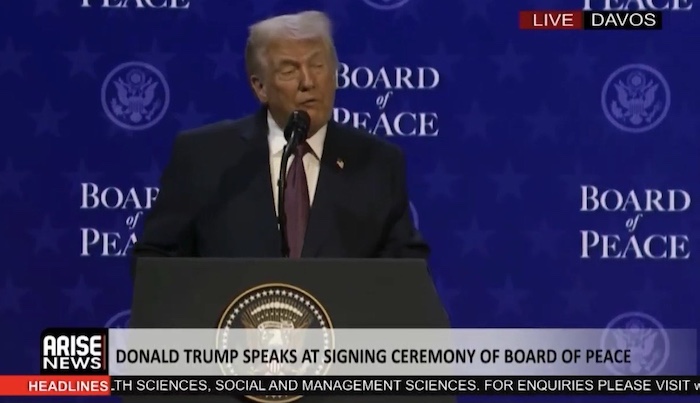
The comments come ahead of an emergency meeting of EU leaders scheduled for Thursday in Brussels, convened to coordinate a common response to threats by U.S. President Donald Trump to buy or annex Greenland. A spokesperson for the European Council confirmed late on Wednesday that the meeting would still go ahead, despite Trump announcing on social media that he and NATO Secretary General Mark Rutte had “formed the framework of a deal”.
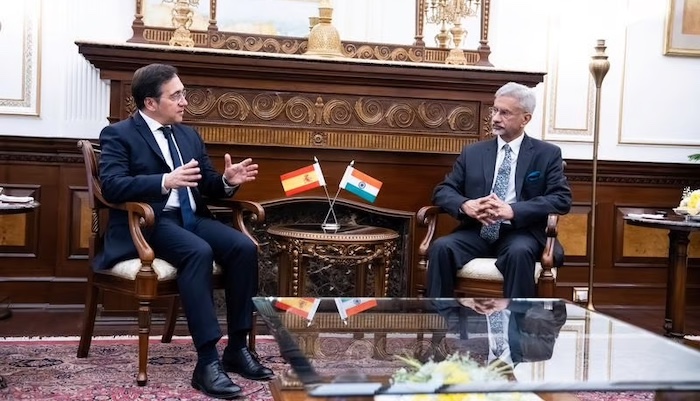
Albares spoke after holding talks in New Delhi with India’s Foreign Minister, Subrahmanyam Jaishankar, where discussions included the prospect of deeper defence cooperation between Spain and India.
He was careful to stress that the proposal for a joint European army was not intended to undermine or replace NATO, reaffirming Spain’s commitment to the transatlantic alliance.
“But we need to demonstrate that Europe is not a place that will let itself be coerced militarily or economically,” Albares said.
According to a senior foreign official, Spain’s position remained unchanged despite Trump later softening his stance on Greenland following discussions with NATO Secretary General Mark Rutte.
“Spain is glad that a pathway for dialogue has been opened within the NATO framework, if that pathway is confirmed,” the official said.
The idea of integrating national armed forces into a supranational European army is not new. It was first proposed in 1951 as part of efforts to counter the Soviet Union and ensure that German rearmament did not threaten neighbouring states. However, the plan was ultimately rejected when France’s parliament voted it down in 1954.
Reflecting on that history, Albares said the current generation of European leaders had a responsibility to complete the project.
“The idea of European defence was part of the origin of the European Union,” he said. “It is up to my generation to finish this task.”
Boluwatife Enome
About the Author