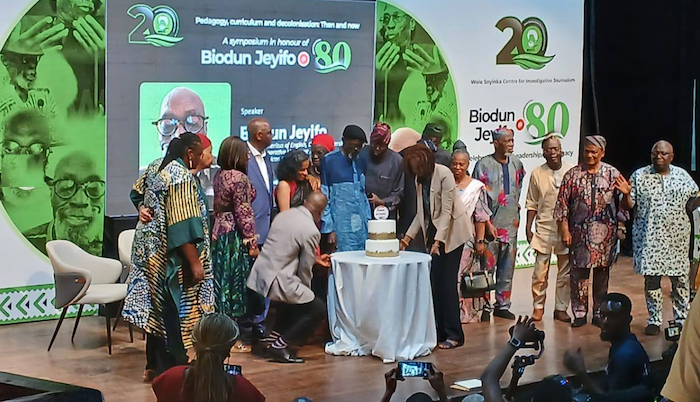
Prominent Nigerians, led by Nobel laureate, Professor Wole Soyinka, on Tuesday night converged on the International Conference Centre, University of Ibadan, to celebrate and honour the renowned literary scholar, Professor Biodun Jeyifo, popularly called BJ.
The event, tagged, “Evening of Tributes,” signalled the commencement of the funeral rites for the pioneer President of Academic Staff Union of Universities (ASUU), who was born on January 5, 1946, and died February 11, 2026 at the age of 80.
Others present at the event included National President of ASUU, Professor Chris Piwuna; past ASUU presidents – Professors Biodun Ogunyemi and Emmanuel Osodeke; Professor Femi Osofisan, his wife, Nike; Professor NiyiOsundare; Dr. Yemi Ogunbiyi; Mr. Kunle Ajibade; Mr. Kayode Komolafe; Mrs. Gbenro Adegbola; and Mr. Muyiwa Ige.
Speakers at the event spoke glowingly about the attributes, humility, character, sincerity, passion, commitment to duty, among other virtues, that the late icon embodied.
While some remarks attracted laughter and smiles from people in attendance, others sparked sober reflection.
Soyinka recounted the days of Jeyifo at the University of Ibadan and how he emerged with a First Class honours.
He said, “Any attempt at a linear seizure of the being that became simply known as ‘BJ’ is bound to collapse under the weight, not of contradictions, but of new detailed revelations of his variegated engagements with the society within which he matured, and against whose deficits he honed both instinct and intellect.”
While describing the deceased as a “Marxist jailer, practical mutineer”, he recounted various episodes and incidents where BJ showed exemplary leadership attitudes to reinforce and instil discipline and worthy characters.
Osundare recalled the beautiful times of togetherness and how he stood against perceived injustice and ill treatment.
He lauded BJ’s various scholarly efforts, adding that despite the works, he also had time for his family.
An old schoolmate, John Ohiorhenuan, recalling Jeyifo’s active involvement in Students’ Union politics, stated, “That young man was to become the gray, long-bearded, fearsome professor at Ibadan, Ile Ife, Ithaca, Cambridge, and places beyond. Irrepressible to the very last, BJ remained true to form until his passing.
“BJ was the personification of the Marxist intellectual. This was demonstrated most clearly in his life of ‘conspicuous under-consumption’ to the very end. BJ looked the same in 1965 as he did in 2025: the same simplicity in clothing and demeanour. He was very much at home in trade union meetings, in the major motor park of Ogunla, and of course, in the lecture theatre.”
In his tribute, Osofisan said, “He was my friend, my best friend. We will certainly meet again.”
Legal luminary, Femi Falana, recounted how Jeyifo, upon his emergence as National President of ASUU in 1980, helped to secure the recall of dismissed lecturers and student activists who were dismissed by the Olusegun Obasanjo military regime in 1978.
ASUU President, Piwuna, in his remarks, said ASUU would not have been where it was today but for the foundations laid by Jeyifo and many other great leaders.
Piwuna stated that although he was not there when Jeyifo led the union, he met on ground solid efforts laid and which they were building on.
He stated, “I was not fortunate to have been there when he was leading the Union, or even for a while after he left. But what we found on ground were solid efforts that were made by him and those who served with him to ensure that our union operates within certain principles, integrity, transparency, courage, trust, solidarity, you know, all those things.
“And it’s also to his credit that it was at his leadership that our Union first entered into a collective bargaining agreement with government. And that has continued to this day, despite efforts both locally, domestically, and internationally to jettison that principle of collective bargaining.
“It’s because BJ and his co-travellers at the time, our leaders at the time, fought to have collective bargaining as the basis for engaging your employer.
“That’s why we have what we have today. So to a very large extent, even the recently signed agreement, it’s to his credit.”
Komolafe, speaking on behalf of the Socialist and Literary Archives (SOLA), said the late literary scholar invested his energy and resources into the body.
He said Jeyifo was a Marxist revolutionary till his death.
Komolafe said, for Jeyifo, capitalism did not represent the future of humanity. He prayed that Jeyifo’s dream of a socialist Nigeria will come true one day.
In a tribute to his “Formidable Dad”, the eldest son of the deceased, Professor Okunola Jeyifous, said, “My father had a formidable presence and this is something I was keenly aware of even before I explicitly understood its meaning.”
He recounted that his father’s oratory volume was famously loud, as he gesticulated emphatically when making any point, but never as a bully.
To the shock of the family and guests at the event, he recalled that unknown to many, driving was something that his father used to get clarity and peace, as it usually served as tool for focus and lively exchange for anyone fortunate to be with him while driving.
He stated, “Time on the road was an incubator and testing laboratory for his writing and speeches, allowing focused meditation, consideration and quite solitude.
“Throughout my childhood and especially beginning in my early adulthood, many of the most resonant and substantive conversations we had, about all manner of topics, unfolded on long drives, some with no particular destination.”
Highpoints of the event included the presentation of a documentary packaged to showcase the life and times of the deceased, from his childhood up to his retirement and life thereafter, music performance by the Ibadan City Chorale, and talk by his grandchildren, Dara and Lola.
Kemi Olaitan
About the Author