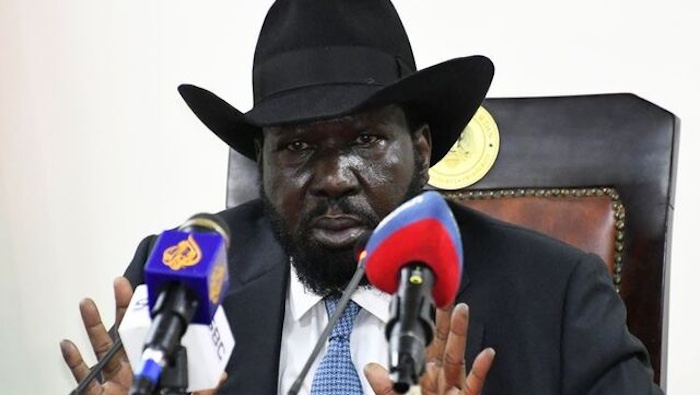
South Sudanese President Salva Kiir has dismissed two senior aides after a major administrative blunder saw a deceased opposition figure appointed to an elections panel.
The controversy erupted after a presidential decree dated 30 January named Steward Soroba Budia as a member of a panel tasked with guiding discussions ahead of elections planned for December. Local media quickly revealed that Budia, a member of the opposition United Democratic Party (UDP), died five years ago.
The revelation sparked widespread ridicule on social media, forcing the presidency to respond. In an official statement, Kiir removed his press secretary, David Amour Major, and the chief administrator in the Ministry of Presidential Affairs, Valentino Dhel Maluet. No reasons were given for their dismissal.
The statement, posted on Kiir’s official Facebook page and signed by Presidential Affairs Minister Africano Mande Gedima, said the president was “pleased” to relieve the officials of their duties and expressed “profound gratitude” for their service.
In a subsequent press release, Amour said the president’s office relied on the “accuracy and currency” of names submitted by stakeholders, admitting that proper verification had not been conducted. He did not identify which stakeholder was responsible. The UDP has not commented.
Budia was a signatory to the 2018 peace agreement that ended a brutal conflict following South Sudan’s independence in 2011. The elections panel is meant to prepare the country for its long-delayed polls, though doubts remain about whether they will proceed.
South Sudan continues to face insecurity, with recent fighting displacing more than 180,000 people, according to the United Nations. Violence has been most severe in Jonglei state, where government forces are battling groups aligned with suspended Vice-President Riek Machar.
Machar is currently under house arrest and faces charges including murder, treason, and crimes against humanity, which he denies. Despite a unity government agreement reached in 2018, political instability continues to threaten South Sudan’s fragile peace.
Erizia Rubyjeana
About the Author