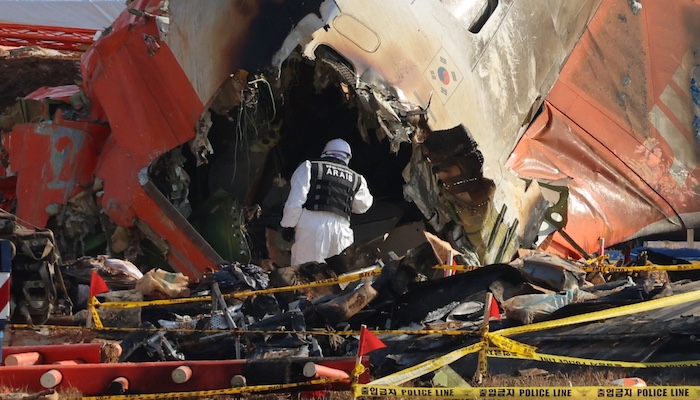
An official from the Ministry of Land, Infrastructure and Transport's Aviation and Railway Accident Investigation Committee takes part in the investigation at the site where a Jeju Air Boeing 737-800 aircraft crashed and burst into flames at Muan International Airport in Muan, some 288 kilometres southwest of Seoul on January 2, 2025. - The Boeing 737-800 was carrying 181 people from Thailand to South Korea when it crashed on arrival on December 29, killing everyone aboard -- save two flight attendants pulled from the twisted wreckage of the worst aviation disaster on South Korean soil. (Photo by YONHAP / AFP) / - South Korea OUT / NO USE AFTER JANUARY 12, 2025 03:31:40 GMT - - SOUTH KOREA OUT / NO ARCHIVES - RESTRICTED TO SUBSCRIPTION USE
Police in South Korea have raided the headquarters of the country’s transport ministry as pressure grows over the government’s handling of the nation’s deadliest aviation disaster.
Investigators searched offices of the **Ministry of Land, Infrastructure and Transport in the administrative city of Sejong on Friday, according to Yonhap News Agency, seeking new evidence related to the crash of Jeju Air Flight 2216.
The Jeju Air aircraft, a Boeing 737-800, overshot the runway at Muan International Airport on 29 December 2024 and slammed into a concrete structure, killing all but two of the 181 people on board.
Preliminary findings indicated the jet had suffered a bird strike shortly before landing. Investigators say the collision with a concrete mound near the runway dramatically worsened the impact and resulting fire.
The raid forms part of the government’s main investigation into the crash, with final results expected by mid-year. At the same time, several other probes are underway involving government agencies and lawmakers.
Public outrage intensified recently after investigators discovered additional human remains and victims’ belongings stored in sacks alongside rubble removed from the crash site. Families of the victims had been calling for months for the debris to be re-examined.
Following the discovery, Lee Jae Myung ordered a fresh inquiry on Thursday to determine why the remains and personal items had not been identified earlier. He also called for disciplinary action against those responsible for delays in recovering victims.
The transport ministry has issued an apology, but relatives of the victims rejected it as insufficient. A spokesperson for the families said the delayed response felt “like killing the victims a second time.”
Separately, an investigation by the Board of Audit and Inspection of Korea concluded that the concrete mound the plane struck had been built as a cost-saving measure.
Because the airport sits on sloping terrain, authorities chose not to level the ground to install a navigation antenna system. Instead, the system’s localiser equipment was mounted on a raised concrete structure near the runway.
Auditors said such structures should be designed to break apart on impact to reduce the risk to aircraft.
Simulations suggested that everyone on board might have survived if the plane had not collided with the solid structure. After a flock of migratory ducks struck the engine, pilots were able to land the aircraft on its belly and slide down the runway before it hit the concrete mound and erupted into a fireball.
Erizia Rubyjeana
About the Author