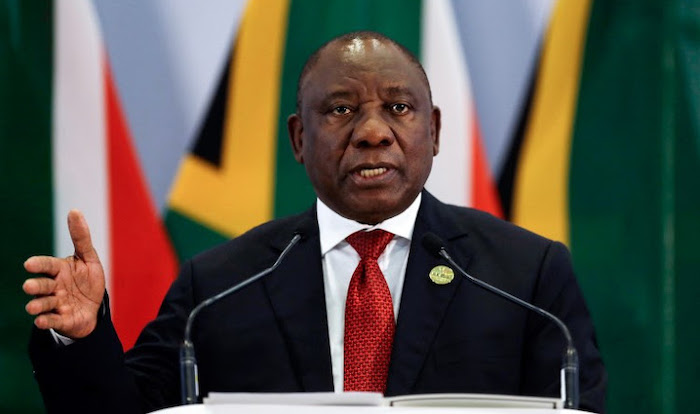
South African President Cyril Ramaphosa addresses a media conference at the end of the BRICS Summit in Johannesburg on July 27, 2018, as the heads of the BRICS group -- Brazil, Russia, India, China and South Africa -- met in Johannesburg for an annual summit dominated by the risk of a US-led trade war. Five of the biggest emerging economies on July 26, stood by the multilateral system and vowed to strengthen economic cooperation in the face of US tariff threats and unilateralism. / AFP PHOTO / POOL / Themba Hadebe
President Cyril Ramaphosa has authorised the deployment of soldiers across multiple provinces to assist police in combating crime and maintaining law and order.
In a notice submitted to the speaker of parliament, Ramaphosa said an initial deployment of 550 soldiers would be sent to Gauteng, which includes Johannesburg, to support security operations. The president said the initial mission would run until the end of April.
Authorities are also preparing a wider military deployment across five of the country’s nine provinces, according to operational details provided to parliament by police officials.
The expanded operations will primarily target illegal mining activities in North West, Free State, and Gauteng. Troops will also be deployed to address escalating gang violence in Western Cape and Eastern Cape.
Police officials indicated that some elements of the national deployment could remain in place for more than a year, depending on the evolving security situation.
South Africa continues to face severe levels of violent crime. Police statistics show that 6,351 homicides were recorded between October and December 2025, representing an average of nearly 70 killings per day in the country of about 63 million people.
However, the plan to deploy soldiers has sparked concern among some residents and analysts in crime-affected communities.
In the Cape Flats, an impoverished area plagued by gang violence where troops are also expected to operate, some residents told Al Jazeera that military intervention would not address the deeper social and economic conditions driving gang recruitment.
Irvin Kinnes, an associate professor at the University of Cape Town Centre for Criminology, also questioned the decision, describing it as politically motivated.
“It’s a very dangerous thing to bring the army because there’s an impatience with the fact that the police are not doing their job,” Kinnes said.
“It’s to show that the political leaders have kind of heard the public. But the call for the army hasn’t come from the community. It’s come from politicians.”
Erizia Rubyjeana
About the Author